UNC trustees approve tenure for Nikole Hannah-Jones, bringing end to campus controversy
READ MORE
The hire and the fury: Nikole Hannah-Jones at UNC
Read all of The News & Observer’s coverage of the University of North Carolina’s decision to hire the Pulitzer Prize-winning New York Times journalist and the controversy that ensued.
Expand All
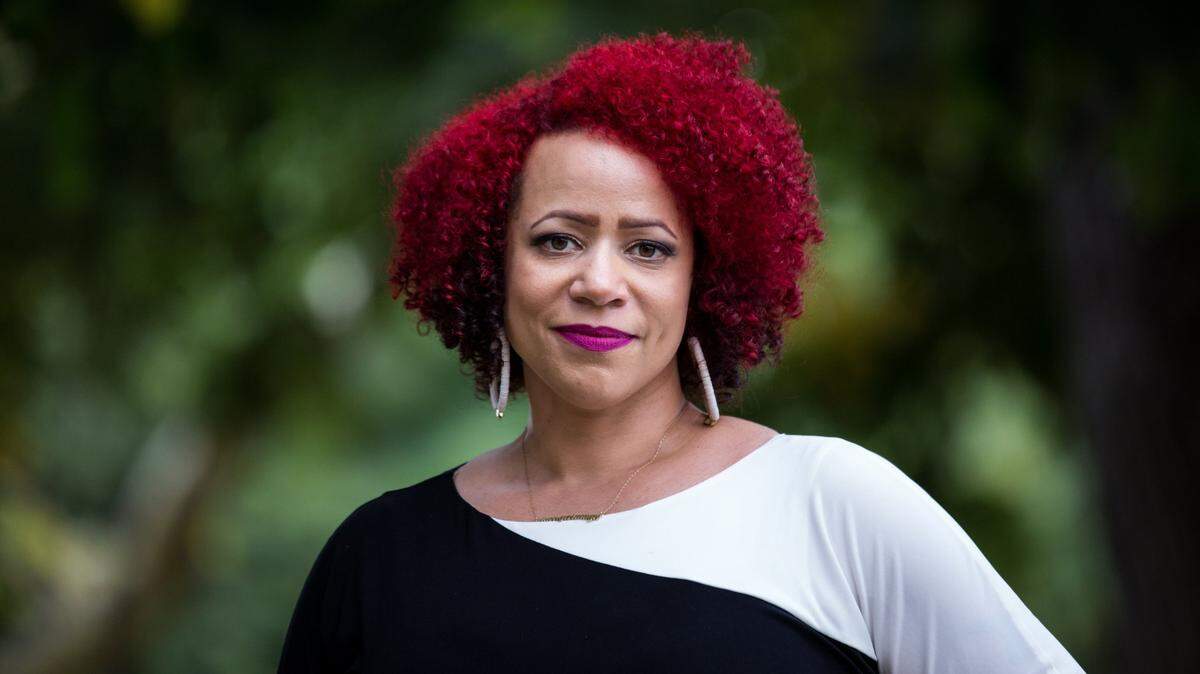
UNC-Chapel Hill trustees voted to approve tenure for distinguished journalist Nikole Hannah-Jones at a meeting Wednesday afternoon, bringing a resolution to the national controversy that has ensued over her hire.
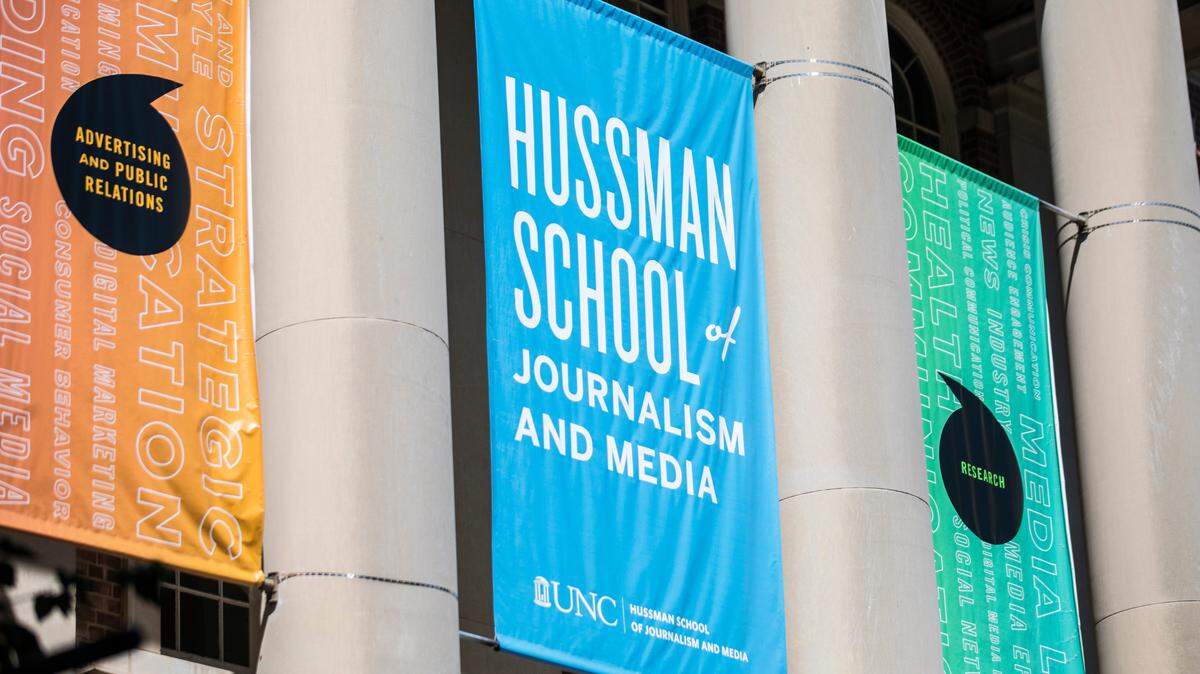
Hannah-Jones, who is a Black woman, is to join the UNC-CH faculty Thursday as the Knight Chair in Race and Investigative Journalism at the Hussman School of Journalism and Media. She and her legal team had said she would not begin the job without tenure.
The Board of Trustees had not previously offered Hannah-Jones tenure for the position, which other Knight chairs at UNC-CH have received. The board voted to do so at Wednesday’s meeting, which was triggered by UNC-CH Student Body President Lamar Richards making an official petition for a special meeting on this issue.
Richards is one of two Black trustees on the board. Ten of the 13 trustees are white men.
The vote was 9-4 in favor of granting tenure.
Trustees John Preyer, Allie Ray McCullen, Dave Boliek and Haywood Cochrane all voted against tenure. None of them made any comments during the public part of the meeting. When reached outside the meeting, McCullen declined to comment on why he voted no.
Voting in favor were Richards, Chairman Richard Stevens, Vice Chairman Gene Davis, Teresa Artis Neal, Jeff Brown, Munroe Cobey, Chuck Duckett, Kelly Hopkins and Ralph Meekins.
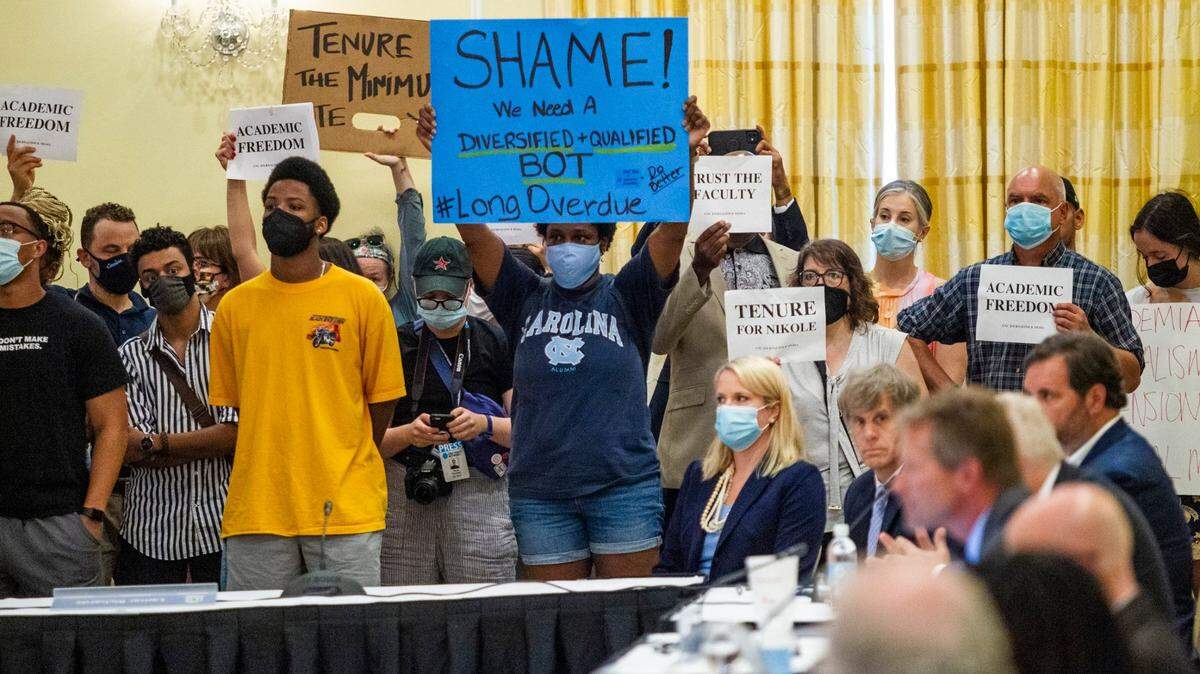
When the meeting reconvened after the closed-session discussion, protesters — who had initially refused to leave when the closed session was called — filed back into the Carolina Inn ballroom to hear the trustees’ decision. Davis read a lengthy statement about how the decision fit into the university’s history and its values. Protesters laughed audibly when Davis mentioned UNC’s respect for a wide range of ideas and its appreciation for all its students.
Reaction to the board’s decision
Hannah-Jones was not in Chapel Hill. On Twitter, she shared a photo of what appeared to be a celebratory cocktail after the vote.
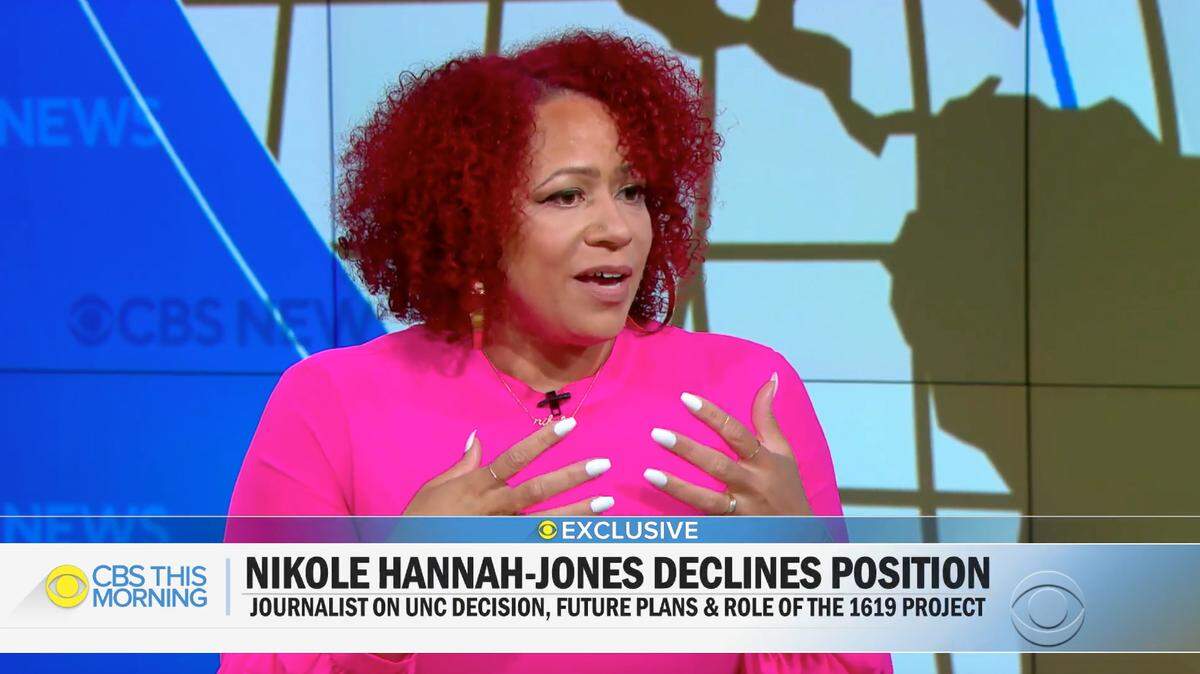
In a statement, Hannah-Jones, creator of The New York Times 1619 Project, expressed thanks for all the support she received.
“I want to acknowledge the tremendous outpouring of support I’ve received from students, faculty, colleagues and the general public over the last month — including the young people today who showed up at the Board of Trustees meeting, putting themselves at physical risk,” she said. “I am honored and grateful for and inspired by you all. I know that this vote would not have occurred without you.
“Today’s outcome and the actions of the past month are about more than just me. This fight is about ensuring the journalistic and academic freedom of Black writers, researchers, teachers and students. We must ensure that our work is protected and able to proceed free from the risk of repercussions, and we are not there yet. These last weeks have been very challenging and difficult and I need to take some time to process all that has occurred and determine what is the best way forward.”
UNC-CH Chancellor Kevin Guskiewicz, in announcing the decision, called Wednesday “an important day for our campus.”
Turning to protesters as he read a statement, he said, “We respect your voices and your passion. We still have a lot more work ahead and are committed to working to pull our community together to ensure all voices are heard and everyone on our campus knows they belong.”
Immediately after the decision, Susan King, dean of the journalism school, tweeted a statement welcoming the news. King said she knew that when the board reviewed Hannah-Jones’ dossier, it would recognize the strength of her tenure application.
“A thank you to the greater Carolina community of students, faculty staff and alumni who have stood by our school, the centrality of journalism to democracy, the ideals of the University and to Hannah-Jones herself. This outpouring of support has reinforced the very principles of the nation’s first public university and will carry us forward.”
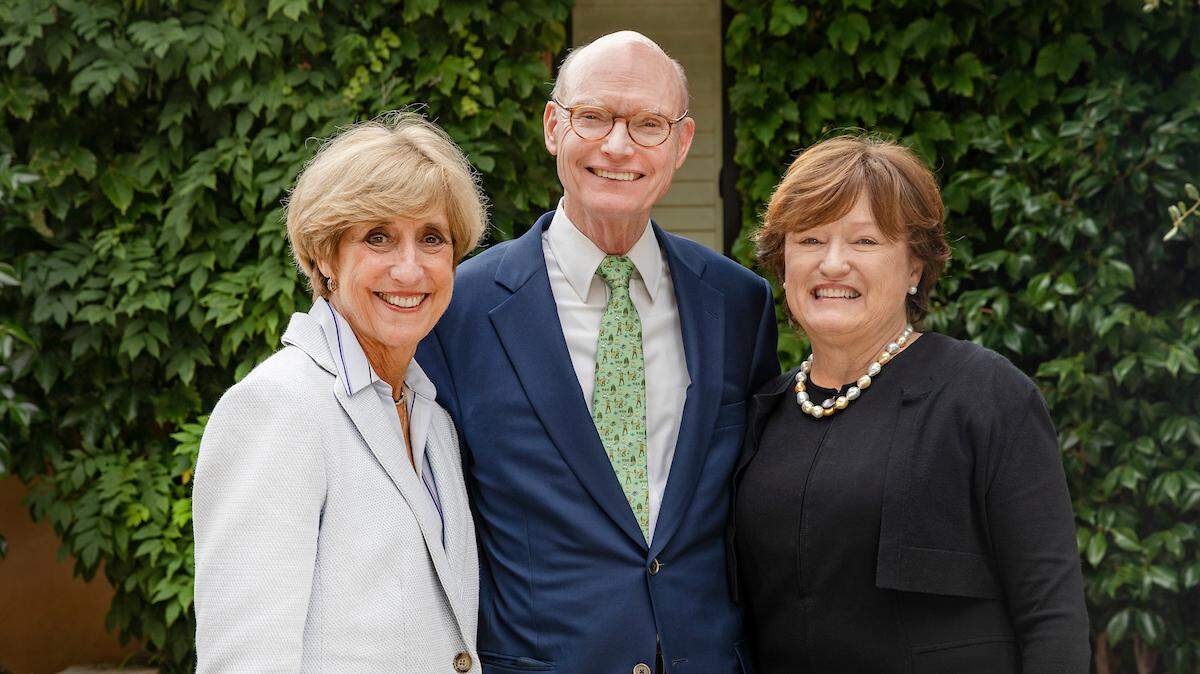
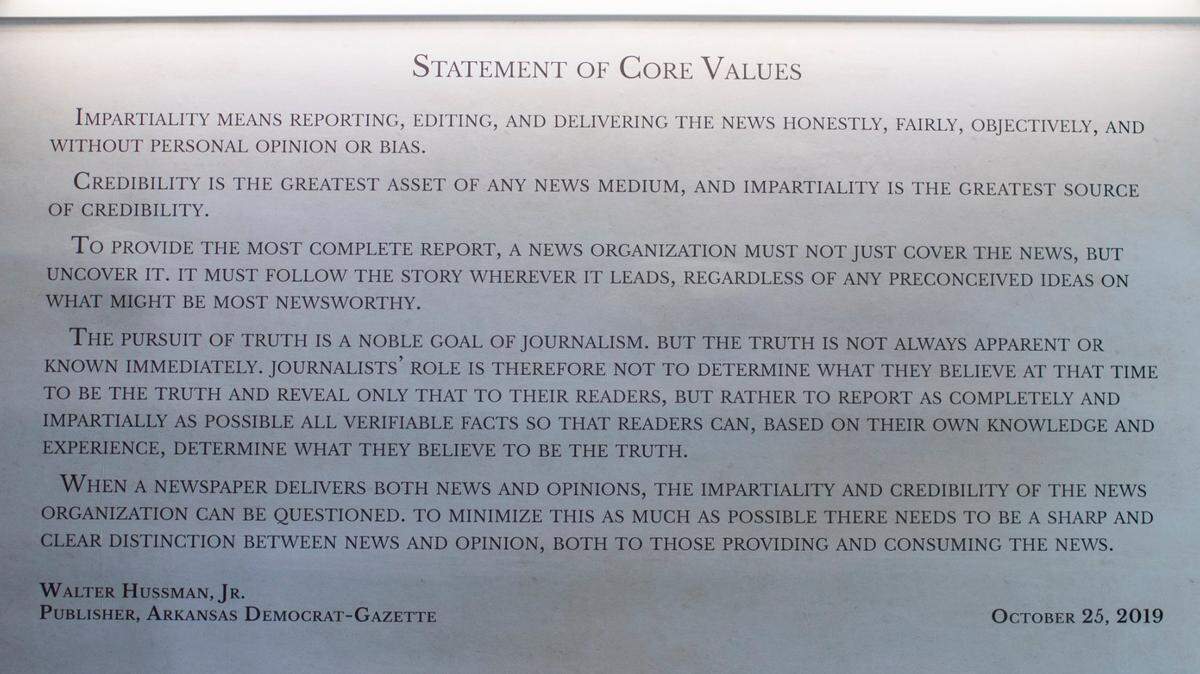
Walter Hussman Jr., a UNC graduate and donor whose name is on the journalism school, had raised questions about Hannah-Jones teaching there. In a statement Wednesday, he said he had expressed concerns about UNC being too associated with the 1619 Project, which has faced criticism from some historians and conservative politicians.
“But as I have said repeatedly, expressing a concern is the limit of what any donor should do in such a situation,” Hussman said. “I respect that academic freedom requires that the authority for hiring faculty rests solely with the University. The University has now voted to grant tenure to Ms. Nikole Hannah-Jones. I look forward to meeting her and discussing journalism. Our plan is to continue to support the UNC Hussman School of Journalism and Media in advocating for the core values.”
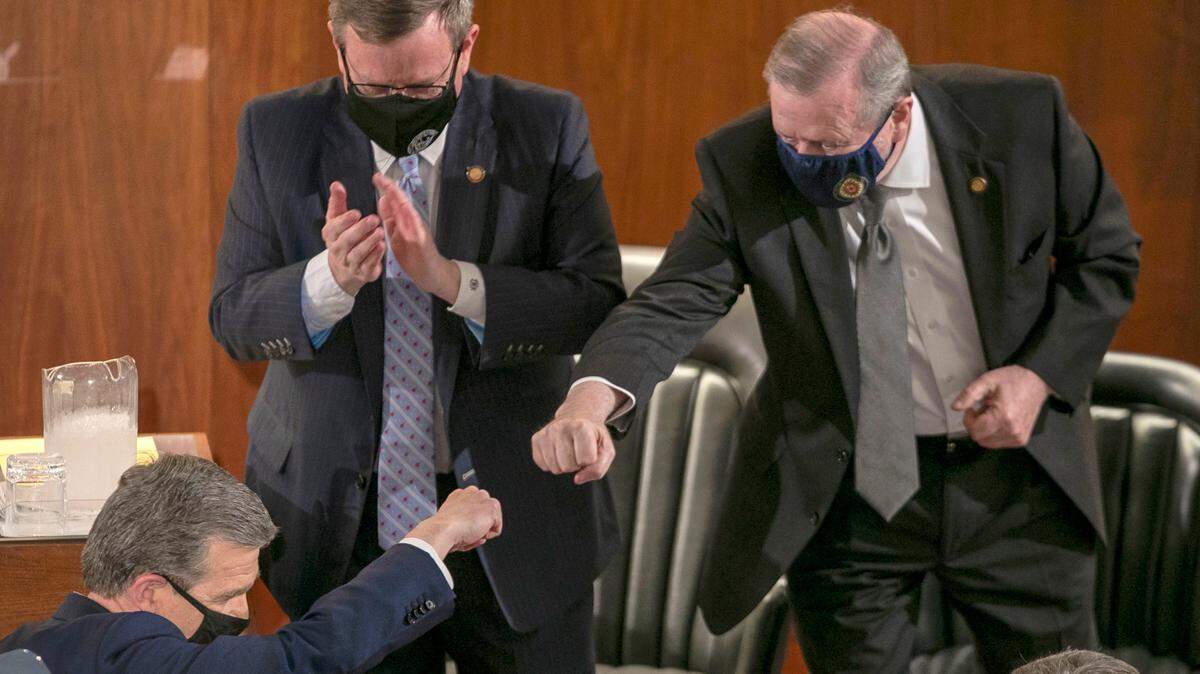
North Carolina Gov. Roy Cooper, in a statement after the vote, said, “UNC Trustees did the right thing today by offering tenure to award winning journalist Nikole Hannah-Jones. Our students will benefit from exploring thought-provoking issues and our campus reputation will be enhanced, helping us keep and attract a diverse array of acclaimed scientists, researchers, doctors and scholars.”
Protesters show up at meeting
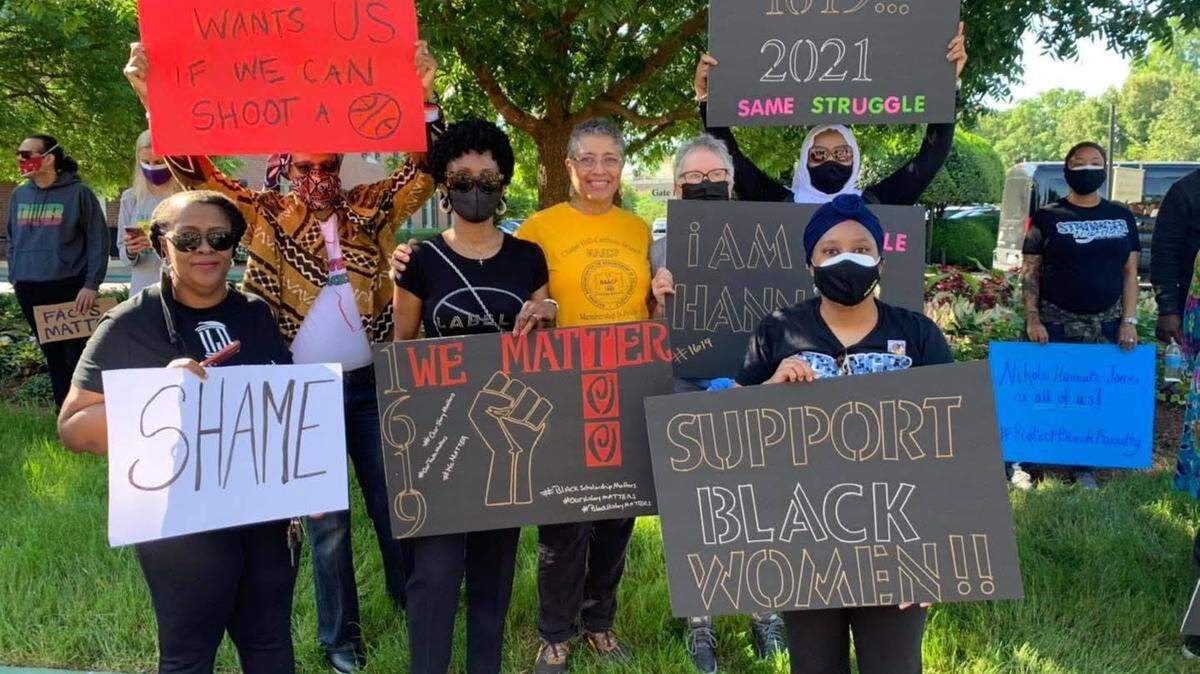
Dozens of protesters showed up at the meeting at the Carolina Inn, including Julia Clark, vice president of the UNC Black Student Movement and a junior from Washington. Clark said she did not expect the trustees to vote to grant tenure to Hannah-Jones.
“Honestly, I’ve become accustomed to expecting the worst from this board,” Clark said.
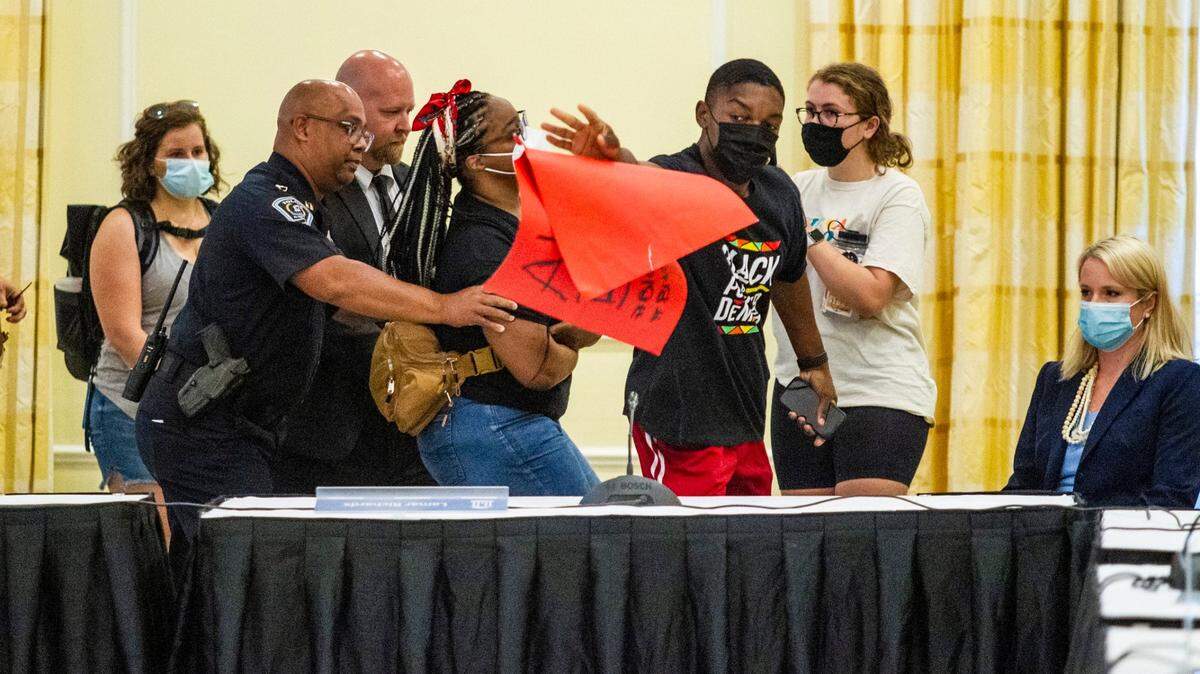
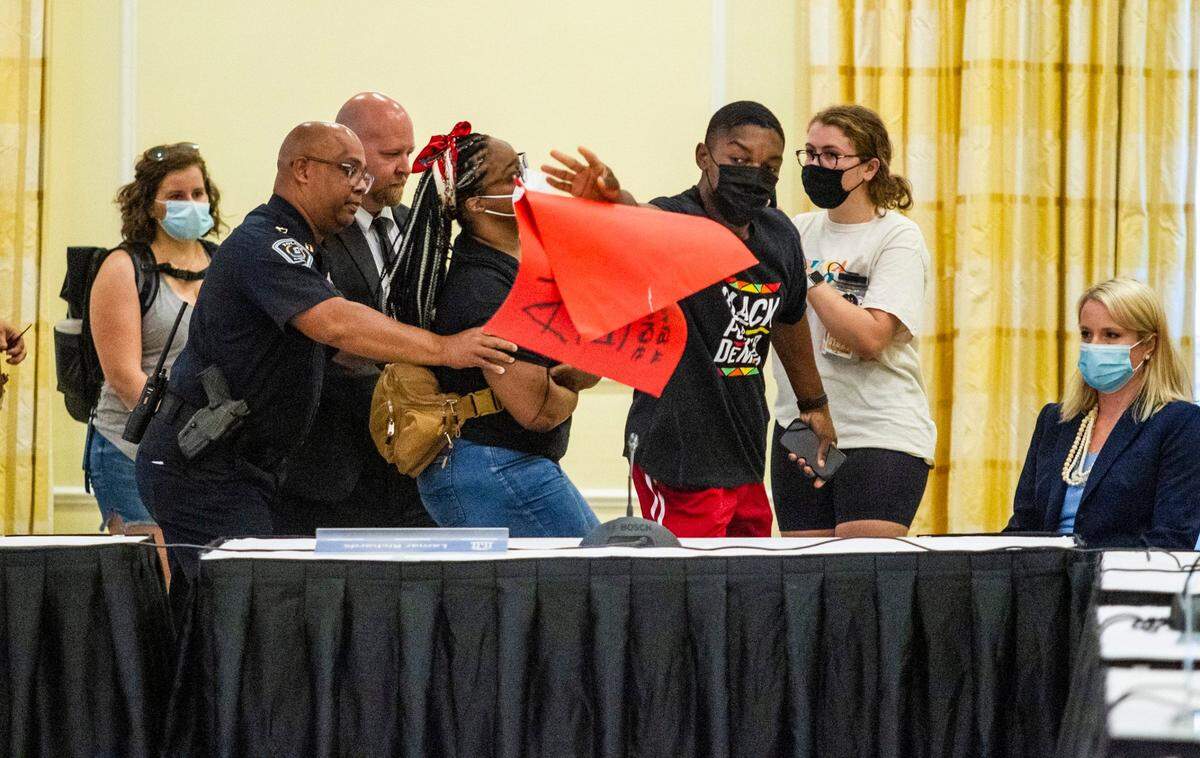
Seventy-five people were allowed into the room as the meeting began, and organizers asked that Black participants be allowed in first. When the board voted to go into closed session, some protesters refused to leave and were forcibly removed while yelling at officers.
Protesters stood outside the door yelling at officers and trustees, while the trustees appeared to be waiting for the crowd to clear before beginning the tenure discussion.
The Black Student Movement organized the protest, saying trustees “will hear and respect our concerns as Black students.”
UNC journalism school faculty, staff and supporters met on the steps of Carroll Hall at 2:30 p.m. and walked to the Carolina Inn together for the Board of Trustees meeting.
Most of the board members and Guskiewicz attended the meeting in person. Richards, Stevens and two other trustees joined via Zoom.
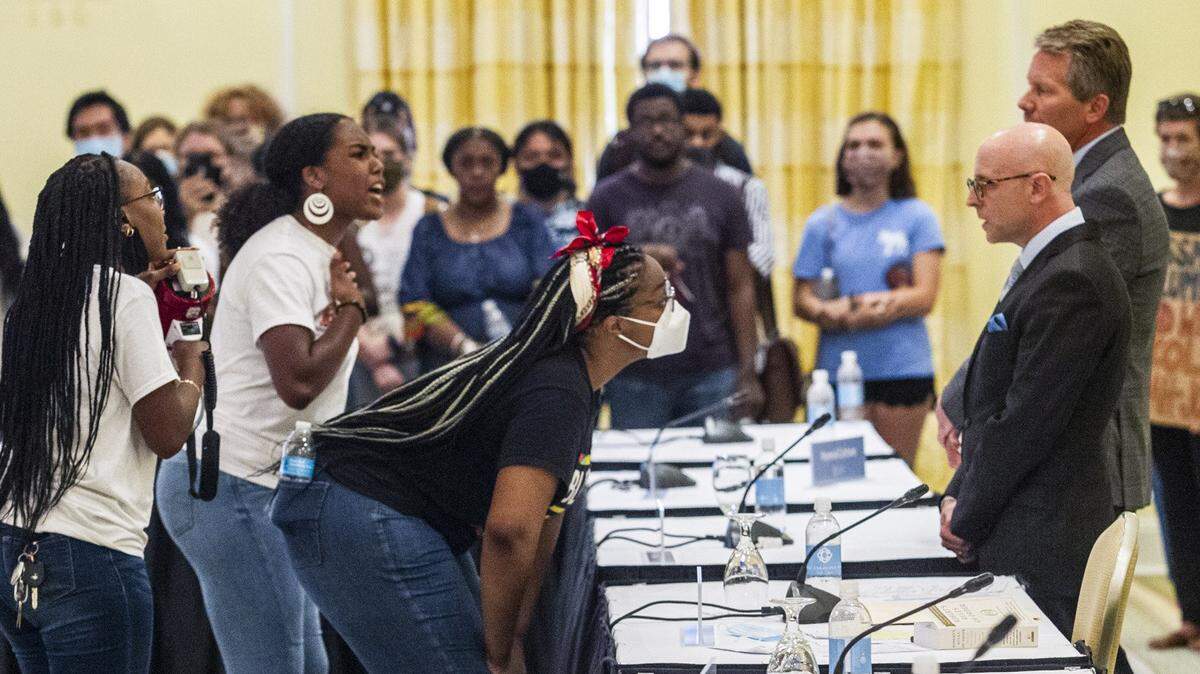
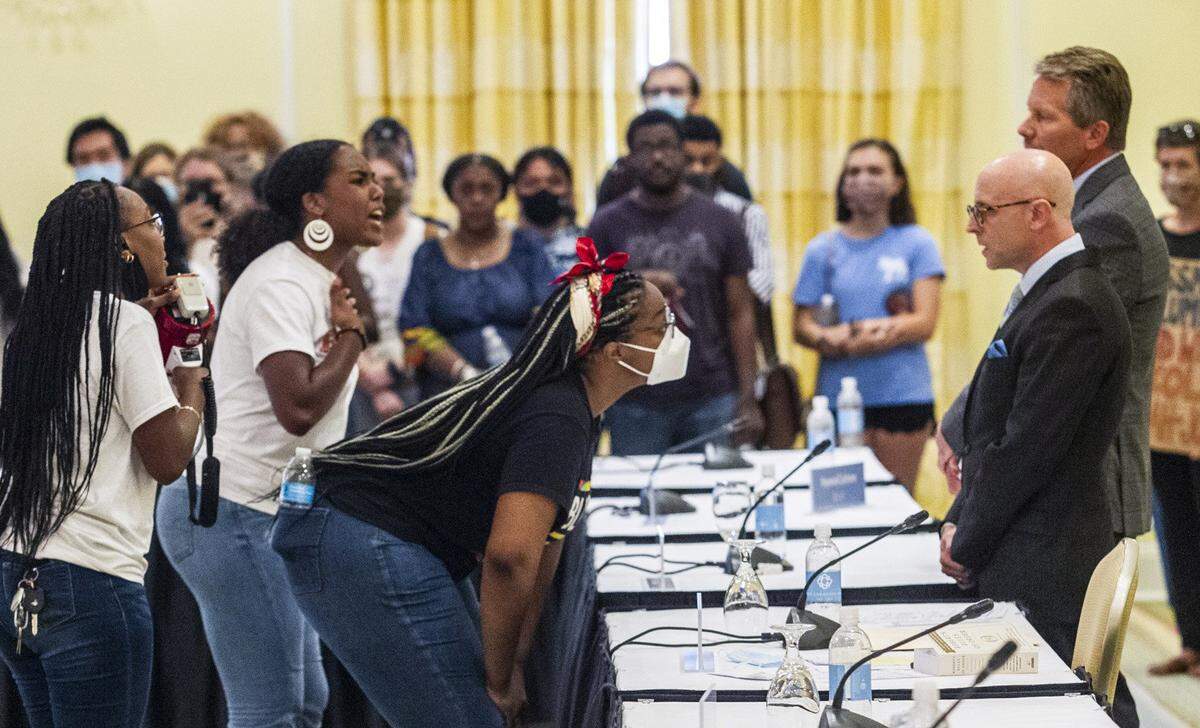
After the meeting adjourned, protesters who had been forcibly cleared from the room by police hours earlier took the opportunity to tell board members how angry they were at that treatment. They said they had been shoved and manhandled by officers and that it was emblematic of their treatment by UNC in general. As they shouted, most trustees left the room.
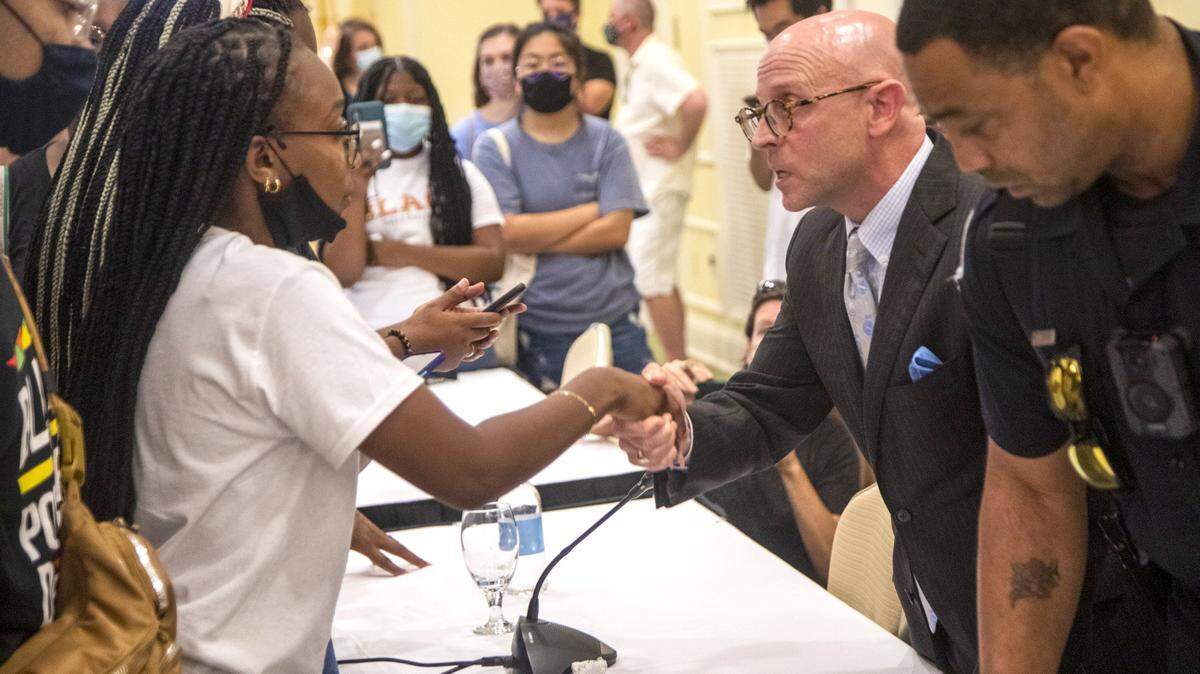
Davis remained, along with Guskiewicz. Clark began shouting at the pair from across the room, and gradually walked closer until she was separated from them only by the narrow conference table. Other protesters joined her there.
At least eight police officers came into the room. The shouting continued for several minutes, then voices quieted down and Davis began to talk with members of the group. Black student leaders gave a list of 54 demands to Davis, and they agreed to set a date to discuss what actions the board can take to meet some of those.
“You heard our cries and you ignored them, and that is a perfect representation of what UNC does to Black students every single day,” Clark said. “It is not that we are not heard. We are heard and purposely ignored.”
As to whether UNC values its Black students, Clark told Davis, “ I can tell you right now this university does not value Black students. So what you should be asking us is, what can you do?”
The closed session conversation
Trustee Duckett told The News & Observer that the closed session conversation was civil and centered around questions that people had, including about tenure policy and the nature of Hannah-Jones’s position. They were also reminded of the importance of confidentiality rules for board members.
He said some people may disagree with her work, but there wasn’t much discussion about her credentials or personal questions. Duckett said he wasn’t surprised by the four “no” votes, but those individuals didn’t give explanations of their hesitations.
“We probably voted the way we voted for different reasons,” Duckett said.
He chairs the committee that reviews tenure and brings the slate of candidates to the full board. He originally had questions about Hannah-Jones’s appointment, which delayed the issue back in January. Duckett said those questions were answered in her dossier and by the provost in the meeting, which is why he voted yes Wednesday.
“I hope she comes here, and I hope she’s great at her job,” Duckett said.
Still, Duckett questions the current tenure policy and whether it’s right to give someone tenure without teaching, he said. While he thinks that policy should change, it currently exists so it did not affect his vote.
Confusion over closed session
The meeting was expected to go into closed session, as is typical with personnel matters like tenure appointments. However, that was never explained to protesters, who were upset that the vote would not be in public.
Protesters rattled the door demanding to be let back in and criticized the police officers and trustees for keeping the meeting closed.
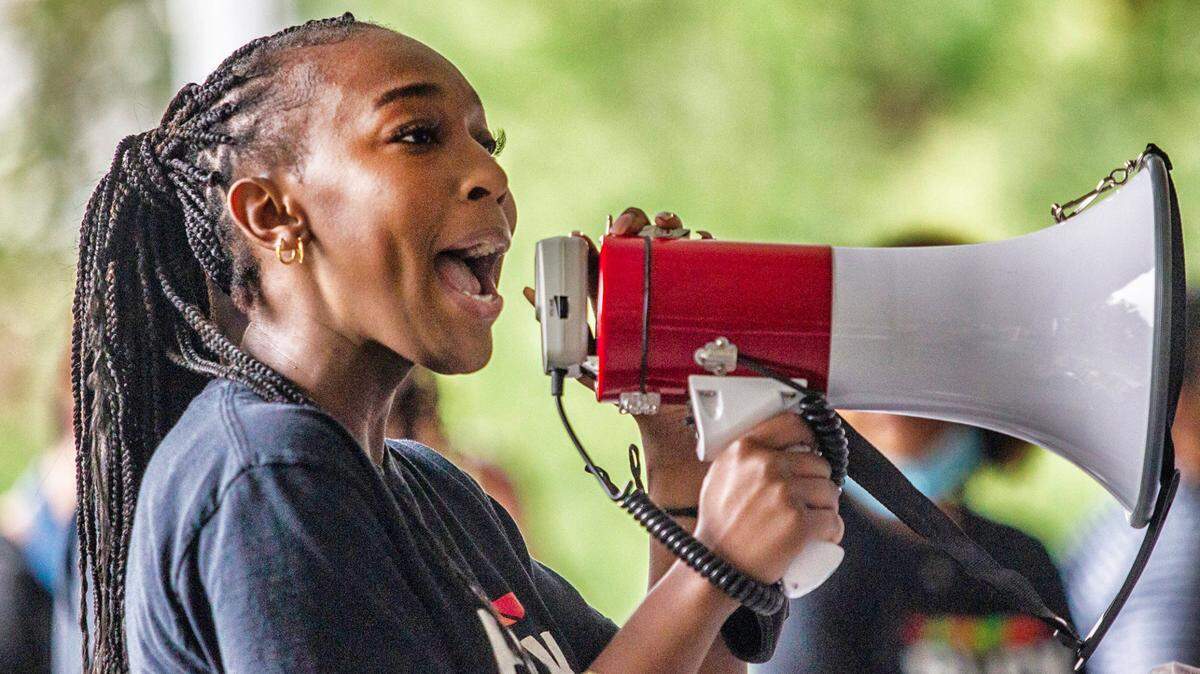
Taliajah “Teddy” Vann, president of the Black Student Movement, yelled at the trustees through the door with a megaphone asking what they were hiding.
They also shouted that they were disappointed that Richards voted to go into closed session.
Richards called Vann to tell them why he voted that way, saying it was done to protect Hannah-Jones.
He explained on Twitter that it is legal and standard procedure to discuss tenure and personnel matters in closed session.
“The reason for this is crucial because depending on any outcome of this meeting we do not want there to be any contest made that could potentially impact/ interfere w/ stuff in the future surrounding this issue,” Richards tweeted. “Our fight is for her to be treated the same as every other candidate.”
Hannah-Jones shared his tweet and said her legal team did not request the closed session.
“The closed session is the normal procedure for tenure votes and our desire was, for the first time in this process, to be treated by the BoT like every other tenure candidate,” she said.
Hannah-Jones sent another tweet saying it “should have been communicated how this meeting would go, that tenure proceedings are always held in closed session, and an attempt made to de-escalate.
“Instead Black students were shoved and punched because they were confused about the process,” she said. “This is not right.”
Support for tenure
The university has been under fire for weeks as professional journalists, scholars and UNC-CH faculty, alumni and students have criticized the board’s failure to offer her tenure. They say race, politics and Hannah-Jones’s work on The 1619 Project are behind the board’s decisions. The project, which was published in The New York Times and won a Pulitzer Prize, reframes the country’s history by putting the legacy and history of Black Americans and slavery at the forefront.
The issue has prompted multiple campus protests, a threat of a federal discrimination lawsuit and statements of support from national and local organizations. It also underscores the feelings from Black faculty, staff and students who say the university does not value them or create a safe, inclusive environment for people of color.
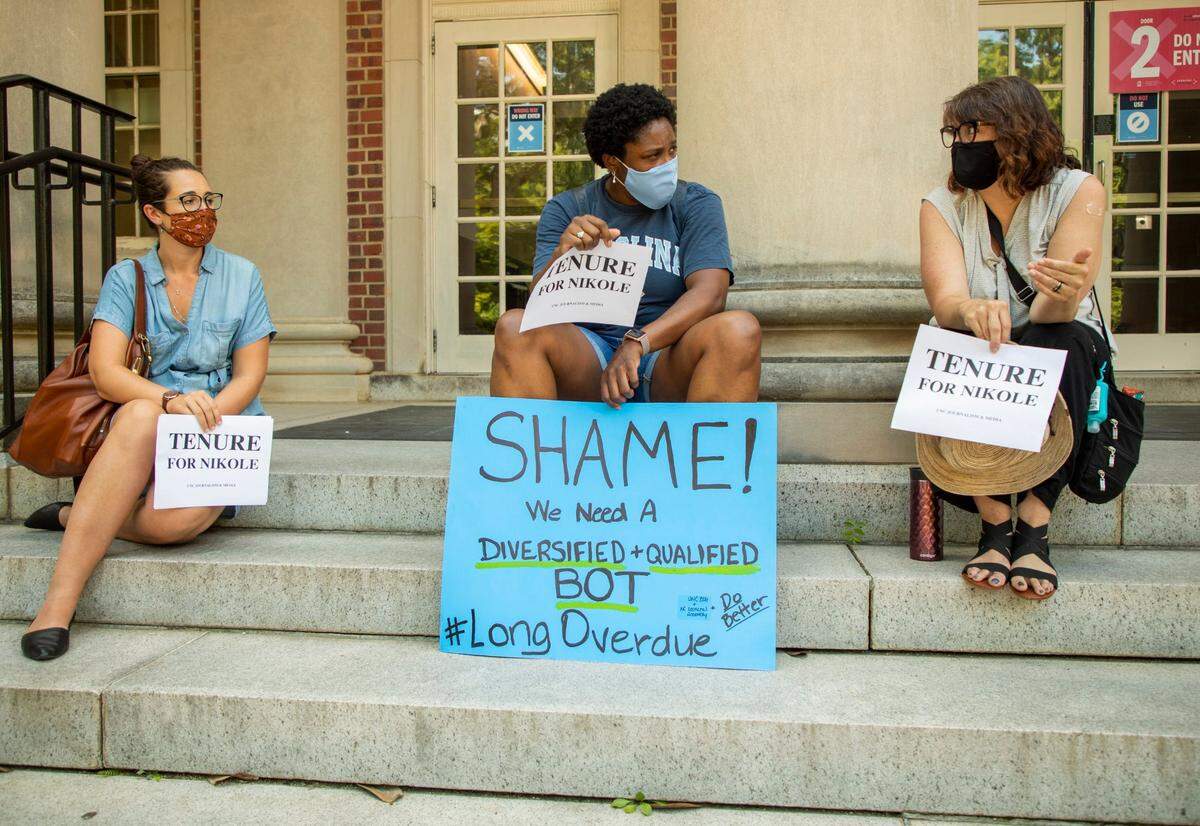
Nearly 500 UNC-CH faculty signed a letter sent to trustees Tuesday calling for the board to approve Hannah-Jones’s tenure appointment at the special meeting.
The letter details how this “intrusion of the Board” into faculty decisions like the tenure process “puts at risk the bedrock assumptions of academic freedom and free intellectual inquiry and integrity.“
How Hannah-Jones came to UNC
Hannah-Jones was recruited by King, the Hussman School dean, and hired to join the journalism faculty this spring as the Knight Chair. The prestigious position is designed to bring successful industry professionals into academia as professors. In March, Hannah-Jones was offered a five-year, fixed term contract as a professor with a $180,000 salary and planned to keep her job at The New York Times.
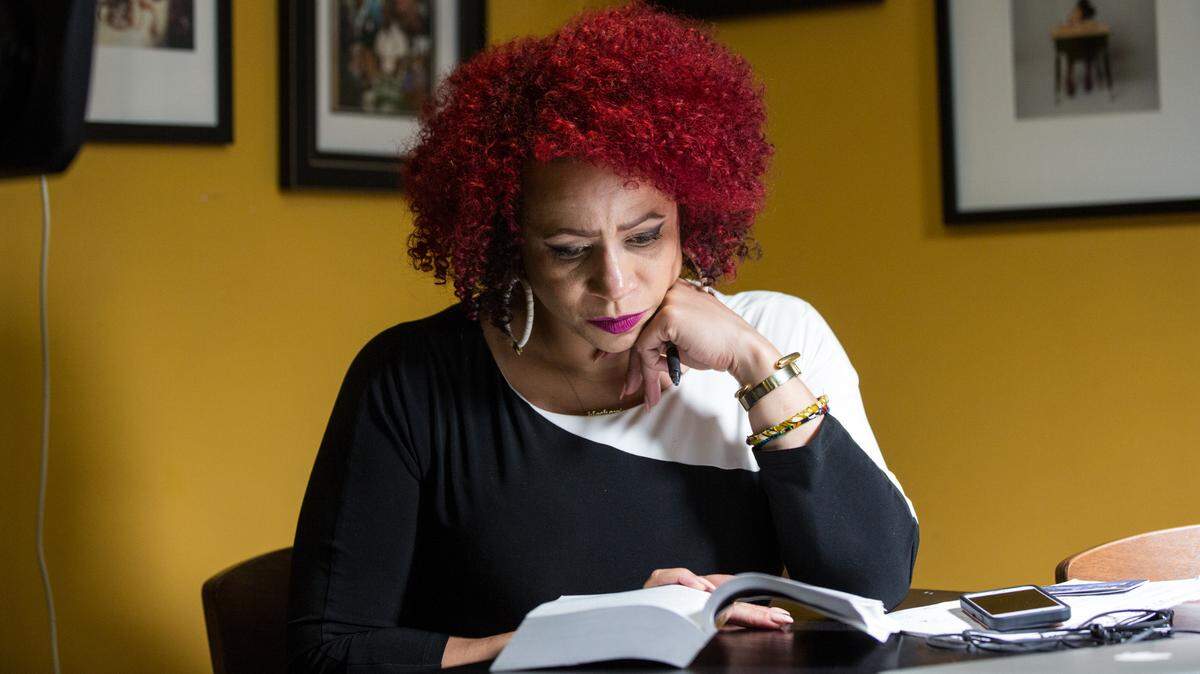
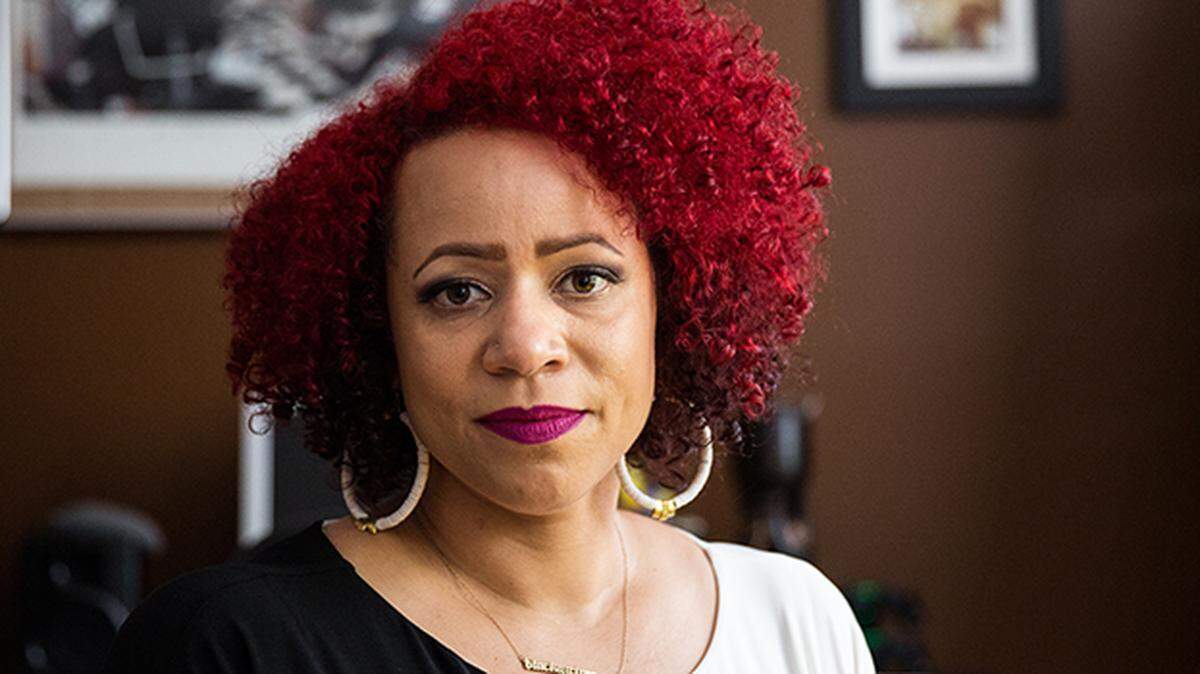
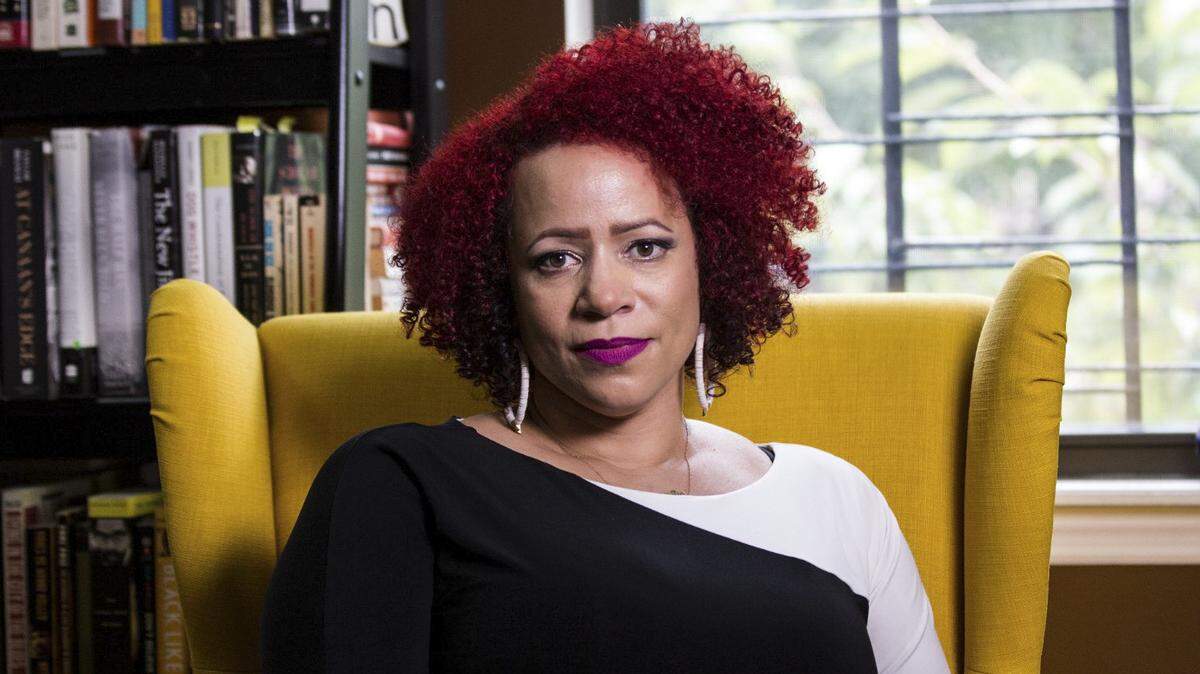
Hannah-Jones is a Pulitzer Prize-winning investigative journalist who focuses on racial injustice. She earned her master’s degree from UNC-CH and has spent nearly two decades as a reporter, including at The News & Observer. Hannah-Jones has earned several professional accolades, including a MacArthur “Genius Grant,” a Peabody Award and George Polk Award.
She is best known for creating The 1619 Project. The Times published a clarification to Hannah-Jones’s piece while defending it. More than 150 scholars, historians and UNC-CH faculty have also supported Hannah-Jones and her work.
The project has also been debated in Congress and state legislatures as lawmakers discuss Critical Race Theory and how schools should teach about systemic racism and slavery.
This story was originally published June 30, 2021 at 6:15 AM with the headline "UNC trustees approve tenure for Nikole Hannah-Jones, bringing end to campus controversy."


.JPG)