Why Myrtle Beach’s oldest golf course, Pine Lakes, is closed for more than two months
The Granddaddy is getting a makeover.
Pine Lakes Country Club, which opened in 1927, closed last week for renovations that include new greens and a rebuilding of the course’s bunkers.
The layout is expected to be closed until early July.
“No one likes to see the Granddaddy closed,” said Steve Mays, president of Founders Group International, which owns and operates the venerable course. “Pine Lakes is figuratively and literally the center of Myrtle Beach and everyone in the Myrtle Beach area and FGI takes great pride in that facility and what Pine Lakes is, so we’re looking forward to getting that back open sooner rather than later.”
Course architect Craig Schreiner, whose home is off one of Pine Lakes’ holes, has been hired by FGI to oversee the bunker renovations.
Pine Lakes was designed by Robert White, the first president of the PGA of America, and its clubhouse was designed in Classical Revival style by Raymond Hood, who also designed New York City skyscrapers.
It is considered the birthplace of Sports Illustrated, and the course and clubhouse are on the National Register of Historic Places.
“If we had our druthers we wouldn’t have picked the middle of April to close down, but we thought it was the right thing to do based on the condition of the golf course and historical nature of Pine Lakes,” Mays said. “We’re excited to make the investment in Pine Lakes because we know it’s going to make that golf course a much better golf course.”
Pine Lakes is the only course in the market with SeaDwarf Paspalum wall-to-wall, but the grass that is known to withstand heat, brackish water and minimal watering is being replaced on the greens by Sunday ultradwarf Bermudagrass, which FGI has installed over the past few years on both courses at Myrtlewood Golf Club and Tradition Club.
Mays said the Sunday greens have been a “great success” at those courses.
The mid-sized and gently rolling greens are also being enlarged back to their size in 2008-09 when the Paspalum was first installed, as the fairways have encroached upon them over the past decade. That will open up more pin placement options.
Mays said the company, which owns and operates 21 Grand Strand courses, was considering replacing the Paspalum on greens in the near future, and the change was expedited when the grass had an adverse reaction to an herbicide that was administered early this year.
“It’s a beautiful grass, but we never got it to the point where we felt we had the ideal putting conditions on the paspalum greens,” Mays said. “It got better every year and our team and superintendent Alan Jarvis got better at managing those greens, but we could still never get the consistency and green speeds we wanted, so we always in our minds wanted to make the change at an appropriate time.”
Closing in late April is not ideal because it is in the midst of the spring golf season, which is the most lucrative time of year for area golf courses. But Mays said the company didn’t want golfers to experience poor conditions on the legendary course.
“For whatever reason there was an adverse reaction to it, so we didn’t have the playing conditions at all that we wanted out at Pine Lakes. So we made the decision rather than have package golfers play on that golf course when the greens were in really bad condition we decided we needed to make a change and go ahead and close down,” he said.
“At the same time we knew we had some other work that needed to be done at the golf course, namely with the bunkers, and we wanted to work with Craig to get those bunkers in great condition.”
Pine Lakes has just 25 bunkers, and they will be rebuilt to modern specifications. Bunker drainage will be improved and a quality bunker sand from North Carolina that is featured at the Members Club at Grande Dunes is being installed.
“We think it’s the best sand we’ve come across in 30 years,” Schreiner said. “It’s very consistent, a lot easier to play out and more forgiving than the really fine white stuff that can get a little soft. This has a little more coarseness to it and the ball sits up very nice in it.”
Some deep bunkers will be made more shallow and more playable, and the top of bunker faces will hang over the sand and feature Zoysia grass, which Schreiner said will create stability as well as a “wispier grey eyebrow look on these, a little older look to them.”
He’ll be reintroducing some character into the bunker design. “They have really lost a lot of their contours and features and little ridges and noses, and that’s what I’m putting back in,” Schreiner said.
Minimal work was done on the bunkers during Pine Lakes’ most recent renovation project in 2008-09. “We just kind of left the natural sand alone in most of the bunkers and we wanted to have the old natural beach sand in them and it just hasn’t worked because it hasn’t drained well, it’s a little bogged and some of the bunker faces were getting too warned out and they’d wash a lot when they got heavy rain,” Schreiner said.
A new front tee box is being built on the ninth hole that will allow all tees to be moved up on a daily basis. The 370-yard hole features a drive into a side hill that pushes balls toward a water hazard on the left side of the fairway.
Some subtle work to conditions will give the course a more natural feel and look, and a few trees that have grown a lot over the past decade may be removed.
Pine Lakes will be celebrating its 100th anniversary in 2027.
“We want to make sure we are who we want to be when we hit that 100th anniversary,” Mays said. “When we open up in early July, we think we’re going to have one of the best courses at the beach.”
DeBordieu gets changes, improvements
Schreiner recently completed renovation work at the private DeBordieu Club in Georgetown.
It included a new short-game area at the practice facility that will soon open.
Schreiner also created a master plan for the course designed to in part make the challenging Pete and P.B. Dye design less difficult. He made renovations to the ninth hole including bunker work, and redirected the fairway in order to make the hole less difficult.
After doing some work in Florida this summer, Schreiner intends to return to DeBordieu in October to work on more holes. Much of the bunkering that is on the outskirts of holes will be eliminated.
“We’re going to apply the same approach we took on nine to the rest of the golf course,” he said. “What we’re doing is making it more playable and a lot more maintainable. The Dye course has such dramatic contouring, it’s tedious and very tricky to take care of, and it’s difficult to play. So we’re keeping very strategic bunkers and we’re going to remove several on the golf course that are more out of play.”
Longtime event changes format
A 29-year event that has raised more than $2 million for the Conway Medical Center Foundation’s community outreach initiatives has a new format this year because of the coronavirus pandemic.
The Conway Medical Center Golf Classic, which for many years was called the Kingston Golf Classic, will be a month-long event in July rather than its traditional three-day format.
The event raises money to support the needy and often the uninsured and underinsured in the community.
Supported programs include CMC’s Healthreach Program, Smart Snacks, Mobile Mammography Center, and scholarships.
The event will be held on seven Founders Group International courses. To separate players the decision was made to create a month-long tournament with digital scoring via the Golf Status App. Play will begin on July 1 and conclude on July 31.
Participants will have the opportunity to play two rounds or more at Pine Lakes Country Club, the Grande Dunes Resort Course, World Tour Golf Links, King’s North at Myrtle Beach National, Pawleys Plantation, TPC Myrtle Beach and Wild Wing Plantation.
The $750 entry fee includes a $400 FGI gift card that can be used to cover the cost of golf, merchandise and food & beverage at the seven participating courses. A gift bag includes a Puma polo shirt, ProV1 golf balls and a $25 Rip Tidz dining card.
Golfers will be placed in eight flights based on handicaps and play a maximum of two tournament rounds, with the lowest score counting toward the standings. Players will enter scores in the Golf Status app to create a real-time leaderboard.
For more information or to register go to httprses://www.cmcfoundationsc.com/events/golf-classic.
Amateur event offers large purse
A new two-day, four-player team event with a modified scramble format in July at the Barefoot Resort Dye Club will have a purse of at $10,000 with a minimum field of 100 players.
The Top $helf Bacon tournament presented by the amateur Grand Strand Golf Tour on July 13-14 has a unique format and is for players of all levels with each foursome consisting of A (0-4 verified USGA handicap), B (5-10), C (11-15) and D (16+) players.
The event is co-hosted by Warren Runia, owner of Top $helf Bacon and Runia Photography, and the GSGT operated by Tom Baccari. The tournament can have up to 144 players and the purse increases with additional players.
An entry fee of $280 per player includes the two competitive rounds, lunch both days and samples of Top $helf Bacon, and Under Armour will be providing shirts, hats, sandals and backpacks of a player’s choice online following registration.
The format for the first round is a four-man scramble. The second round will feature a unique scramble and individual format.
The A player will play the two hardest holes according to course handicap on both the front and back nine (excluding the ninth and 18th holes), and the B, C and D players will play the next two hardest holes on each side, in descending order.
The three teammates not playing a hole individually will play a three-man scramble on each hole. The individual score and scramble score will be added together to make the team score for each hole.
All players will play their own ball on holes 9 and 18, and the two best scores on each hole will be the team totals for those holes.
A players will play the Dye Club’s back tees, B players will play the blue tees, and C and D players tee off from either white or senior tees depending on age.
A skins competition on both days costing $80 per team is optional with payouts for both scramble and individual scores.
Players can register online for the Top $helf Bacon tournament.
Local amateur tour thriving
Baccari moved to the Myrtle Beach area from New York about six years ago and started the Grand Strand Golf Tour in September 2019 after regularly playing with a few guys who broached the subject of starting a tour.
“I sat home one night and kind of outlined what this group/tour could be and then went to work on social media and just kind of blasted the information around,” Baccari said. “It got some [interest] week by week and what started out as six or seven guys is now 110 players throughout this year and we get anywhere between 40 to 64 guys an event. It has really taken off nicely.”
The tour plays just about every weekend, sometimes both days to play approximately 60 tournaments a year.
Tour membership is $125 per year and Baccari said events average about $65 -- with average green fees around $40 and an extra $25 added for the tournament purse, closest to the pin contests, etc.
Players are grouped into flights by handicap, so each event has individual flight winners and an overall winner who qualifies for a late-season tournament of champions, which last year was played at Barefoot Resort.
The tour has a points system to determine annual awards and also has four majors, a late-season playoff, a tour championship, a players championship and a Ryder Cup-like team event.
“It’s competition, but they’re not all in it for the money, they want to see where their name is on the points list for the season, possibly win a trophy, meet new people and play new golf courses,” Baccari said. “A lot of good friendships have started because of that, and that’s what I’m most proud of.”
The tour’s Facebook page has more information.
Opportunities abound for Taylor
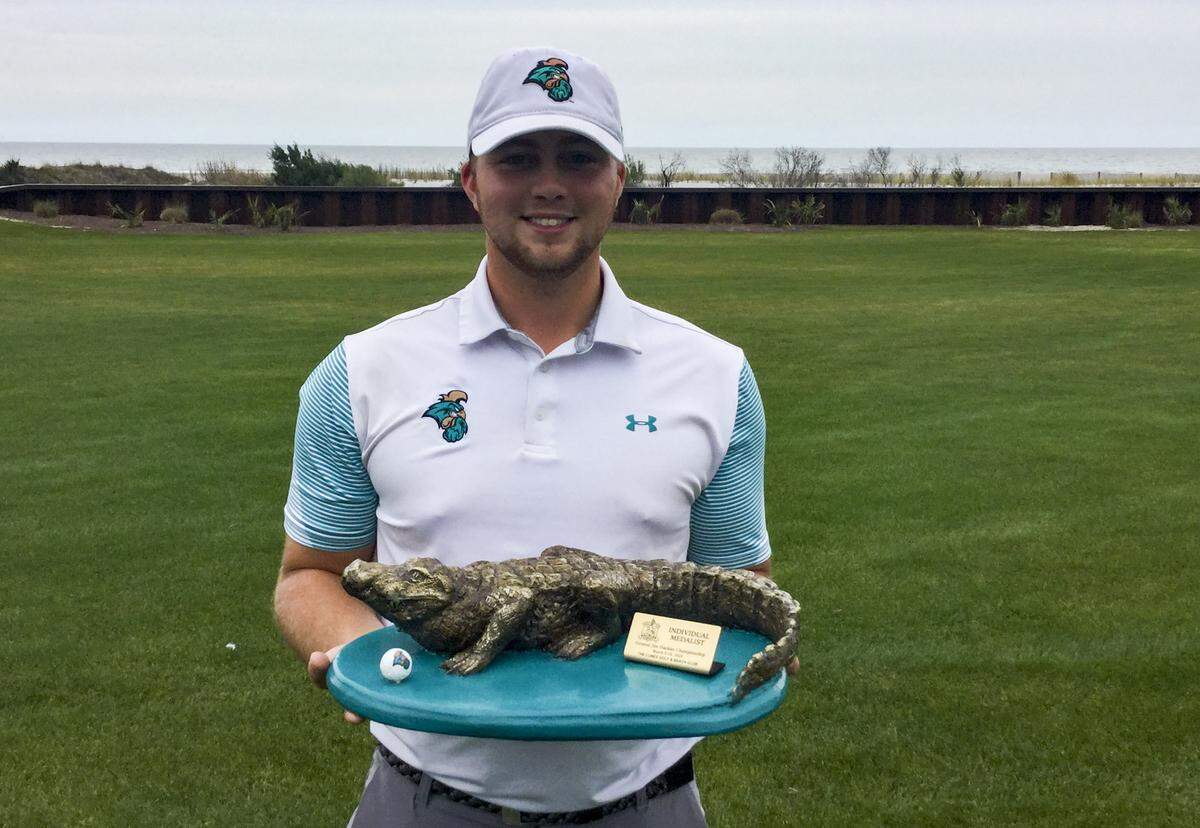
Coastal Carolina graduate student Zack Taylor will have a chance to make some noise in a pair of upcoming events.
Taylor was selected Wednesday to participate as an individual in the NCAA Noblesville Regional on May 17-19 at The Sagamore Club in Noblesville, Indiana. He was one of 45 players chosen to participate as an individual in a regional.
On Monday, Taylor shot a 4-under 68 to win a U.S. Open Local Qualifier at Plantation Bay in Ormond Beach, Fla. His round included two eagles on the par-5 first and 10th holes, two birdies and two bogeys.
The win qualifies Taylor for the 2021 U.S. Open Sectionals and he’ll play 36 holes at one of nine sites on June 7. The 121st U.S. Open will be played June 17-20 at Torrey Pines outside San Diego.
His NCAA regional will consist of 13 teams and 10 individuals. The low five teams and the low individual not on those five qualifying teams will advance to the NCAA Championship, scheduled for May 28-June 2 at Grayhawk Golf Club in Scottsdale, Arizona.
Taylor, who also played as an individual in the 2019 Myrtle Beach Regional as an individual, is one of six CCU golfers to compete at a regional as an individual along with Rafael Vera (2001), Alvaro Velasco (2003), Sebastian Soderberg (2012), Andrew Dorn (2014, 2015), and Ben Wheeler (2014, 2015).
Taylor has two collegiate victories over the past two seasons, and his career stroke average of 71.38 is first all-time in CCU men’s golf history in front of current world No. 1 Dustin Johnson (72.26).
In his final event at CCU, Taylor tied teammate Seth Taylor for second at the 2021 Sun Belt Men’s Golf Championship in El Dorado, Arkansas.
In March, Taylor finished third at the second Mackenzie Tour Qualifying Tournament at Mission Inn Club and Resort to earn full status for the first half of the Mackenzie Tour - PGA Tour Canada season this summer.
Harford qualifies for Women’s Open
Haylee Harford, who is a part-time instructor at Classic Swing Golf School at Legends Resort in the LPGA-USGA Girls Golf junior program, has qualified for the 2021 U.S. Women’s Open.
Harford assists teacher Stef King with the program and is a student of Classic Swing’s Ted Frick.
She qualified in a 36-hole Women’s Open qualifier Wednesday at Mid Pines Inn & Golf Club in Southern Pines, N.C., tying for second at 2-under 142 and advancing in a four-person playoff for two of the sites three available spots.
Harford, of Leavittsburg, Ohio, tied Gina Kim of Durham, N.C., Natalie Srinivasan of Spartanburg and Jaravee Boonchant of Thailand for second. On the second playoff hole, all four players hit their approaches within 12 feet of the hole and Harford and Kim made their birdie putts to advance.
Harford, 24, won four college tournaments and holds Furman’s all-time career scoring average record of 72.89. She competes on the Symetra Tour -- the LPGA Tour’s feeder circuit -- and is seventh on the money list through five 2021 events.
The U.S. Women’s Open will be played June 3-6 at the Olympic Club in San Francisco with a limited number of spectators in attendance.
This story was originally published May 7, 2021 at 6:58 AM.