
Course review: The Pearl’s West Course challenging, scenic
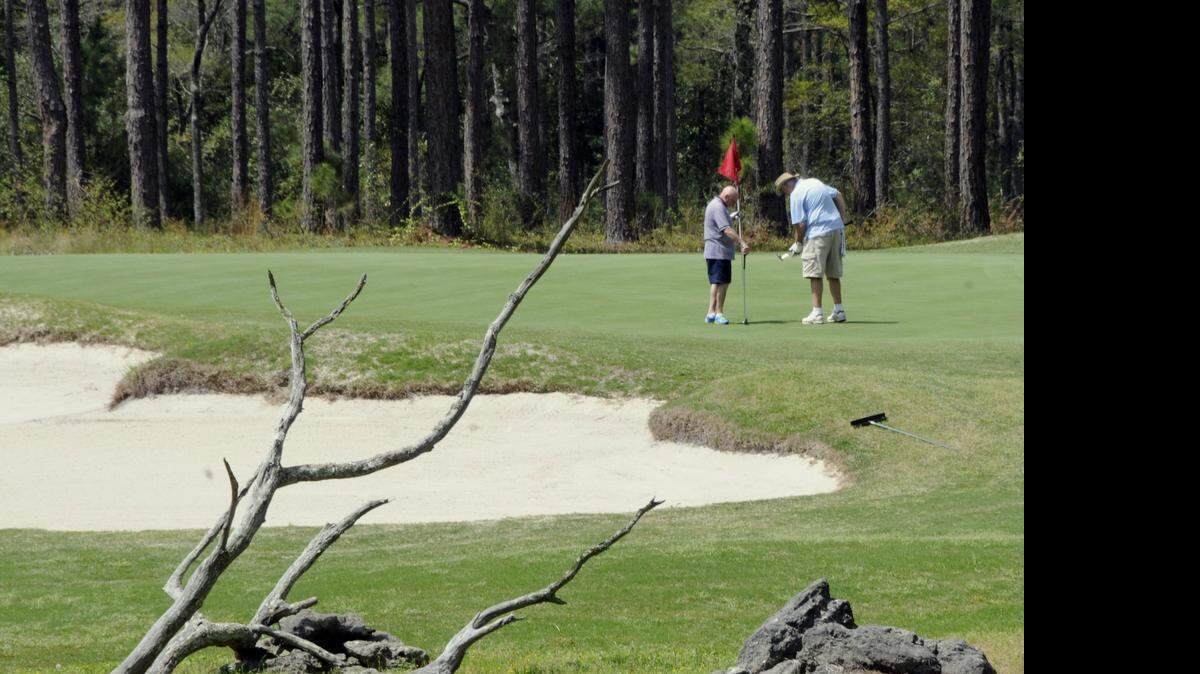
Bucking a decade-long trend on the Grand Strand, owners of The Pearl Golf Links chose to re-grass the greens on their West Course with bentgrass rather than a new ultradwarf Bermudagrass when the time came to replace them in 2012.
The newer A1/A4 bent greens, along with a fun and attractive layout that finishes along the Calabash River and its accompanying marsh, are reasons to experience 28-year-old Dan Maples-designed West Course.
“I like the course very much. The course is interesting,” said Kyle Ladd, the superintendent at Mingo Springs Golf Club in Rangeley, Maine and a 0.2 handicap who took part in a review of the course in early April. “The layout as a whole was good and it’s challenging and scenic.”
The West Course is one of two Maples designs at the facility, and the owners chose bent in 2012 to intentionally have one course with ultradwarf Bermuda and one with bent to give players options.
Joining me and Kyle, a longtime Pawleys Island snowbird, in the review foursome were Rick Ramos of Myrtle Beach, a 13 handicap whose professional name is Famouz at the Beach DJ, and Hannah Fesperman of Georgetown, a student with an 8 handicap.
“I like this course a lot. It’s enjoyable to play,” Hannah said. “It was nicely landscaped and had a few holes that tested your imagination.”
The 7,006-yard layout is a par 35-37–72 with five par-5s and five par-3s. The par-5s are long, particularly on the back nine with two longer than 600 yards.
The course has a lot of natural scenery and wildlife, clusters of native grasses and defining characteristics such as dead trees in waste areas. “I like what Maples did with the nature on the course,” Kyle said. “He left a lot of cypress trees that are in waste bunkers and the other natural vegetation that is on the course.”
It’s a mixture of tree-lined and open links-style. “For me there are only about 6-9 holes that are really links-style,” Kyle said.
“I like the holes with a lot of open space,” Rick said. “It gives you more room to move the ball. I’m a left-to-right hitter so it helps.”
Waste and traditional bunkers, water, wetlands and marsh provide a challenge, but not as much as the as the often severe undulations on greens. “The greens are very tough with the undulations,” Kyle said.
The greens, and course in general, were in good shape for our round. “I loved the greens,” Rick said. “They were in exceptional shape and putted great.”
Likes
Hannah appreciated the scenery of the final four holes. “It’s gorgeous,” she said. “The marsh made it feel all beachy.”
She also thought painted conch shells as tee markers “were a nice touch,” and found the course to be in “great shape,” and the greens to be in “tip-top shape,” and enjoyed their challenge.
Rick found the course to have quality sand. “I liked the sand in the traps. They played nicely,” Rick said.
Kyle appreciated the receptiveness of the greens.
Dislikes
There were tree canopies on the 10th and 13th holes that affected Kyle’s tee shots from the back tees, and the one on the 394-yard par-4 10th kept him from hitting driver. “For a course that’s supposed to be links-style there are a lot of trees that affect tee shots,” he said.
Kyle and Hannah pointed out the grass in fairways was generally a little high, likely because mowers hadn’t been able to cut it very low because of recent wet conditions. “I felt like I was unable to hit the ball in the sweet spot,” Hannah said.
Rick wanted club/ball washers on the carts and believed that “a few holes you can be misguided on the direction without the yardage book.”
Kyle found some pins to be in unfair positions and thought the 18th green was among the greens that were too severe, especially considering the movement with the bentgrass. “It’s a good thing the greens weren’t mowed too low or some players would still be out there,” he said.
Par-3s
The par-3s measure between 147 and 215 yards from the tips and between 130 and 191 from the white, with the two shortest par-3s on the back nine to balance long par-5s.
“The par-3s were a nice distance and that allowed you to get up and down around the green,” Rick said. “You could freely hit your tee shot.”
The 205-yard second hole features a creek to the left of the green below the level of a green that falls off front left and has bunkers front and back. The 167-yard fourth has a mildly crowned green with water horseshoeing around the left, back and right of a green with a front-right bunker. The 215-yard eighth has a slightly elevated green with mounding left and a bunker and water behind.
“I think the par-3s are really well done,” Kyle said. “When you get on the green complexes there’s an intimate feel to each one. The par-3s are very good, very attractive and very interesting.”
The 147-yard 13th has a tees set back in trees and a slightly downhill tee shot over wetlands, a dead tree and cacti to a redan green that falls off more steeply to the left. “I like the dead tree,” Kyle said. “It adds character to the hole.
The 151-yard 17th has wetlands below the green to the right, a mound left and rolling and undulating green with a mild mound middle left. “The par-3s were attractive and nicely landscaped,” Hannah said. “Most were short enough for wedges, but the greens are challenging enough to balance the shortness out.”
Par-4s
Most par-4s have a manageable length, though three of the eight are longer than 430 yards. “The par-4s are fair and challenging, though there’s not a lot of mix of irons into greens,” Kyle said.
The 391-yard first hole has water left and a bunker right pinching the fairway off the tee and a mildly rolling green, the 358-yard sixth has a rolling fairway and fairly flat green protected by a front-right bunker, and the 458-yard ninth turns slightly left with a pair of bunkers left of the green.
The 394-yard 10th has a drive over water, a trio of bunkers cutting off most of the fairway on the right side, and an uphill second shot to a green sloping left toward a bunker. The 358-yard 11th has a drive over a crest to a downhill approach to a green protected on the left by a big weeping willow tree, behind by water and to the front right by a large, deep bunker.
The 401-yard 12th turns slightly left around water and a couple trees, fairway bunkers right and a mild two-tiered green protected in front by a wide bunker. The narrow 443-yard 15th turns slightly right with a green semi-circled on the sides and back by a narrow bunker and backed by the Calabash River.
From the gold tee, Hannah liked the par-4s and found them to be “short and sweet.” Five of the eight measured between 320 and 360 yards and a pair were less than 290. “The par-4s were enjoyable and were simple,” she said.
Par-5s
The par-5s measure between 534 and 614 yards. “The par-5s were tough and required much thought upon hitting any shots,” Hannah said. “Most of them were hard to reach because they were very long. Overall they were nice to play.”
The 556-yard third hole turns right after the drive and has a slightly elevated, fairly flat green. The 579-yard seventh is a dogleg left with bunkers on both sides of the fairway short in the landing area and a crowned green sloping slightly right. The 614-yard 14th has a tree in the fairway around the landing area of the drive and a rock- and railroad tie-lined pond fronting a small green with a severe false front sloping to the water.
“For me personally the par-5s played long, especially No. 14 with water in the front,” Rick said.
The 604-yard 16th has a river down the entire right side and thick, tall trees down the left. The 18th is a sharp dogleg left with a downhill tee shot along a left tree line with a bunker and water to the right. A drive around a corner leaves an option to go over water to the right to the green or lay up down the left of the water, though two separated trees can impact approaches to a green that slopes sharply to the front left.
“No. 18 has the most risk-reward on the course,” Kyle said, “but if you’ve played here before, depending on the pin position you might not want to go for it in two.”
“… On the back tees par is a good score on some par-5s, particularly the 614-yard 14th with a tree in the middle off the tee, which is kind of foolish,” Kyle said. “Most of the par-5s are pretty long and require a driver, layup and 8- or 9-iron into greens.”
Favorite holes
Rick’s favorite hole was the 431-yard par-4 fifth, which played 388 from the white tee and is straightforward with a bunker deep down the left landing area and left greenside bunker. “It just set up right for me with a wide fairway for the drive and approach shot,” Rick said. “If you put two good shots together you have a good shot at par.”
Kyle’s favorite holes were the 15th and 16th. “They’re good holes on the marsh with good views and great shot values,” Kyle said.
Hannah’s favorite holes were the par-3 13th, which measured 118 from the gold tee, and par-5 14th, which measured 486 yards from the gold. “I enjoyed playing 13. It’s a challenging par-3 and is also very pretty,” she said. “[No.] 14 is a tough par-5 but reachable. It had a good layout with some tough obstacles.”
Least favorite holes
The 534-yard par-5 18th was a consensus pick as the least favorite.
It measured 508 from the white tee, and Rick selected it “because of the trees on the left side off the tee,” he said. “It forced me to hit my ball too far right with water and bunkers over there.”
Kyle was also critical of the tee shot on 18. “Off the tee 18 is not defined well enough for the direction of play,” Kyle said. “It doesn’t frame up well from the tee with the direction the hole goes.”
Hannah concurred. “It was not very clear and I felt as if I was playing it blindly,” Hannah said. “The risk-reward didn’t have a good enough end reward.”
Contact ALAN BLONDIN at 626-0284 or on Twitter @alanblondin, or read his blog Green Reading at myrtlebeachonline.com
This story was originally published April 25, 2015 at 5:07 PM with the headline "Course review: The Pearl’s West Course challenging, scenic."