
As South Carolina prepares for a firing squad execution, here are how many have gone wrong
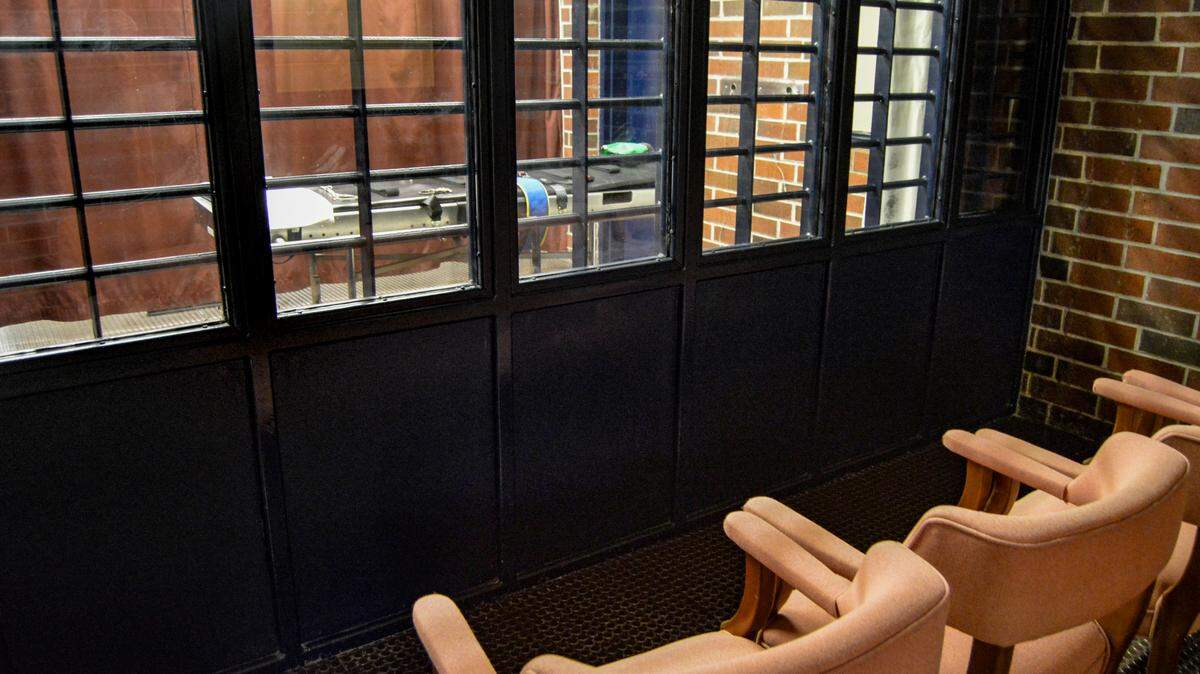
Brad Sigmon will soon be the only person alive to know what death by firing squad feels like.
But he’ll die with that information in seconds if the state of South Carolina kills him as planned.
On Friday, Sigmon is set to become the first prisoner in the U.S. in 15 years to die by firing squad, the fourth to die that way since 1976 and the first ever so killed in South Carolina. He will have a hood on his head and a small target over his heart. Three volunteer shooters who work for the South Carolina Department of Corrections and will remain unnamed will fire unspecified weapons from behind an opening in the state’s death chamber. If their aim is true, he will die in seconds.
If it’s not, our conversation will be markedly different.
Sigmon is on death row for beating his ex-girlfriend’s parents lifeless in 2001 with a baseball bat then kidnapping and shooting at her. He missed as she ran away, her world suddenly harder and smaller and horrifyingly unimaginable.
Sigmon’s world will be harder and smaller in a few days when his own death is imminent. He would likely be on the death row of any state in the habit of killing brutal multiple murderers, so let’s set aside the death penalty debate for this column. Let’s focus instead on the method: firing squad.
Is it something our supposedly civil state and society should use in the year of our Lord 2025?
Only four other states allow it as a method of execution: Idaho, Mississippi, Oklahoma and Utah.
State-sanctioned executions in general are far less common than they used to be nationwide, and firing squads have been displaced as a major way to carry them out. Still, it’s not been that long since their place was being debated at the highest levels of our judicial system, by a chief justice of the Ninth Circuit Court of Appeals in 2014 and a U.S. Supreme Court justice in 2017.
Comparing firing squads to hangings, electrocutions, lethal gas and lethal injection, Supreme Court Justice Sonia Sotomayor said in a dissent in a 2017 Alabama case Arthur v. Dunn, “In addition to being near instant, death by shooting may be comparatively painless.” She cited a 2014 study of U.S. executions to note that 7% of the 1,054 lethal injections conducted between 1900 and 2010 were “botched” but that “none of the 34 executions by firing squad had been.”
Actually, that’s not quite right. But let’s start at the beginning of U.S. firing squad executions, which Fordham University School of Law professor Deborah W. Denno has studied closely.
She says the first documented firing squad execution occurred in Virginia in 1608 and that there had been 30, mostly in California and Louisiana, by 1789. Firing squads and hangings are the oldest methods of U.S. executions, but firing squads have been used only 144 times to date.
The three since 1976 “went as predicted,” Denno said. But that hasn’t always been the case.
Conor Friedersdorf wrote in The Atlantic in 2015 of a condemned man who “strode from his cell” ‘“in black broadcloth” and “a white felt hat,” carrying a cigar and exhibiting “unmistakable effects of liquor,” who refused to be tied to a chair or blindfolded in Utah in 1879. Four shots rang out, sending his body flying, but none struck his heart. He was pronounced dead 27 minutes later.
Firderserdorf reported that another prisoner wasn’t declared dead for several minutes in Utah in 1951 when two of the four bullets fired from 15 feet away hit him in the hip and abdomen.
Firing squad deaths follow a policy here and now and should take only seconds. Experts say it’s less painful than other methods, but they also acknowledge there’s no way to measure the pain.
One inmate killed in Utah in 1938 let doctors put electrocardiograph wires on him. They recorded that his heart was beating nearly three times the normal rate before he was shot — and that it stopped 15.6 seconds later. The AP reports anesthesiologist Joseph Antognini said in a 2019 federal case that there’s no guarantee of painless firing squad deaths because inmates can remain conscious for up to 10 seconds depending on where the bullets strike, which could be “severely painful, especially related to shattering of bone and damage to the spinal cord.”
So should the state be in the firing squad business? It may actually be the best method.
In a 2014 legal ruling at the 9th Circuit Court of Appeals, Chief Judge Alex Kozinski weighed forms of execution and wrote this in a dissent in an Arizona case called Wood v. Ryan: “The guillotine is probably best but seems inconsistent with our national ethos. And the electric chair, hanging and the gas chamber are each subject to occasional mishaps. The firing squad strikes me as the most promising. Eight or 10 large-caliber rifle bullets fired at close range can inflict massive damage, causing instant death every time. There are plenty of people employed by the state who can pull the trigger and have the training to aim true. The weapons and ammunition are brought by the state in massive quantities for law enforcement purposes, so it would be impossible to interdict the supply. And nobody can argue that the weapons are put to a purpose for which they were not intended: firearms have no purpose other than destroying their targets.
“Sure, firing squads can be messy, but if we are willing to carry out executions, we should not shield ourselves from the reality that we are shedding human blood,” he wrote. “If we, as a society, cannot stomach the splatter from an execution carried out by firing squad, then we shouldn’t be carrying out executions at all.”
Until the early 20th century, hanging was the preferred execution practice, Sotomayor explained in 2017: “After several grotesque failures at the gallows — including slow asphyxiation and violent decapitation — revealed the ‘crude and imprecise’ nature of the practice … states sought to execute condemned prisoners ‘in a less barbarous manner’ and settled on electrocution.”
Then The New York Times called the first electrocution in the state “a disgrace to civilization.”
In the end, only the executed know what it feels like. It’s society that struggles with the aftermath.
This story was originally published February 27, 2025 at 6:00 AM with the headline "As South Carolina prepares for a firing squad execution, here are how many have gone wrong."