
More than 100 years ago, NC’s largest city grappled with its own insurrection
Note: This story was originally published on Jan. 9, 2021.
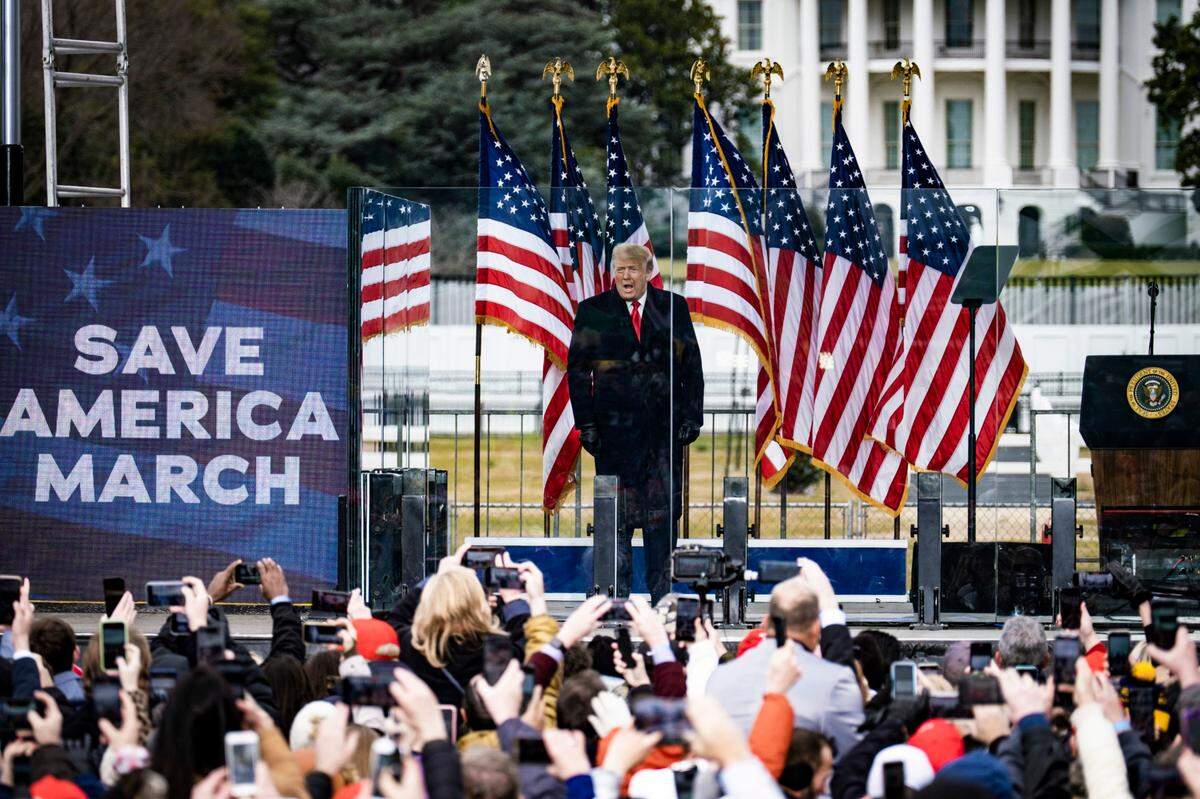
In the hours after a wave of pro-Trump rioters crashed through the halls of the U.S. Capitol building Wednesday, North Carolina’s political leadership was quick to separate what the world was watching unfold in Washington, D.C., from America’s identity.
Egged on by a leader and his allies, whose baseless claims had echoed for weeks through the chambers of right-wing media and vilified public servants in some of the cities with the largest Black populations, the mob forced its way into the seat of political power.
Many of the men and women were armed and armored. Some hoisted symbols of white supremacy. The group attacked members of the press, assaulting reporters, destroying equipment and scrawling “Murder the Media” on a door like bathroom graffiti. They livestreamed and posed for pictures.
And when they were done, most of them walked away.
“Today’s terrorism is not who we are,” Democratic Gov. Roy Cooper said Wednesday in a tweet, adding that “America is better than this.”
“As Americans we cannot tolerate violence,” newly elected Republican Rep. Madison Cawthorn of North Carolina, who spoke at the rally that preceded the riot just hours earlier, tweeted. “Peacefully protest ONLY.”
“The lawlessness witnessed at the Capitol today is despicable and should be condemned in the strongest possible way,” Rep. David Rouzer, a Wilmington Republican, said on Twitter. “This is not who we are as a nation.”
More than 100 years ago, another mob bore down on the center of government power, this time in Wilmington, which at that point was North Carolina’s largest city. For weeks, the throng of angry white men had been incited, incensed and cajoled by an elite band of conservatives pushing a manufactured message of fear and grievance, an effort aided and abetted by the state’s most powerful media voices, The News & Observer and its publisher.
The mob, adherents to a campaign of white supremacy, brandished weapons of war and burned a newsroom to the ground. They posed for a photo in front of its smoking ruins.
By the time their march of terror was complete, they had killed dozens of Black people and forced the resignations of the city’s leadership, among them Black and white members of a “Fusionist” party of Republicans and Populists. And in the aftermath, the mob’s actions went entirely unpunished by state or federal leaders, entrenching a Democratic Party that brought about decades of Jim Crow policies aimed at keeping white people in power.
The coup d’etat in Wilmington on Nov. 10, 1898, succeeded. The insurrection in Washington, D.C., on Jan. 6, 2021, did not.
But when North Carolina’s political leaders contended that Wednesday’s events aren’t what America is about — isn’t who we are — historians and longtime observers say they aren’t so sure that’s the case.
“In many cases, it’s exactly who we’ve been,” said Gary Pearce, a political consultant and former News & Observer reporter who worked as a speechwriter for Democratic Gov. Jim Hunt. “We’re a country born of revolution and violence, and we grew so divided at one point that we fought a war with each other. This is always the dark side of America that we have to be concerned about.”
Wednesday’s assault on the Capitol, experts say, shares similarities with a number of historical events in tone or tactic.
The Whiskey Rebellion pitted farmers angry about a new spirit tax against federal collection agents less than two decades after the country’s founding. Parties clashed for control of Pennsylvania politics in the Buckshot War of 1838. And following a contested federal election in 1876, the country’s deadlocked parties struck a deal to award the presidency to Rutherford B. Hayes, in exchange for withdrawing troops from Southern states barely a decade after the end of the Civil War.
While very different in purpose and tactics, even more modern labor and civil rights movements to occupy public spaces with a list of demands, experts say, have some parallels.
But again and again this week, conversations on TV and social media have turned to Wilmington and 1898 — and a cadre of powerful white men who were unhappy with their party’s performance at the ballot box.
A campaign of subversion
To understand what happened that day on Nov. 10, 1898, it’s important to understand the years leading up to it, said LeRae Umfleet, lead author of the 2006 report produced by North Carolina’s Wilmington Race Riot Commission.
“The violence in Wilmington and the coup that overthrew the legally elected government were an outflow from the political campaign of 1898 to seat the white supremacy platform of the then-Democratic Party,” Umfleet said, adding that the two major parties followed substantively different political philosophies than those of today.
Southern Democrats, many of them former Confederates clinging to ideals of white supremacy, had lost steady ground to a new coalition of Republicans and Populists consisting of both white and Black leaders.
And in no city was this more apparent than Wilmington.
“That’s what those folks saw in Wilmington back then: ‘Hey, we all want the same thing. Let’s come together in this Fusion and collaborative type of government’,” said Chris Everett, a filmmaker and director of the 2015 documentary “Wilmington On Fire.” “That’s what made Wilmington a model of what the New South could have been — and also what America could have been.”
Against the backdrop of the 1898 campaign for the legislature, the statewide Democratic Party launched a campaign to vilify and subvert Black people in North Carolina and any politicians who worked with them.
Party leaders like former Confederate Col. Alfred Moore Waddell and Charles Aycock crisscrossed the state with stump speeches extolling the threats of the Black community to the white working class. A militant gang of white men called the Redshirts terrorized and intimidated voters.
And in Raleigh, News & Observer editor Josephus Daniels weaponized his paper in support of the white supremacy campaign with articles and, more importantly, political cartoons.
“Someone who took up the newspaper, who may not be able to read every word in it, could certainly look at those cartoons and say, ‘OK, white women are endangered by these big, black burly brutes, and we need to do everything we can to protect them from that,’ or, ‘They’re going to steal the ballot box,’” Umfleet said.
The N&O, and the papers that carried its content, pushed that narrative over and over again throughout the 1898 campaign.
“Newspapers were king, so they had domination over public discourse,” said David Zucchino, New York Times reporter and author of “Wilmington’s Lie: The Murderous Coup of 1898 and the Rise of White Supremacy.” “That’s where people got their news. And that’s where people formed their opinions.”
On the legislative level, their efforts were enormously successful. But behind the scenes, the Wilmington area’s white elite also engaged in a conspiracy to overthrow the local government.
“The day after the election, Nov. 9, the white leadership in Wilmington, who had been a part of the campaign planning, came together and said, ‘You know, we won, and we don’t want to see Black men telling us what to do any longer,’” Umfleet said.
Shortly after, Umfleet said, “things hit the fan.”
.JPG "j9ka8889.Untitled-44 (1).JPG")
Mobs roamed the streets
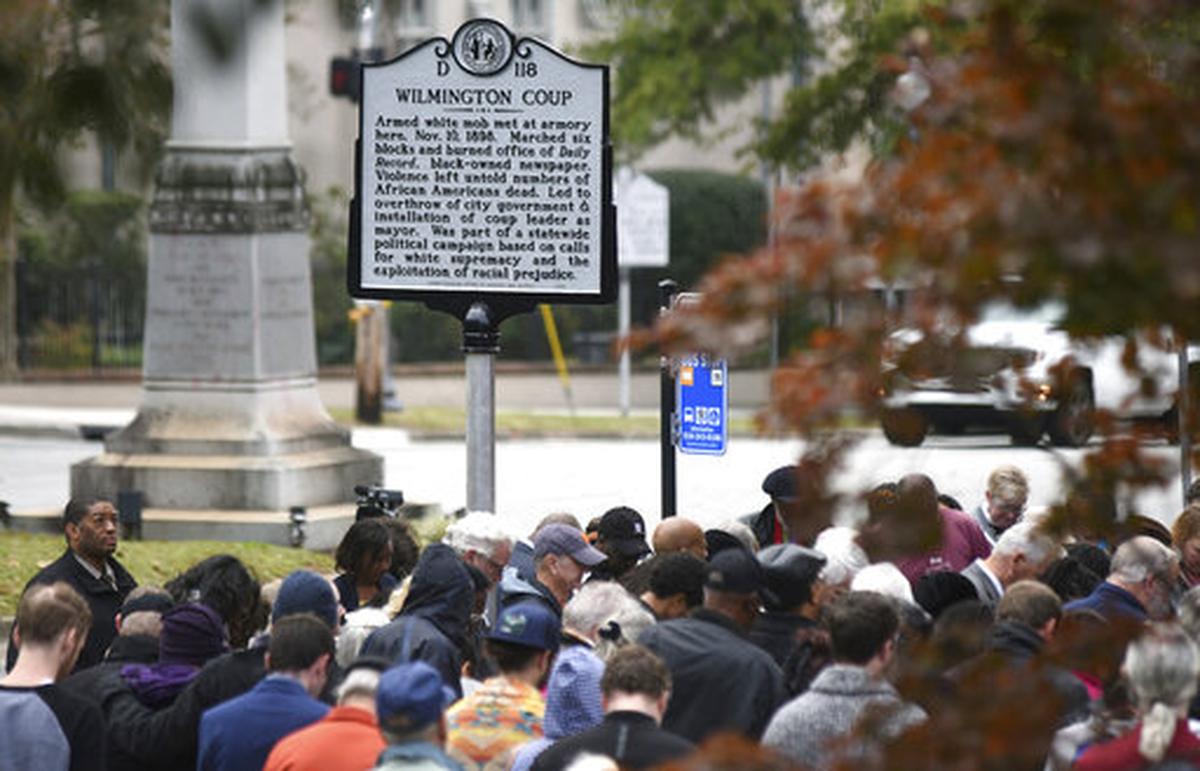
Among the findings in the 2006 commission report on the incident, she wrote that the mobs that roamed the streets on Nov. 10, 1898, “left an unknown number of dead on Wilmington’s streets.” Her estimate puts the number of killings at 60, although that figure may be even higher. More than 2,000 people fled the city, many of them never to return.
The mob burned down the building of The Daily Record, a newspaper operated by Black editor Alex Manly, a frequent target of the white supremacist campaign. In a photo, dozens of those men clutch weapons, grinning as the building smolders in the background.
By day’s end, the mob ascended the steps of Thalian Hall and forced the resignations of Wilmington’s leadership.
“It was a coup,” Zucchino said. “It culminated in gunmen going to city hall and at gunpoint, forcing the city council, the mayor and the police chief to resign and then they replaced them with leaders of the mob.”
Rather than pay a price for what happened, the coup d’etat and the events leading up to it yielded reward for those involved.
“Five of the next six governors had all participated in the white supremacy campaigns — in leadership,” said Tim Tyson, a senior research scholar at the Center for Documentary Studies at Duke who authored a 2006 special section in the N&O called “The Ghosts of 1898.” “That was the political credential of a generation: Where were you in 1898?”
(The N&O in 2006 apologized for its role in the coup in an editorial that ran with the special section).
The lack of consequences, says Everett, was empowering for the white supremacists of the late 1800s.
“They saw that the federal government wasn’t going to intervene at all,” Everett said. “It just opened the door, not only for things to happen in Wilmington, but all throughout the South.”
What followed in North Carolina was decades of Jim Crow segregation, starting with state legislation just a year later in 1899. And nationally, there were more massacres of Black people by white mobs: Atlanta, in 1906; during the Red Summer of 1919; Tulsa, in 1921; and Rosewood, Fla., in 1923.
To Tyson, it’s not hard to trace the lineage of mob violence in Washington, D.C., Wednesday right back to Wilmington.
“Political violence has been pivotal in shaping the history of the South. So goes the South, so goes the nation,” Tyson said. “What we’re seeing here is an extension of that history.”
’Same music, same beat’
Irving Joyner sees the similarities too.
He’s an N.C. Central University law professor, longtime civil rights advocate and vice chair of the 2006 Wilmington Race Riot Commission. He’s also a veteran organizer of demonstrations across the country, including in Washington.
“The difference that I see is that in 1898, there was a loud and public pronouncement that we are out to get rid of these African Americans who are elected and who are voters,” Joyner said. “This time, it was code words that were used to basically say the same thing. And in this instance, the code word was ‘illegal voters.’”
President Donald Trump and his allies have continued, for weeks, to lob widely debunked claims of fraud at cities like Atlanta, Philadelphia and Detroit — areas Joyner notes have high concentrations of Black voters.
“The playbook, as far as I look at, it is pretty much the same,” Joyner said. “It’s the same music, same beat, same tone, that was followed as far back as 1898.”
Accusations that Trump and his allies actively incited the crowd have also struck a familiar chord with historians and political observers.
The president has drawn widespread condemnation for his comments before and after the riots. And members of his own party, among them Republican leaders such as Rep. Liz Cheney, of Wyoming, and Sen. Richard Burr, of North Carolina, have directly faulted the president for inciting the mob.
“All you have to do is read the words of Donald Trump, Donald Trump Jr. and others who spoke at that rally. They were very clear in saying in essence, go down to the Capitol and make your views known,” Zucchino said. “To me, that’s incitement.”
.JPG "CapitolBreach (1).JPG")
A matter of power
The idea of occupying public spaces — even private ones — isn’t foreign to American political movements.
Black students from N.C. A&T University sat down at a Woolworth’s lunch counter in Greensboro in 1960, refusing to move until they were served. Years later at Duke University, a group of students took over the main administration building with a list of demands for the protection and support of Black students.
And as recently as the last decade, crowds gathered weekly in the grassy square across from the N.C. Legislative Building in Raleigh as part of Moral Monday, a movement to protest policies of the Republican legislature after the party took control of both chambers of the General Assembly for the first time in about a century. Part of that protest involved the arrests of hundreds who entered the building on trespassing charges, most of which were eventually dropped.
But Joyner, who represented some of those protesters, said there’s an important difference between these movements and the actions of the mob at the Capitol in Washington: power.
Movements like Moral Monday, he said, were organized by people out of power seeking to obtain their goals, not those in power trying to hold onto or take it. It wasn’t, in other words, a coup.
“I see that as a distinction between those efforts designed to occupy a building for the purpose of making statements and those efforts directed toward elevating or maintaining the power that people had felt that they were about to lose,” Joyner said. “Here, the building was just the symbol of the takeover.”
And unlike other occupy movements, Tyson added, Wednesday’s takeover was marked by violent clashes with police, ending with the deaths of five people so far.
“This was not civil disobedience. It was disobedient, but it was not civil,” Tyson said. “They were not there to break an unjust law or make a point and offer their hands to handcuffs.”
‘A political question’
Reeve Huston, an associate professor of history at Duke University, was one of the many arrested during the Moral Monday protests for failing to disperse. He’s focused his work lately on political movements in the United States and acknowledges there are plenty of examples — coups, invasions and political violence — woven through the fabric of American history.
He’s not so sure it’s fair to call the events of Wednesday — or other efforts to use violence to contest elections — fundamentally “American.”
“Is this un-American?” he said. “I think most people would agree that we want to make that un-American, but that’s a political question.”
Huston said there are elements of the Jan. 6 takeover that operate within an American tradition of protest, “but they took it way further.”
“What’s different now is that they took over Congress,” Huston said. “Congress is not just a public space. It’s the public space. But it’s supposed to be sacrosanct.”
“American” or not, he said the label might not be as meaningful as it appears.
“I’m committed to democracy. But you can use democracy to do some really, really bad things,” he said. “We shouldn’t assume just because it’s in the American tradition, that it’s good. Or just because it’s a use of grassroots power that it’s necessarily a good thing.”
In the days after the takeover, historians like Umfleet said they’re still trying to process what happened. In a phone call this week, she hesitated to draw parallels between Washington and Wilmington.
“I think we’ll learn more over time about the causes and effects of what happened in Washington, D.C.,” she said. “But I don’t know that we’ll know it today or tomorrow or next week. I think historians 50 years from now will be trying to figure it out, too.”
But she said the events of 1898, and how the state has grappled with it since, can provide some lessons for today.
“Truth and cold, hard facts help people understand and come to grips with what happened, regardless of their racial, economic or gender background,” Umfleet said.
That reckoning, and the accountability that comes with it, is important to Joyner, too. But so are efforts to be proactive.
“When people advertise overthrowing and revolution and insurrection, you need to pay attention to it,” he said. “And where people are seeking to use anything at their disposal for the purpose of gaining power and lording power over powerless people, you need to pay attention to that.”
That’s important, he said, because Wednesday’s assault felt more like a beginning than an end.
This story was originally published January 9, 2021 at 11:12 AM with the headline "More than 100 years ago, NC’s largest city grappled with its own insurrection."