Author wins Pulitzer for ‘Wilmington’s Lie,’ explaining racist incident from NC’s past
Update: David Zucchino won the Pulitzer Prize for General Nonfiction on June 11, 2021, for “Wilmington’s Lie: The Murderous Coup of 1898 and the Rise of White Supremacy.” The following story was published Jan. 9, 2020.
After decades of documenting the impacts of tribal conflict and war around the world, North Carolina-based journalist David Zucchino has focused his writer’s eye on the specifics — and the stubborn legacy — of a racist insurrection that happened in the state more than a century ago.
“It’s a story that needs to be told,” Zucchino said of the white supremacist campaign that led to the violent overthrow of Wilmington’s elected government in 1898.
Zucchino’s new book, “Wilmington’s Lie,” released this week by the Atlantic Monthly Press, “shows what can happen when people exploit ancient hatreds and suspicions and fears,” the author said in an interview with the News & Observer shortly before the book landed in stores.
Zucchino, 68, is a career journalist now covering Afghanistan for the New York Times. He won a 1989 Pulitzer Prize for his coverage of apartheid in South Africa and has been nominated for four other Pulitzers. On June 11, 2021, he won the General Nonfiction Pulitzer Prize for “Wilmington’s Lie.”
He’s known for the depth and thoroughness of his reporting, the compelling clarity of his writing and an insistence on first-hand, primary-source information. In a recent story for the Times on alleged widespread child-sexual abuse in Afghanistan, Zucchino tracked down and talked to boys who said they had been victims of assaults, and got comments from community leaders whose job is to protect citizens, including the youngest and most vulnerable.
Bringing Wilmington story to a wider audience
Zucchino is by far not the first to write about what happened beginning in the spring of 1898 and culminating on Nov. 10 of that year, when a violent mob set about restoring white leadership in Wilmington, the largest city in North Carolina at the time. But the accuracy and reach of previous accounts have varied, and Zucchino’s book is likely to bring the story to a much wider audience.
The gist of the story is this: In 1898, Wilmington was a majority-Black town, having become a post-Civil War destination for former slaves who hoped to find work and acceptance there. It also was the site of a rare-for-its time experiment in governance, with elected Black officials working alongside white ones, allied in their populist opposition to wealthy Democratic party leaders of the day.
This Fusionist government was a thorn in the side of white supremacist Democrats in the region and as far away as Raleigh, where Josephus Daniels, publisher of The News & Observer, conspired with like-minded political leaders such as Furnifold Simmons, chair of the state Democratic party, and former Confederate Army officer Alfred Moore Waddell, who had represented North Carolina in Congress and had his eye on the mayor’s seat in Wilmington.
They and others devised and executed a plan to foment fear and anger among white residents until they believed that Black leaders were incompetent and Blacks in general were a threat to white people’s jobs and safety. In newspaper editorials and racist cartoons, in speeches and in widely distributed pamphlets, they argued that the only way to restore proper balance was to force Blacks out of leadership positions in Wilmington, by killing them if necessary and replacing them with whites.
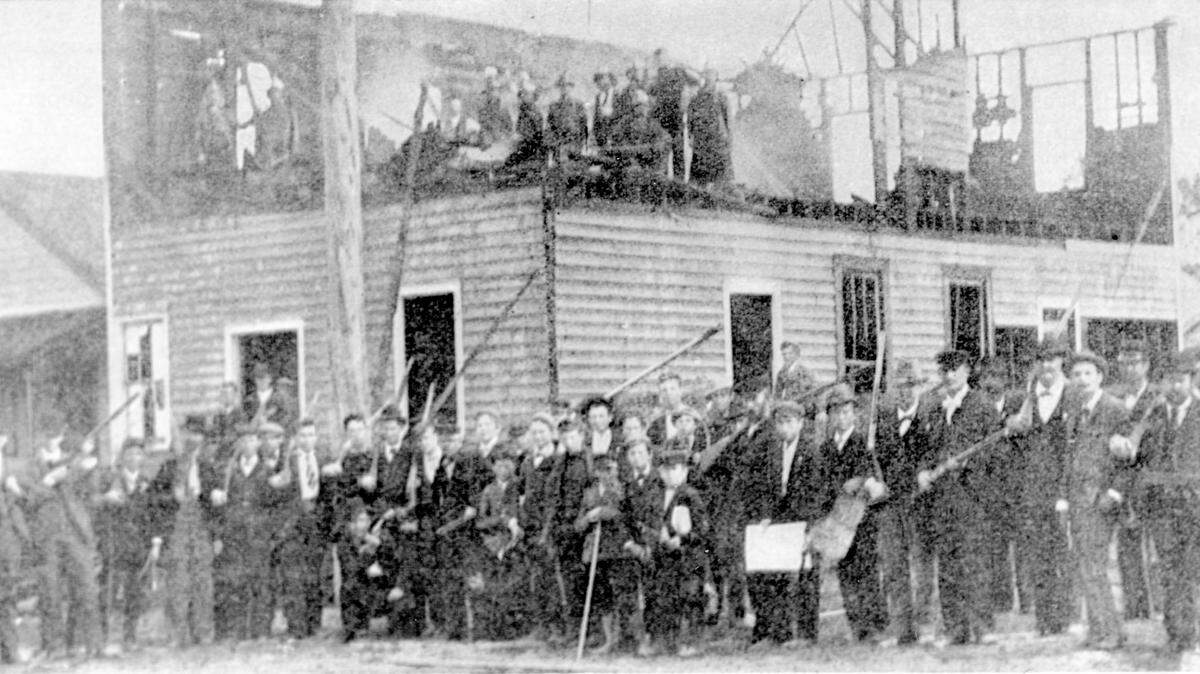
After setting the stage for the overthrow with months of rhetoric, organizers set loose an armed mob on the city on Nov. 10, 1898, that murdered at least 60 Black residents, torched the Black-owned local newspaper, sent thousands of Black people into hiding in swamps and woods and changed the city forever.
Though the white supremacist campaign was conducted in public and those who orchestrated it, including Daniels, later bragged about how it had been accomplished, when it was talked about at all in historical accounts it was misrepresented, Zucchino writes, as the necessary put-down of a Black rebellion by smarter white overseers.
.jpg "IMG-3289 (2).jpg")
A history hidden for years
Zucchino, an Army kid born in Kansas, attended high school in Fayetteville when his dad was posted at Fort Bragg. He also spent four years getting an undergraduate degree at UNC-Chapel Hill, where campus buildings bore the names of some of those white supremacists involved in the coup.
“But I never heard a word” about the Wilmington riot in those formative years, he said.
In his book, Zucchino says the first factual account of the coup didn’t come until 1951, when a black woman who was a scholar at N.C. Central University in Durham published a doctoral thesis about it.
The coup was again a subject of discussion in 1998, when on the 100th anniversary academicians at UNC Wilmington proposed forming a biracial committee to find a way to commemorate the events. That same year, The News & Observer, having been sold by the Daniels family to the California-based McClatchy Company, published a special section dedicated to the Wilmington coup.
Two years later, the N.C. General Assembly approved a move by two black legislators from Wilmington to form a commission to investigate the causes and effects of the coup. The commission published its report in 2006.
Zucchino became fascinated with the story, he said, because:
▪ it was a deliberate and planned campaign that resulted in the only overthrow of a democratically elected government in U.S. history.
▪ it remains nearly unknown outside North Carolina.
▪ it left scars on the city and its then-residents that remain to this day,
▪ it employed racist tropes that continue to be used today to cultivate anger and mistrust.
Zucchino’s book uses historical accounts from newspapers of the day, journals and memoirs of participants and their families, archives and interviews with descendants of participants to draw intimate portraits of the story’s characters. His detailed accounts then place them on the stages where they gave their speeches and stands them on the streets of Wilmington as the shots rang out.
“I see a straight line from those events to today,” Zucchino said, and not just in the tribal animosities that result in violence in other countries.
‘Hatred is a powerful force’
Here, in the U.S., he said, the threatening image of the criminal “other” is alive and well, still being used by some white supremacists against African Americans and Hispanics, and by some political leaders, including in North Carolina, are still working to curtail minorities’ voting rights and political access.
”Some of these same forces are very much at work today,” Zucchino said. “There are some politicians who are willing to stoke those fears.
“Hatred is a powerful force, and once it’s unleashed, it’s very hard to control.”
This story was originally published January 9, 2020 at 2:50 PM with the headline "Author wins Pulitzer for ‘Wilmington’s Lie,’ explaining racist incident from NC’s past."