
Raleigh protest against police violence shifts to vandalism as curfew arrives
This story was updated at 10:35 p.m. Sunday, Aug. 30, 2020.
What began as a peaceful march through downtown Raleigh to protest police violence and systemic racism took a turn Friday night, with some scattered vandalism and 14 arrests as some people remained downtown more than an hour past the city’s 10 p.m. curfew.
After more than two hours of marching and speeches, the crowd had grown, and some protesters showed no sign that they’d obey the curfew set by Raleigh Mayor Mary-Ann Baldwin. At the Wake County Justice Center, some protesters tossed around plastic barricades meant to keep them away from the building, while others started a fire in the middle of Salisbury Street and sprayed red paint on a memorial to fallen Wake County sheriff’s deputies.
“I would rather die out here tonight of pepper spray, rubber bullets and sticks than to die on the streets with people thinking I’m a devil,” said Jeffrey Stallings, 34, of Raleigh, waving a piece of barricade. “We’re people. We’re brothers and sisters.”
Saturday update: Raleigh mayor says police tactics were effective.
Raleigh police tweeted that a portable toilet had been knocked over, and one protester pulled up a street sign and smashed the window of a substance abuse agency on Davie Street. “We are asking protesters to keep it peaceful,” the police Twitter account said at about 9:20 p.m.
About 25 minutes later, police used a loud speaker to tell the crowd that the gathering had become an “unlawful assembly.” People began to disperse, with some heading toward the State Capitol, where some protesters pulled down metal barriers that surrounded the Capitol grounds.
There, an estimated 300 protesters were met by dozens of Raleigh police officers in full riot gear, armed with tear gas. The officers stood between the Capitol and the protesters, who then continued marching through the city in defiance of the curfew, setting off fireworks and pulling trash and recycling bins into the street.
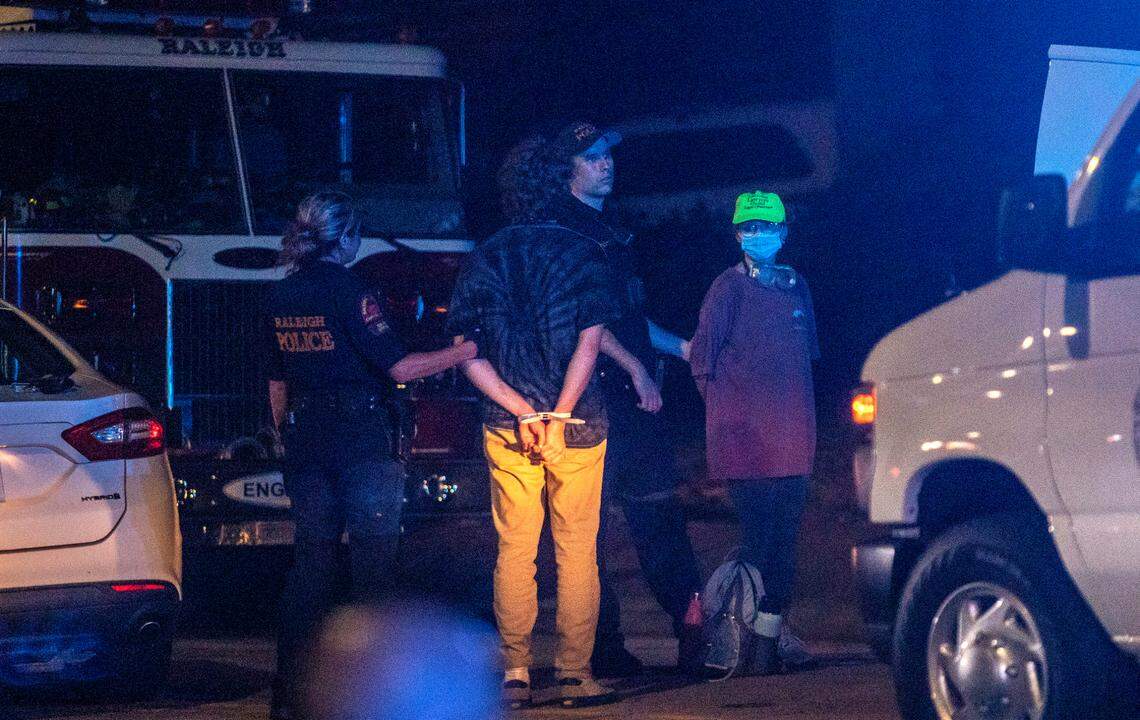
By 10:30 p.m., police began warning those who continued marching that they could be arrested. About 45 minutes later, as the crowd dwindled more than an hour after curfew, police began making arrests.
Fourteen people were arrested and charged with violating curfew, according to the Raleigh Police Department.
A curfew violation is a class two misdemeanor which can carry a maximum of 60 days in jail and a fine up to $1,000. Four individuals faced an additional charge, including disorderly conduct and assault on a law enforcement officer.
Many business and property owners had boarded up their windows against the potential for a repeat of the violence that erupted after protests on May 31 and June 1. Downtown is still recovering from the looting and vandalism those nights, and business owners asked for a 10 p.m. curfew that Baldwin issued for Friday and Saturday.
On Sunday, Baldwin lifted the curfew as planned.
“More than 1,000 people came to downtown this weekend to peacefully and civilly exercise their constitutional rights to freedom of speech and assembly,” she said in a statement.
“While a small number sought to cause distractions — and were held accountable — the message of reform and justice is not lost or overlooked,” she continued. “These voices are needed in our community and we hear you. And we promise action and solutions.”
Protesting police violence
The protest was organized after last weekend’s shooting in Kenosha, Wisconsin, of Jacob Blake, a Black man who was paralyzed after a white police officer fired seven shots towards his back as he opened the door to his SUV. Blake, who had briefly scuffled with police as they tried to arrest him on an outstanding warrant, was hit four times.
The protest began outside the Wake County Courthouse, on an otherwise mostly deserted Fayetteville Street. The city closed the street and nearby sections of Martin and Hargett streets to traffic from 5 p.m. Friday until 5 p.m. Sunday.
“No justice, no peace,” protesters chanted as they headed up Fayetteville Street toward the State Capitol shortly after 7 p.m., with TV helicopters hovering overhead. The group met State Capitol Police at the barricaded grounds, some yelling “Pigs!” and “Open fire!”
The march continued around the Capitol to the Executive Mansion, where protesters stood at the front gate and chanted, “When I say Cooper, you say coward!” Raleigh police kept their distance, blocking traffic as the crowd snaked and circled through downtown.
“The whole Black Lives Matter and men getting killed by the police is exhausting,” said Kristina Harris, a 19-year-old student at St. Augustine’s University. Harris, a criminal justice major from Smithfield, said she was attending her first protest in Raleigh. She appreciated seeing people of all races at the protest, not just Black people, she said.
She was joined by other students from St. Augustine’s, including Desmond Myers, 20, from Charleston, South Carolina.
“It’s a good idea that we come together as one,” said Myers, a social work major. “I have four brothers. Who knows, it can be my brother next. It’s very scary being a Black man in America.”
Thursday’s announcement from Wake County District Attorney Lorrin Freeman was also on protesters’ minds. Freeman said a Raleigh police officer acted lawfully in January when he shot and killed Keith Collins. Collins, who was Black, ran from officer W.B. Tapscott, who is white, carrying what proved to be a BB gun.
Gloria Mayo, Keith Collins’ mother, decried Freeman’s decision at a press conference Friday morning but urged protesters to be peaceful.
“I don’t want protesters to be going down, tearing up Raleigh,” Mayo said. “Be peaceful. Because the people downtown with the stores and the businesses and stuff, they didn’t kill Keith. They didn’t kill Keith. Tapscott killed Keith.”
Baldwin said Thursday that she anticipated that Friday’s protests would be peaceful and that she wants people to be heard. But she said she wants to avoid what happened in Raleigh following George Floyd’s death at the hands of police in Minneapolis. She said the city was “overwhelmed” that night.
“We firmly believe that those coming down to protest should have their voices heard,” Baldwin said. “We firmly believe in the mission of social justice. We also believe that we need to take action to address these issues. What we want is to find solutions that we can work on together, and most importantly, we want peace in our community.”
Activist Kerwin Pittman said the curfew hinders the constitutional rights of people to protest and shows Baldwin is on the wrong side of history.
“Putting the city on the curfew is showing she is valuing property more than people,” Pittman said in an interview before Friday’s demonstration. “This is nothing more than another form of intimidation.”
Pittman said Friday’s gathering is meant to show solidarity with the people of Kenosha and reinforce the need for concrete changes in police practices in Raleigh and across the country.
“It was too hard to know that these kinds of police shootings are taking place despite the spotlight being put on police brutality,” he said. “It shows how this brute force mentality is ingrained in law enforcement.”
‘I’m tired of what’s going on’
After more than an hour of marching through downtown, the protesters ended up back on Fayetteville Street, to the spot where they started. After another hour of speeches, some through a bullhorn, they began marching again shortly after 9 p.m. toward the Wake County Justice Center.
Victoria Smith of the Wake County Black Students Coalition for high school students said she isn’t surprised the shooting with Blake took place, even after all the attention being paid to police after Floyd’s death in Minneapolis just three months ago.
“We’re all talking about it, but people in power don’t want to make change,” Smith said, though she added she’s happy to see that white people are learning about the lives of Blacks in America.
“They should have already learnt about the struggles of the Black community and communities of color,” she said.
Don Lewis, who describes himself as a Raleigh community activist, said the problems of the Black community go beyond police violence.
“I’m tired of what’s going on,” Lewis said. “I’m tired of police violence. I’m tired of what’s going on amongst my Black brothers. We’re killing each other everyday.”
Protesters made sure to keep the names of Floyd and Breonna Taylor, who was shot and killed by police in her home in Louisville, Kentucky, part of the conversation. Kelsey Ward held a portrait of Taylor that her friend had painted. Together, Ward and her friend have painted pictures of all the victims in Raleigh police shootings and given them to their families.
She sat on Fayetteville Street holding the painting of Taylor as admirers snapped pictures.
“I think it’s time for a change,” she said. “I think the people here have the power to do it, and I support them.”
The City of Raleigh announced a “Shine the Light” prayer vigil Saturday at 4 p.m. at Moore Square. The event is being organized by the city council, Wake County Commissioners, Raleigh police chief and faith and business leaders.
Johnny Bernard Hill, Dean of Shaw University School of Divinity, said in a news release that he hopes “bringing people together we can move forward together.”
The city also asks residents to step outside at 9 p.m. with a flashlight or candle to “shine a light for unity and social peace,” according to a news release.
This story was originally published August 28, 2020 at 7:43 PM with the headline "Raleigh protest against police violence shifts to vandalism as curfew arrives."
