These states make up more than half of nearly 4M fliers flocking to Myrtle Beach
Myrtle Beach International Airport has seen such an increase in flight traffic during the past five years that its runway is rapidly degrading.
The airport saw 3.8 million passengers in 2024, an all-time high for the Myrtle Beach hub, according to a recent report to Myrtle Beach City Council from Judi Olmstead, director of airports. Much of that increase comes from people flying to Newark, New Jersey, with 280,000 passengers a day, according to second quarter figures in 2025.
That’s followed by people heading to New York City, with 267,000 passengers a day, and Boston with 244,000 passengers a day.
Myrtle Beach International is the second busiest single-runway airport in the U.S., only behind San Diego International, according to the report. It’s nearing “critical capacity,” Olmstead told council members.
Myrtle Beach is a top tourist destination in the country, bringing thousands of people to South Carolina’s coastal area each year. However, because of the fast growth of Horry County, where Myrtle Beach is located, the airport also has seen an uptick in residents flying to states including New York, New Jersey and Pennsylvania.
The rise in air traffic from 2019 to 2024 is largely a combination of an increase in both residents and visitors, Ryan Betcher, assistant director for airports, wrote in an email. While the numbers fluctuate depending on the time of year and specific market, about 34% of passengers flying through Myrtle Beach International Airport in 2024 were residents and 66% were visitors, Betcher added.
The airport saw an increase in nearly 30,000 Myrtle Beach area residents flying to New York and 6,500 flying to Philadelphia in 2024, according to the latest numbers available. Some of those numbers, including flights to Philadelphia, cannot be accurately compared to 2019 because some flights have been added and others have ceased, according to the airport’s figures.
The airport offers nonstop service to more than 50 destinations through 10 major U.S. carriers.
“Despite a larger share of traffic being from visitors, especially during peak travel seasons, our local residents are a key part of this growth,” Betcher wrote. “We actively share this data with our airline partners to encourage more flight options, especially beyond the busy summer months.”
In addition to commercial traffic, the airport is also used by military air bases for flight training.
Horry County continues to see thousands of people moving into the area each year. The county saw nearly 16,000 new residents between 2023 and 2024, making it one of the fastest growing counties in the United States, according to the South Carolina Department of Employment and Workforce. Horry County’s population is projected to grow by nearly 200,000 by 2040, which requires the Myrtle Beach area’s infrastructure to keep pace with community needs, according to the airport’s report.
Horry County and South Carolina are spending millions of dollars to upgrade roadways in the Myrtle Beach area to try and keep up with the amount of new residents and traffic that has resulted from the fast growth.
The airport has made improvements, including a 50,000-square-foot terminal expansion completed in November 2025 that added six new gates, upgraded restrooms and new concessions. The budget for the expansion project was $98 million.
The airport is now preparing to spend $160 million to repair its only runway.
Who is paying for the runway project?
The money for the runway project comes from a combination of federal, state and airport cash reserve, Betcher said.
“No local property tax dollars are used to fund airport projects, including this one,” he said.
A breakdown of the phase 1 project shows that more than $20 million will come from FAA grants, $22 million from a Bipartisan Infrastructure Law Grant, more than $2 million from a DC Blox property sale and $10.6 million from Myrtle Beach International funds.
Because the pavement and subgrade of the runway is nearing the end of their useful life, it will require a full reconstruction that will be a multi-year project that will happen in two phases, Betcher added.
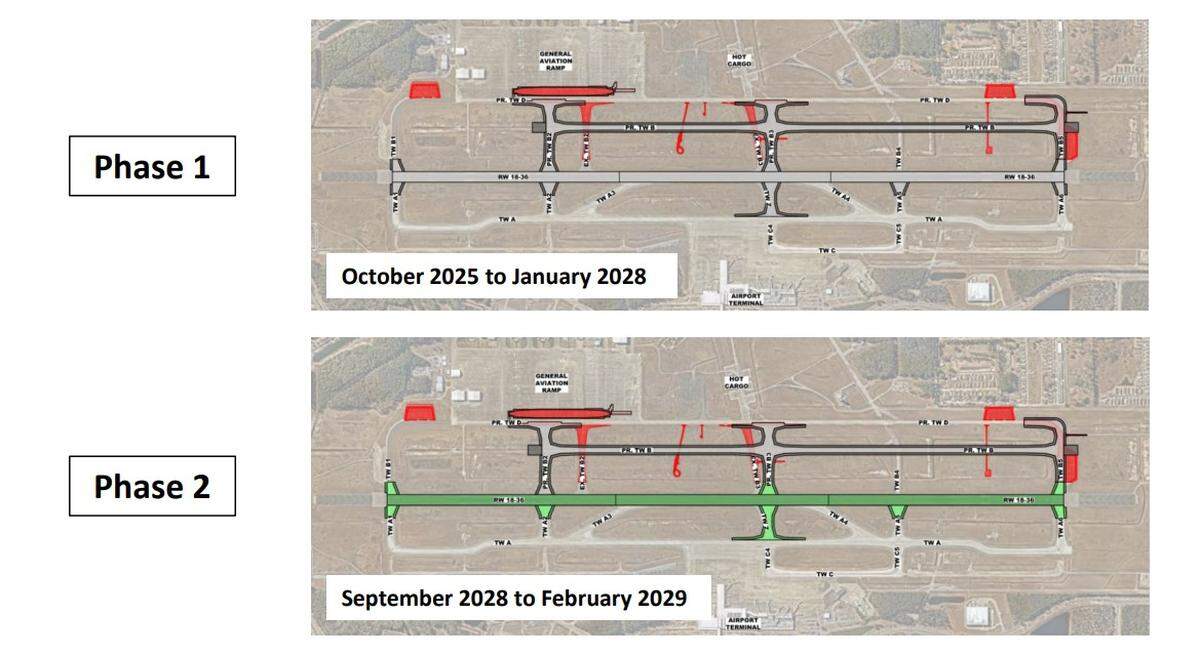
The first phase of the runway project is expected to begin in Feb. 2026 and will last until Jan. 2028, according to the report. This will involve construction of a temporary runway that will be located between the existing runway and the west parallel taxiway on the general aviation side of the airport, Betcher said.
Once complete, phase 2 will begin, which includes transitioning aircraft operations to the temporary runway and closing the existing primary runway for 4-5 months. That is expected to happen in Sept. 2028 and run through Feb. 2029.
The closure is anticipated during the fall through spring timeframe to minimize operational and travel impacts, Betcher said.
After the primary runway’s reconstruction is complete, the temporary runway will be converted into a permanent parallel taxiway, Betcher said.
When asked why the temporary runway couldn’t be used as a permanent, second runway, Betcher said that in order to make the temporary runway permanent, “significant and costly modifications would be required to meet FAA runway design standards.” Additionally, the close proximity of the two runways would prevent simultaneous operations, meaning a second runway would primarily serve as a backup rather than helping to increase capacity.