
Thousands of little blobs are washing up on Myrtle Beach, SC area beaches. They’re not jellyfish
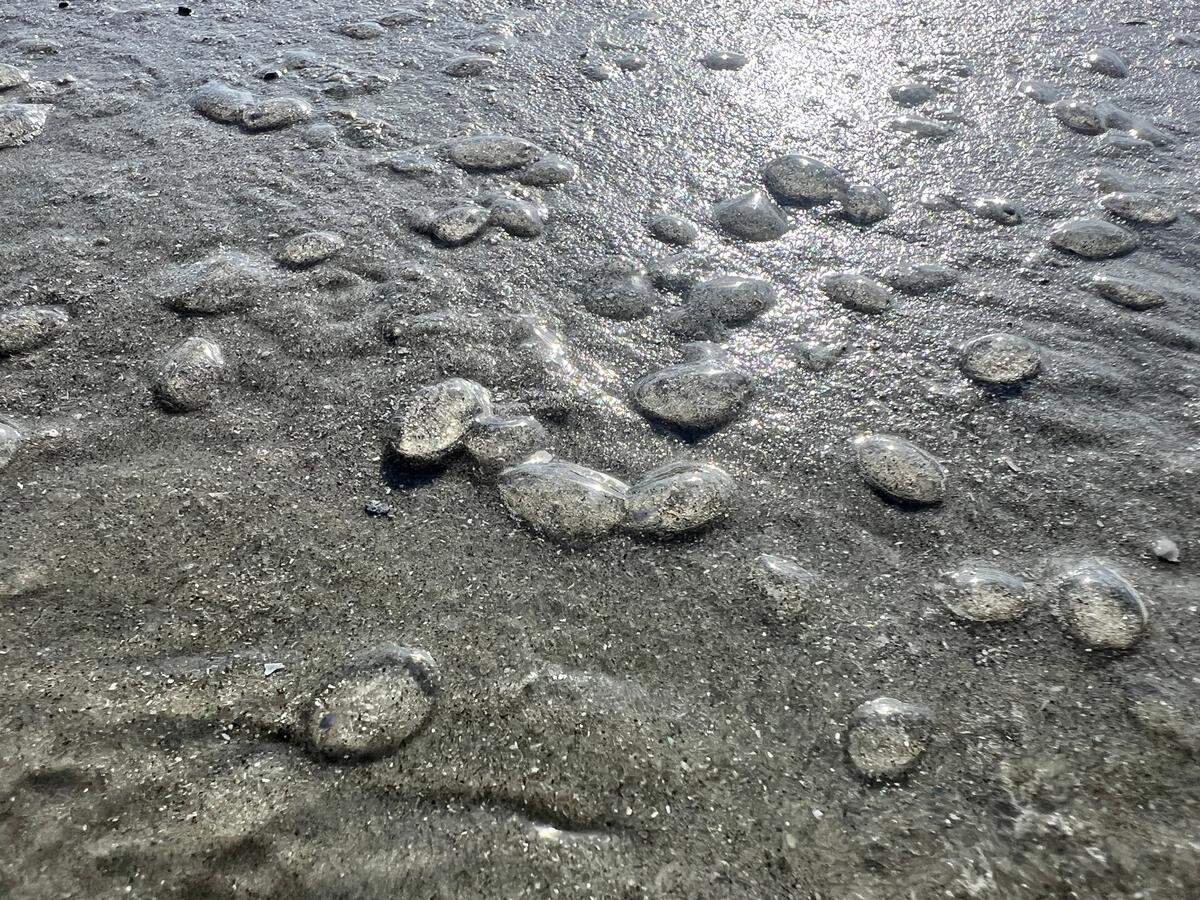
If you’ve been to a beach in the Grand Strand lately, you might have noticed thousands of little clear blobs scattered across the sand. But what are the colorless, gelatinous creatures?
The strange clear blobs may resemble jellyfish, but salps are actually a kind of gelatinous zooplankton that can grow several inches long. Here’s what you need to know about salps, why they’re here and if they’re dangerous for you or your family.
What are salps?
Unlike jellyfish, which are cnidarians like sea anemones and corals, salps are chordates — a classification they share with humans.
“Salps actually, this will sound a little odd, they’re our cousins. They are very simple members of the phylum chordata,” said Coastal Carolina University marine science professor Juliana Harding.
Salps are zooplankton, which the Environmental Protection Agency calls “the animals of the planktonic community.” While phytoplankton produce energy from the sun, zooplankton consume their energy.
The filter feeders get around by pumping water through their bodies, propelling themselves and feeding on tiny organisms like bacteria and single-cell algae. Salps may not do much, but they’re vital to the ocean food chain.
“They’re important in the lower parts of food webs,” Harding said. “Sometimes they’re consumed by larger things. Other times, they simply process the food to make it available for other organisms in the food web.”
Are salps dangerous?
While salps may be a strange sight, the good news is they don’t pose a threat if you want to poke or pick one up.
“Salps are completely harmless to touch for humans and pets. They have no stinging cells,” Coastal Carolina University assistant professor of marine science Lauren Stefaniak said. “I would not recommend eating them.”
Throwing salps back into the water could help the little plankton, but the current will likely wash them back ashore.
“It’s a neighborly thing to do, but it’s sort of inevitable the wind is still coming on shore that they’re just going to get stuck here,” said Harding.
Why are there so many salps on the beach?
Food, reproduction and currents could all contribute to the surge of salps on Grand Strand beaches.
Ocean currents
If you’ve noticed a rise in jellyfish washed up along the coast alongside the increase in salps on the beach, there’s good reason. Neither salps nor jellyfish have much control over where they go, so when a strong current carries them to the beach, they get stuck on shore.
“As plankton, they float along with the water,” Harding said. “I suspect that with the wind direction we’ve had the last couple of weeks, or particularly in the last week or so … they probably have just been blown in, and once they’re in against the shoreline, until the wind changes, they’re they’re going to be here.”
Algae
Phytoplankton, microscopic algae, are an excellent food source for zooplankton like salps, so when phytoplankton increases, zooplankton follows.
“This time of year, as the water temperatures are warming up a little bit and the light levels are going up quite nicely, as the sun increases the algae out there. The productivity will increase because there’s more light, and so there’s more food for the salps,” Harding said. “And so usually, after a phytoplankton bloom we will see a bloom in zooplankton.”
Beyond the population increase, an abundance of food also means salps grow bigger, so they’re easier for humans to spot.
Salp chains
As salps reproduce, some form chains that can reach 6 feet long, according to Harding. Because salps are carried by the current, these long chains get washed inland to the beach.
“Many salps species can reproduce both sexually and asexually. When they reproduce asexually, they quickly form long chains of many individuals,” Stefaniak said. “As they approach the shore, the waves break up the chains, scattering the salps on the beach.”
Basically, the growth in algae increased salp reproduction, so the asexually reproducing zooplankton formed chains, which were then carried by the current and stranded on South Carolina beaches.
This story was originally published April 8, 2025 at 6:00 AM.