She cycled through jail until dying there. Is that cost of homelessness in Myrtle Beach?
Leonora Russo, groggy and confused, slowly peeled herself off the damp park grass, trying to peer through her bloodshot eyes to make out the dimly lit figure who had shaken her awake.
On this humid Wednesday evening, it wasn’t a friend, but a Myrtle Beach police officer. By this point, Russo knew the drill — stumble into the back of the patrol car, get booked into the county detention center, plead guilty, get out and be right back out on the street, a compilation of police reports and interviews with her friends shows.
It was the 32nd time MBPD had arrested her in 17 months. All misdemeanor violations — public intoxication, park use after hours, trespassing, sleeping on the boardwalk — just the cost of living homeless with an alcohol addiction in the South Carolina tourism hub.
Russo’s friends and family had gotten in the habit of checking the J. Reuben Long Detention Center booking photos every morning, disappointed but relieved when her mugshot popped up. At least they knew she was alive.
But three days later, on Sept. 16, deputies found the 61-year-old unresponsive in her cell, and Russo was declared dead after being rushed to a local hospital. The cause is still under investigation.
By the end, Russo’s longtime loved ones hardly recognized the Brooklyn, New York native they called Lori. Only able to enjoy glimpses in recent years of the generous, bubbly animal lover they knew, as a combination of severe ailments, both mental and physical, kept her cycling between jail and the streets.
“My sister was a good person; that’s what I want people to know,” Russo’s younger sister, who requested the newspaper not use her name, said. “She would do anything for anybody. She was just sick. And nobody would help us (help her).”
Russo’s tragic story highlights the continued ineffectiveness of criminalizing homelessness in Myrtle Beach, one of countless cities across the country constantly faced with the difficult balance of maintaining a safe, inviting downtown needed to draw visitors and fairly treating a population whose physical presence is perceived as contrary to that image.
More than one of every three people arrested for misdemeanor violations in 2022 by the department was listed as homeless, according to a Sun News review of online court records. Trespassing, public intoxication and sleeping violations were among the most common charges.
“This is a public health issue, but we keep treating it as a law enforcement issue,” said Eric Tars, senior policy director for the National Homelessness Law Center. “Why do we keep coming back to the criminalization approach, when they’ve proven not to work?”
Building family at the park
A Buckcherry song blares from a portable stereo midday as a group huddles around their go-to bench in Chapin Memorial Park on the opposite side of the adjacent library.
At first glance, the small crowd may appear disparate and random, but this is a family — a family defined at this moment by who’s missing as much as who’s together.
Some are only missing temporarily — likely about 20 miles away in Horry County’s detention center — but Russo was also a mainstay in this park crew.
“It’s been a really hard few months for us,” Wendy Coady explains, adding that their makeshift family also suffered another loss when Anthony “Tony” Garrett died from cancer just a few weeks before Russo. He was found in the alley beside a nearby gas station.
Coady became homeless herself while battling cancer about 13 years ago after losing her Murrells Inlet home amid rising medical debt. Another cancer diagnosis last year finally convinced her to seek help, and she’s now six months clean and living in a sober living home. She still returns to the park most days hoping to convince her friends to join her in sobriety.
“I’m sick of watching my friends I’ve known at the park die on me,” she said.
Coady proclaims herself the queen of Chapin Park, the “alcoholic park” as she describes it, scoffing that others using “crack, ice and other crap” have sadly inundated their hangout spot in recent years.
Coady recalled Russo was often the last one to arrive each day because she walked so slowly, hobbled by several strokes her sister says partially paralyzed her on the left side of her body.
Her late friend’s daily routine usually involved drinking until she passed out on a bench or the ground, waking up, using the library bathroom and starting to drink again, Coady said.
“We’re stuck outside, gotta do something,” she said. “We don’t have to drink, but we feel like we have no choice. Nothing is getting better in our lives, feels like we’re stuck here.
“I didn’t think I’d ever make it out of here, but you can. I tried to talk to her (about getting her help), but she wasn’t ready yet. She said she needs booze to help with the pain.”
Coady has helped two of her park friends get into rehab facilities recently and almost had a third earlier this month, but when she went to pick him up the morning after he told her he was ready, he had already been picked up — by police for public intoxication.
Criminalizing homelessness
Myrtle Beach Police Officer Steph Parran, a longtime member of the department’s community policing team, said homeless outreach is a big part of her job, and she feels she has a great relationship with members of the homeless community.
“They’ll probably know who I am because they’ll probably call me the ‘little red head,’” she said. “I’ve always been fair but firm. ... I am there to help them and get them resources if they need it, but I’m also there to go ahead and take enforcement (actions) if it needs.”
But for many of those living homeless and cycling in and out of jail, they feel unfairly targeted by Myrtle Beach police.
“Police call us by our names and pick at us because they know who we are,” said Randy Barnhill, who says he was Russo’s boyfriend, although her family disputes it.
Just finding somewhere out of sight of officers to sleep each night for the two of them was extremely stressful and likely bolstered her desire to drink more, said Barnhill, who’s been arrested 11 times himself during the past couple years.
“We got nowhere else to go, and cops see everything we’re doing,” he said, pointing to a surveillance camera positioned high up near the middle of the park. “They could just give us a fine, but no, they arrest you.”
Myrtle Beach Police declined to specifically discuss Russo or make Chief Amy Prock available for interview.
Parran emphasized that officers are required to uphold state laws and city ordinances, though they do have the discretion on a case-by-case basis to give verbal warnings or tickets instead of making an arrest for violations including sleeping on a park bench after hours.
Parran and the other two officers on the department’s community policing team arrested people listed as homeless for misdemeanor violations 97 times last year, the review showed.
She countered that she doesn’t believe arresting people facing homelessness prevents her and others on that team from building trust within that community because they understand officers have a job to do.
Myrtle Beach needs
Eric Tars, senior policy director for the National Homelessness Law Center, said the arrest statistics compiled by The Sun News are unfortunately common in communities across the U.S. because the ordinances that lead to these arrests overwhelmingly target people living without shelter.
“If the purpose of criminalizing something is to deter the behavior, you can’t deter biological needs: to sleep, seek shelter and deal with addiction,” he said. “If (they) just lived inside, (they) wouldn’t intersect with the criminal justice system.”
Myrtle Beach, and Horry County as a whole, have proven particularly ineffective at providing that shelter, as it consistently has the highest percentage in South Carolina of its homeless population counted as unsheltered — nearly 73%, according to the 2020 S.C. State of Homelessness report.
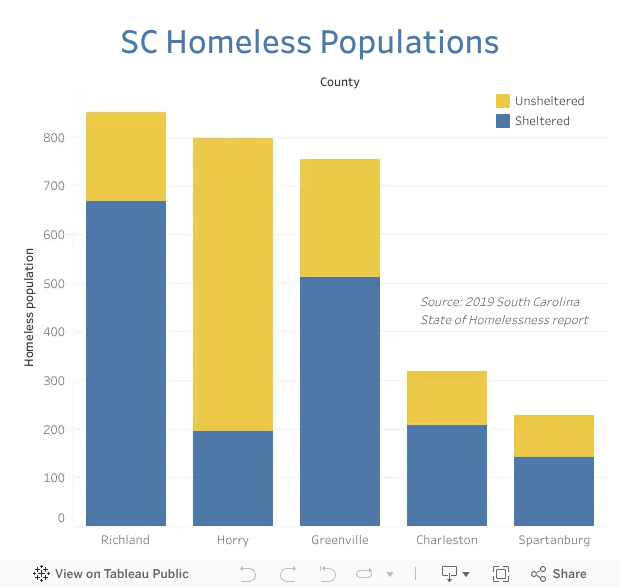
Mike Chestnut, who has served as a Myrtle Beach councilman since 2000, said city officials have been trying for years to find solutions that balance the needs of the homeless population with the needs of the business and residential communities, but there is no “magic answer.”
“I don’t know what to do, I’ll be honest with you,” he said, sitting on a bench outside his downtown restaurant Big Mike’s Soul Food, across the street from Chapin Park. “Other than work together to try to solve the problem.”
Chestnut hears much more frequently from taxpayers that the city is “soft” on crime related to homelessness and provides too many services than the opposite, he said.
“People are not going to come to an area if they don’t feel safe,” he said. “I even hear that from my customers.”
Tars suggested that increased public safety doesn’t always mean more law enforcement. Other cities have had more success building trust with the homeless population by sending trauma-informed social workers to calls for service instead of police officers.
Public education is also key, Tars said, to show how much more cost effective it would be to provide more affordable housing instead of cycling people through jails.
Russo, for example, spent 181 days in J. Reuben Detention Center — at $134 per day to house an inmate on average, according to the Horry County Sheriff’s Office — since last year. That same $24,254 could’ve covered rent for more than two years in a low-cost apartment, Tars said.
“And in an apartment, it would’ve been easier for her to get medical attention and treatment for her addiction,” he said. “That’s taxpayer money better spent and possibly could’ve saved her life.”
One of the main reasons cities continue to criminalize homelessness is because it’s more “politically convenient” to hide the costs in police, jail and court budgets rather than spend up front to address housing needs and battle with communities that don’t want affordable housing near their homes, Tars added.
Chestnut admitted that the “not in my backyard” attitude is likely a huge reason affordable housing in the city remains scarce. He recounted when, prior to his election to council, he served on the Myrtle Beach Housing Authority, and a plan to build a complex near Racepath Street off Highway 501 was nixed because residents there fought it.
Housing First solution
Tars touted the success of Milwaukee, Wisconsin, which was recently recognized for having the nation’s lowest unsheltered homeless population by embracing the Housing First model that’s required for many U.S. Department of Housing and Urban Development grants.
That model, which prioritizes offering permanent housing with minimal barriers and not forcing people receiving that assistance to participate in services, has been in contrast to the approach of Myrtle Beach, which has primarily funded organizations that require sobriety and program participation, The Sun News has previously reported.
Chestnut said he wasn’t aware of any conversations among city council members about Housing First, but he’s always open to hearing about any ideas to help address homelessness. He added that even if the city were able to secure more funding, finding appropriate space for affordable housing or more shelter beds could still be an issue.
Some cities have made more efficient use of the space they do have to serve the homeless population by building tiny homes. Columbia became the first city in the southeast to implement this idea, breaking ground last year on 50 small shelters to serve as transitional homes for their chronically unsheltered homeless population.
A local nonprofit is currently completing a group of 25 tiny homes in Myrtle Beach to serve 41 veterans facing homelessness.
Chestnut and Parran both lauded increased coordination in recent years among Myrtle Beach nonprofits and organizations that serve the homeless population, which allows each group to connect people seeking help to appropriate services.
They also emphasized the personal responsibility of those who choose to break the law rather than accept these services.
“The city is not the big bad person on the block trying to crack down because you’re homeless,” Chestnut said. “We want to get you help, but you’ve got to want to help yourself.”
Tars argued that the idea people facing homelessness are “service resistant” is a myth, but rather they’ve become resistant to the people offering those services, often after years of diminished trust.
“No one wants to live on the street. Every one would rather be in housing,” he said, “But if they haven’t been offered what they need, they’re going to improvise.”
‘Nobody helped’
Joann Lopez tried for years to help Russo get into sobriety programs, but was constantly met with no’s — typically because her longtime friend couldn’t meet work requirements due to her health issues.
“I was making so many calls. It got to the point where I was getting anxiety,” she said.
Lopez met Russo more than 20 years ago when the two worked at a collections agency in New York, and they’ve been friends ever since — often talking on the phone daily despite Lopez remaining in New York after Russo moved to Myrtle Beach.
“Lori was always pleasant, not confrontational ... always making jokes,” she recalled. “Everyone liked her.”
Russo moved to the Myrtle Beach area with her parents and sister about six years, according to her sister, who said the move was made as part of her and her husband’s decision to retire. She requested her name not be used in this story out of concern for her family.
“She didn’t want me leaving her, that was her whole thing — ‘I’m going wherever (my sister is) going,’” she said. “Me and my sister were very very close. She was my heart.”
Russo had minor issues related to alcoholism and her mental health in the past, her sister said, but those issues were exacerbated drastically shortly after the move, particularly after her strokes. She suggested the medicine prescribed to treat her pain caused hallucinations, so her sister would stop taking the pills and drink instead.
“This other person was a different person,” she said. “My sister was a beautiful woman. She was beautiful, and nobody helped. She was in pain from her head to her feet, and that’s why she drank.”
Fighting off tears, she was still in disbelief that the woman who’d stay home from work just to lay at her side while she dealt with her own severe health issues was gone.
“We came here to enjoy the rest of our lives together. And that’s not going to happen.”
This story was originally published October 25, 2023 at 5:30 AM.