Myrtle Beach homeless remain largely unsheltered. Is ‘Housing First’ the answer?
Leaning forward off the tree-patterned back cushion of her couch, Amber Muirhead gestures side to side, speeding up her words as she recounts the “vicious cycle” she was in just six months earlier.
“I’m sweating to death and sleeping in my bathing suit in the back of my van because it’s so hot outside, then I gotta get up in the morning … clean myself up to make it look like I’m not sleeping in my car because I don’t want my boss to know I’m homeless.
“… People judge you when you’re homeless, and they look down on you, and it’s sad … because you don’t have the money, and then when people look down on you, it’s making me feel down and … starts working on your depression, and next thing you know,” she says, finally pausing to exhale, “you want to do drugs because you don’t want to think about it or feel it anymore.”
Muirhead was homeless in Myrtle Beach and struggling with addiction for more than four years, mostly living out of her van, occasionally renting a motel room when she could afford it.
Last August, she was finally able to move into an apartment in the Conway area — which has helped her maintain her latest recovery effort — as part of Eastern Carolina Homelessness Organization’s permanent supportive housing program, which is funded primarily through U.S. Department of Housing and Urban Development grants that prioritize low-barrier housing.
As Horry County, and Myrtle Beach in particular, try to address one of the largest and least sheltered homeless populations in the state, the city’s overarching strategy appears to be in contrast with federal guidelines.
Housing First and Toxic Charity
HUD had approximately $2.3 billion available through its fiscal year 2019 continuum of care program to grant to organizations addressing homelessness, according to its notice of funding availability, which specifically cites the Housing First approach as a priority for its grantees.
Housing First means offering permanent housing with minimal barriers, meaning a person’s income, work history or sobriety won’t impact eligibility; and not forcing people receiving that assistance to participate in services to keep their housing.
“(Housing) gives them a sense of self-worth first, then we can work on the issues (that led to their homelessness),” said Joey Smoak, executive director of ECHO. “(But) if they choose not to do anything, we can’t make them.”
ECHO, partly because it follows that Housing First approach, received nearly $1.5 million in HUD funding in addition to about $1.3 million combined from U.S. Department of Veterans Affairs, state and county grants, according to its 2017-18 financial report.
The City of Myrtle Beach, meanwhile, has focused its homelessness support financially towards New Directions of Horry County, which was created in 2013 on the heels of city leaders consulting with the author of “Toxic Charity: How Churches and Charities Hurt Those They Help and How to Reverse It.”
The “Toxic Charity” philosophy encourages charities to explore whether they’re just providing handouts that can promote complacency among those they’re helping or if they’re actually teaching them how to move forward.
In contrast with the Housing First approach, New Directions requires sobriety for admission to its transitional housing shelters, which include mandatory program participation.
Kathy Jenkins, executive director of New Directions, said their program shares the same goal as the Housing First — to get people housed and living independently — but it’s difficult to mix active substance users with those working on recovery, and their program gives people the tools to get help even if they end up homeless again after exiting.
“Just saying that what a homeless person needs is a home is way too simplistic to me,” she said. “They need more, and that’s what we provide.”
Jenkins noted that the shelters once had minimal barriers with no coordinated effort to get people back on their feet before New Directions took control.
“Then we went to the opposite extreme, where we only worked to get people help who wanted it,” she said, “but now we’re finding the need for (low-barrier shelter) still exists.”
New Directions, which receives a small federal grant that covers about 5 percent of its annual budget, is mostly funded by the city and community donations. It is currently fundraising to renovate the upstairs of its men’s shelter, which would create enough living space to allow it to add about 35 low-barrier, emergency shelter beds downstairs, Jenkins said.
Homeless without shelter
About 75 percent of the nearly 800 homeless people in Horry County last year were unsheltered, meaning residing somewhere not meant for human habitation, far and away the highest percentage among counties with at least 100 homeless people, according to the 2019 South Carolina State of Homelessness report.
Richland County, by contrast, is the only county listed with a higher homeless population than Horry, but more than 78 percent of them have shelter, the report shows.
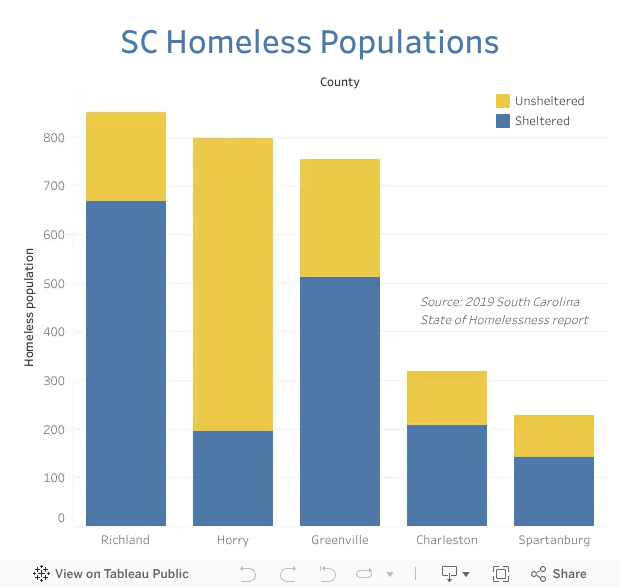
Those figures are based on the annual Point in Time count, which is based on a single day each January when volunteers physically count every homeless person they can find, a process Smoak and other homeless advocates often criticize as significantly undercounting the actual total.
Michelle Strickland once counted herself among the unsheltered population before receiving permanent supportive housing assistance from ECHO about three years ago.
When Strickland was married with kids, a full-time job and house, she always wondered how people could become homeless, but when she turned to drugs to escape an abusive relationship and daily stresses, she found herself on the street.
“I was empty inside, at the point of giving up,” she said. “Once I put a heroin needle in my arm, I thought I’d lost God for good. … I just wanted to overdose and die.”
Strickland never wanted to seek or accept help, even as she felt her life slipping away.
“On the streets, there’s always an ulterior motive,” she said. “When someone says they’re going to get you help, they’re not.”
But sitting in her Myrtle Beach apartment, in front of large, curtainless windows allowing the sun to beam inside, Strickland proudly notes that she’ll be four years clean in May and is preparing to travel to Honduras for a mission trip.
She says she’s delayed putting curtains up because, unlike before, she has nothing to hide, and she’s finally starting to feel fulfilled.
“Even when I owned a home before, it never felt like it,” Strickland said.
Long waiting list
While Strickland is just one of many local successes ECHO and other local homeless organizations are proudly supporting, the amount of people who are waiting for that same help remains daunting.
Smoak noted they have more than 1,100 people on wait lists for their various housing-assistance programs, and Jenkins said New Directions’ transitional housing shelters are consistently full.
Muirhead had to wait three years before ECHO was able to find her housing, and she can’t get back what she lost during that time.
Her apartment is mostly filled with various items others were throwing away, but any direction she looks inside, she’s able to see a reminder of her son — framed pictures, Mother’s Day gifts and letters — who was taken from her and put into foster care while she was still struggling with homelessness and addiction.
Muirhead’s ECHO caseworker, Alison Moen, reassures her as she tears up thinking about him, reminding her of how far she’s come.
“I lost him, but that’s my past,” she finally says, regaining her composure. “I’ve picked myself up. … Now is the future. I’ve been given another chance to have shelter, which is huge.”
This story was originally published March 12, 2020 at 9:36 AM.