
A fossilized rock sea bed exposed in Myrtle Beach. An exclusive look at uncovered history
If you grew up in Myrtle Beach before the late 1990s, you may remember carefully walking across slick rock ledges to get to the surf at certain areas along the Grand Strand.
At lower tides, these rock formations trapped sea life in tidal pools providing hours of entertainment for children, and a chance to study a very different marine habitat from our typical sandy sloping shoreline.
The ancient fossil beach near the 2nd Avenue Pier is back
During low tide this month, rock formations protruded about a foot above the sand along about a 60-foot-wide section of beachfront just South of the 2nd Avenue pier. Children and adults peered into tidal pools searching for shells and admiring tiny crabs and other marine life trapped within the rock-rimmed tidal pools.
According to Paul Gayes, executive director of the Burroughs and Chapin Center for Marine and Wetland Studies at Coastal Carolina University, this rock formation represents an ancient beach more than 80,000 years old.
“What you are looking at is basically a fossil beach,” he said in a recent interview.
“Myrtle Beach is a usual area,” he said, explaining that there are no barrier islands that would trap sand and sediment along our coast and no rivers or inlets directly depositing new sediment along the shoreline. So the older, often fossilized material remains close to the surface and easily exposed by constantly shifting sand.
“We literally we used to take classes down there from Coastal, for marine science to look at rocky intertidal communities, very different kinds of habitats that you might typically think about in the West Coast,” he said.
According to scientists, much of this fossilized rock, once recognized as Myrtle Beach landmarks, have been mostly covered since the last renourishment cycle.
A decades-old picture on the 2nd Avenue Pier shows a vast shelf of exposed rock near the shoreline. Dale Cisson, a worker on the pier, says that the rock outcropping frequently makes an appearance depending on the tide and on recent surf conditions that cover and undercover the rock.
But it depends on the day. Just a week after pictures were made of families exploring the outcropping, most of the rock was completely covered by sand or barely visible beneath the waves.
In a scientific article written in 2019 in Beach Renourishment Magazine entitled, “Myrtle Beach: A history of shore protection and beach restoration,” the authors describe our shoreline this way:
“Today’s Myrtle Beach is essentially a thin deposit of sand on top of consolidated limestone or “marl,” a calcium carbonate-rich sandstone or mudstone. With no rivers or inlets draining Myrtle Beach, nearly all natural sands are recycled material from the nearby coast and ancient beach ridges. While not completely sand-starved, Myrtle Beach has limited sand resources onshore and in nearshore waters.”
Gayes says he was part of a team that has surveyed much of the Grand Strand area’s sea floor from the North Carolina line to Winyah Bay. They found that much of the inner shelf, out to about five miles, had less than 50 centimeters (about 20 inches) of sediment atop these older deposits.
They also found extensive areas of exposed outcrops of older material called “hard ground” serve the role of aquatic reefs in providing important fish habitat.
What else might be found under the sands of Myrtle Beach?
With portions of Myrtle Beach reaching what is considered to be the end of a re-nourishment cycle, other historic features may present themselves.
Hurl Rocks Park at 21st Avenue South in Myrtle Beach was originally named for the the prominent Hearl family. The beach’s usual rock formation that he called a “cliff of rocks” were noted by American naturalist William Bertram during his exploration of the region in 1776. Today a historical plaque marks Hurl Rocks Park as part of the William Bertram Trail.
The Freeda A. Wiley, a shipwrecked three-masted ship that sunk off the coast of Myrtle Beach has occasionally been uncovered at 43rd Avenue North in North Myrtle Beach.
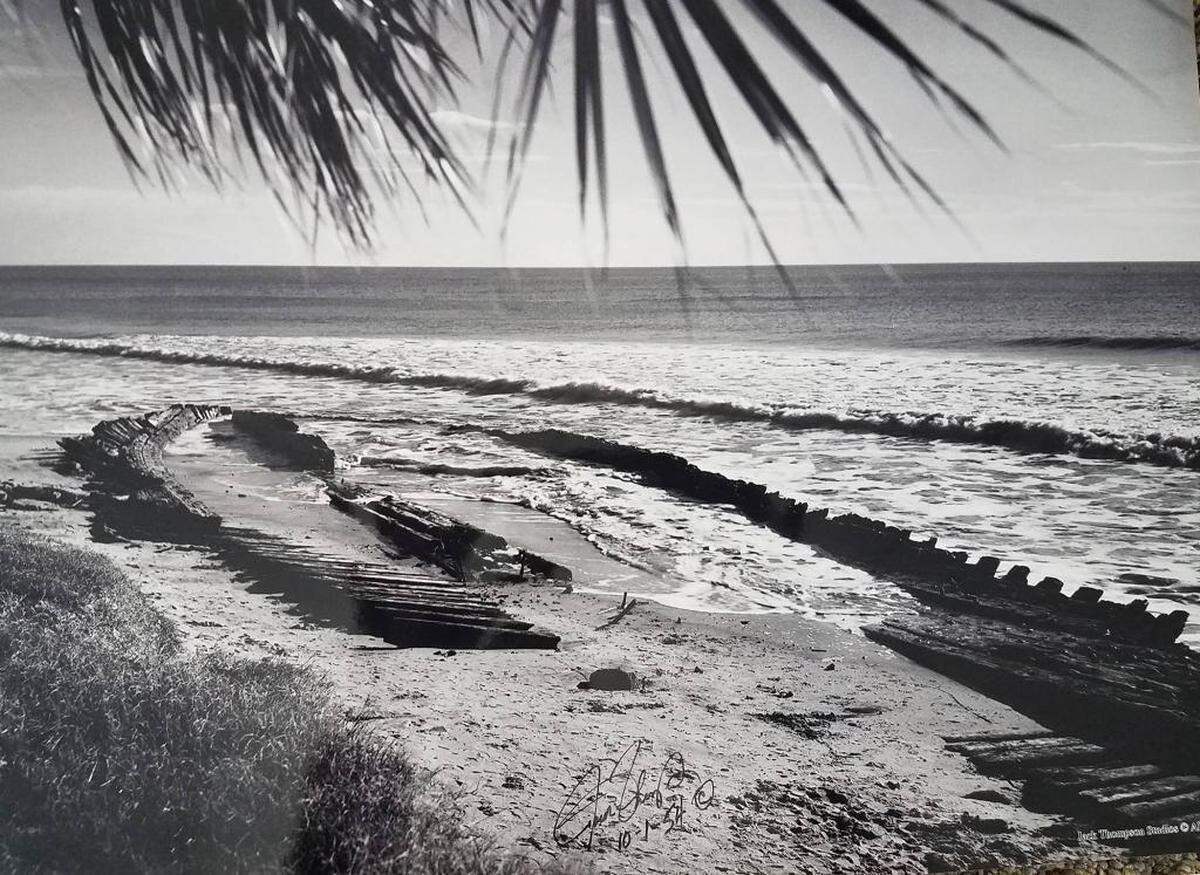
According to a Myrtle Beach City Government Facebook post, the ship burned to the waterline in a 1983 hurricane known as the “Great Storm”, and washed ashore near the sight. The post shared a picture from local photographer Jack Thompson and many locals recalled playing among her remaining timbers before the ship was once again covered by sand.
Fossils and megalodon teeth are frequent finds along the Myrtle Beach shoreline.
Beach combers almost annually find the teeth of these ancient sharks, that grew to 60 feet long and weighed up to 70 tons, along our beaches.
But these are not the only artifacts of a bygone area to be found along our sands.
Gayes says that recent studies show that shown that as much as 30% of shells found along the Grand strand are fossils.
Up and down the Carolina coast, archaeologists have found remnants of the past buried by the sands. From Native people’s shell middens, to pirate shipwrecks, to Revolutionary wartime forts, to Civil War era submarines, there is no telling what the next storm might uncover.
Look fast, it could all be covered back up soon
The last renourishment project in Myrtle Beach was completed in 2018 but in March of 2023 the U.S. Army Corps of Engineers granted the city $56M to repair the damage caused by Hurricane Ian in 2022.
So, 27-miles of the Myrtle Beach coastline is set to receive 650,000 cubic yards of sand to rebuild the beach. City spokesman Mark Kruea said that while the funds have been approved, he hasn’t yet seen a schedule but would expect work on the project to begin sometime in 2024.
This story was originally published August 13, 2023 at 6:00 AM.