Horry County has new policies after van transport deaths, documents show. What changed?
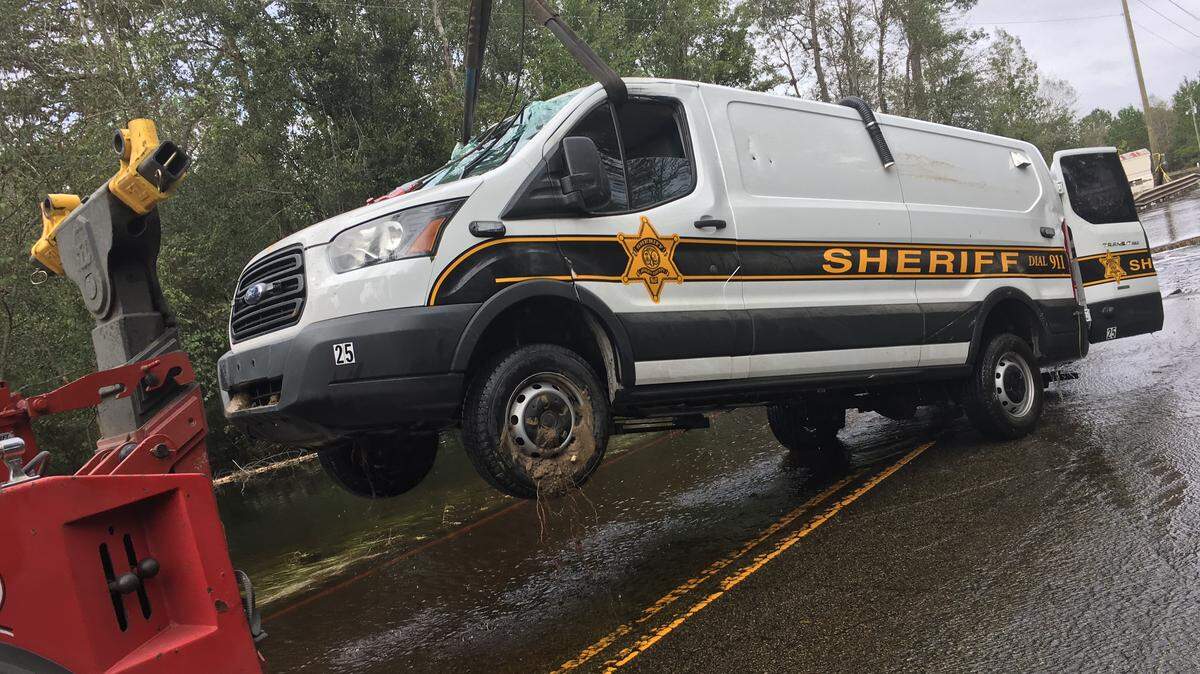
After the drowning deaths of two women locked in the back an Horry County Sheriff’s van during Hurricane Florence in 2018, the department has changed the way they transport mental health patients.
The two women, Nicolette Green and Wendy Newton, were being transported from a Conway hospital to health facilities in Marion County.
They drowned while locked in a caged compartment in the back of a sheriff’s van — a security system in place to prevent an escape or officer injury — after deputies drove the vehicle through Hurricane Florence floodwaters, despite a supervisor’s orders.
In another incident a year later, Abed Michael Naqshabandi, who was on suicide precautions at an Horry County jail, fatally harmed himself while in the back of a sheriff’s van. He was being transported back to jail from Conway Medical Center, where he was being treated for a previous attempt to harm himself.
The changes went into effect in May 2020, but were not acknowledged by the county until July 2021.
At that time, Kelly Moore, a spokesperson for the county, said that procedural changes had “been implemented to better protect the safety of mental health patients in Horry County,” but she did not expand on those changes when asked by The Sun News.
Records obtained this week by The Sun News from the sheriff’s office outline the changes made by the county.
The big change: no more vans
The biggest change to the transportation policy is that mentally ill patients are no longer transported in sheriff’s vans.
It is common for sheriff’s offices to transport mental health patients who pose a risk to themselves or others, even if they have not committed a crime.
But according to May 2020 policy, the preferred vehicle for conducting therapeutic transports is now an unmarked sedan or SUV-style car with protective caging between the driver and passenger.
The vehicles are equipped with a child-lock system to prevent people in the back seat from opening the doors.
Officers also have access to crowbars, sledgehammers and other extraction equipment in case of an emergency.
Other policy changes
▪ New training. In 2019 officers in the sheriffs office began to receive Crisis Intervention Training “designed to help Law Enforcement Officers do a better job when they interact with people with a mental illness.”
The training, certified by the South Carolina Criminal Justice Academy, is done by the National Alliance on Mental Illness.
So far, 16 sheriff officers are trained, eight are scheduled to complete training in September and November.
The department has 256 officers at J. Reuben Long Detention Center, 20 of whom are assigned to the transportation division, according to the Sheriff’s office.
▪In-car cameras. An addition policy requires all transport vehicles to have in-car camera systems that cannot be turned off by the officer.
The cameras were installed in 2015 and were implemented to help officers be aware of people they were transporting.
How Newton and Green became trapped
There are three parts of a sheriff’s transportation van.
The front cab is where the deputies sit. In the back, there is a cage for inmates, split into two compartments, one small and the other large. Between the compartments is a locked grate.
Green and Newton were in the smaller compartment, but not shackled or otherwise restrained, authorities said.
When water started to flood the van, Joshua Bishop, one of the officers in the van, escaped and went to help the passengers.
The sliding door that led directly to the women’s compartment wouldn’t open, so Bishop tried the back doors. He was able to get into the larger compartment.
The divider between the compartments had two padlocks. Bishop had no key. He took out his gun, intending to shoot open the locks. Bishop said he shot both locks multiple times, but still couldn’t remove the gate.
The women remained trapped.
Mental health transports
The sheriff’s office is responsible for transporting hundreds of mental health patients a year.
In 2019, just under 700 patients were transported by the sheriff’s office. In 2020, the number went up by almost 100. This year the sheriff’s office has transported 423 mental health patients so far.
Chief Deputy Tom Fox said the COVID-19 pandemic was one of the reasons the numbers have continued to rise.
A 2019 investigation into the practice by The News & Observer and The Sun News found that such patients commonly endure hours-long trips in handcuffs or cramped metal cages, even when they’ve shown no signs of violence.
Lawsuits and criminal charges
The estates of Green and Newton are involved in multiple lawsuits, one of which was settled in July with Horry County agreeing to pay each estate more than $6 million.
There is also a criminal case against the two officers who were driving the van.
Naqshabandi’s family is also involved in several lawsuits, all of which are still pending.
The start of a criminal trial for Bishop and for Stephen Flood, the deputy who was allegedly behind the wheel, is planned for November in Marion County.
Flood and Bishop were fired from the Horry County Sheriff’s Office in October 2018.
Flood is charged with two counts of reckless homicide and two counts of involuntary manslaughter. Bishop faces two counts of involuntary manslaughter.
This story was originally published August 28, 2021 at 2:30 PM.