Are Doc Antle’s conservation claims legit? Explore ‘Tiger King’ star’s nonprofit, breeding
In the wake of his negative portrayal in Netflix’s “Tiger King,” Bhagavan “Doc” Antle has pointed to his conservation record and managed tiger breeding program as a defense, but a review of available records associated with each show inconsistencies.
The owner of Myrtle Beach Safari, already popular on social media, has faced newfound notoriety following the March 20 release of “Tiger King: Murder, Mayhem and Madness,” which has been among Netflix’s most-watched shows for weeks.
The seven-episode series doesn’t focus on Antle, but does include accusations that he operates similar to a cult leader and euthanizes tiger cubs. An after-show episode was added Sunday but doesn’t mention him.
Antle, who for decades has defended his business against accusations from animal rights groups, has been sharply critical of the show in interviews and on social media of the show. He said he only participated in the series because the directors told him the docuseries would feature his conservation efforts.
Doc’s nonprofit
Antle serves as president of the Rare Species Fund, established in 1982 to provide financial support to on-site wildlife conservation projects and wildlife education programs around the world, according to the nonprofit organization’s website.
The organization derives its funding from Myrtle Beach Safari, also known as The Institute for Greatly Endangered and Rare Species (T.I.G.E.R.S.), with more than $1 million donated to conservation initiatives, according to Antle’s bio on the Myrtle Beach Safari website.
Nonprofits exempt from income tax are required to submit financial information annually, via Form 990, to the IRS and state governments, and records show Rare Species Fund is registered as a 501(c)(3) in Florida as Preservation Station Inc.
The forms require disclosure of revenue, expenses and board members — which include Antle, his son and three employees, despite an assertion in their reports that no officer has a family or business relationship with any other officer.
The Rare Species Fund has brought in more than $1.5 million between 2014 and 2018, which is the most recent annual report available. But most of that money appears to have been spent caring for what it calls its “animal ambassadors,” which are based at the Myrtle Beach facility.
More than $1 million has been spent on animal food and care or habitat repair and construction compared to about $500,000 on grants to organizations. That includes about $282,000 in grants to domestic organizations and $216,000 to foreign groups.
Conservation efforts
The reports don’t specify any organizations that received money, but the Rare Species Fund website lists projects in South America, Africa and southeast Asia that it has helped along with videos of visits to bring supplies to these organizations.
Most of those videos feature Dr. Robert Johnson, who works at the safari according to a recent Facebook post by Antle.
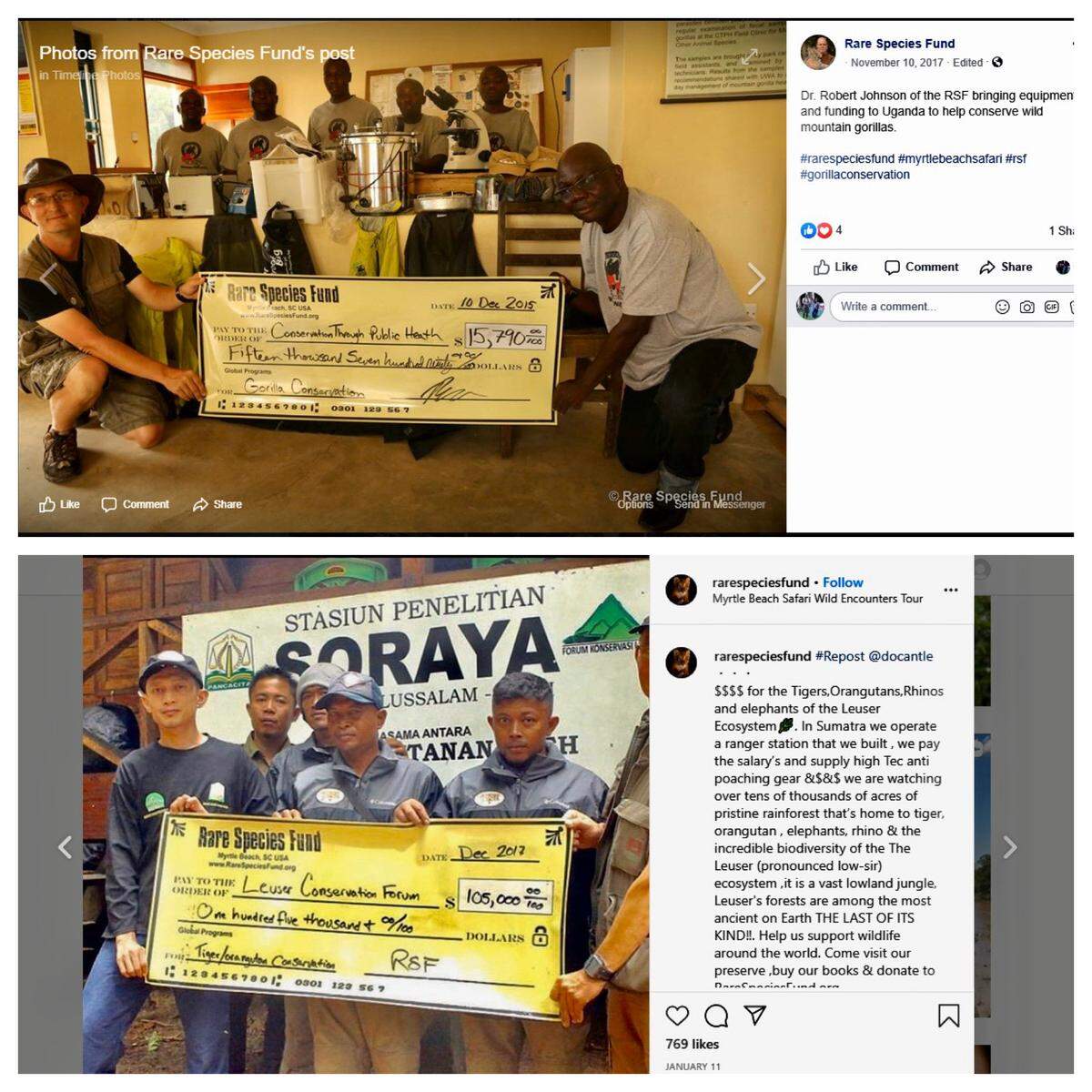
The website doesn’t appear to list amounts of money given to specific organizations, but a review of the organization’s social media pages found images of oversized checks given to Conservation Through Public Health in Uganda in December 2015 and Leuser Conservation Forum in Sumatra in December 2017. But the amounts don’t match up with what’s reported in the nonprofit’s annual reports.
The check for the Uganda organization shows $15,790, while the Rare Species Fund’s report shows no money granted to foreign organizations in 2015, and the check for the Sumatra organization shows $105,000, while less than $35,000 was reported as given to foreign organizations in 2017.
Neither organization responded to requests for interviews.
Antle, reached by phone Friday morning, chided The Sun News for attempting to contact those organizations because he perceived those attempts as “trying to poke a hole in the situation.”
“It just seems that what you’re doing is not necessarily an investigation,” he said. “You seem to be turning it into an assassination of a project that you don’t even understand the product.”
He said he donates a lot of money personally to organizations, and it doesn’t have to go through the nonprofit.
“It’s my money and I take my money, by the millions and millions of dollars, over decades of time and I help other wildlife organizations to flourish,” Antle said.
He spoke for about 10 minutes, primarily about how animal rights activists would overwhelm organizations with negative emails if he disclosed his relationship with them, before stating he had to take another call and advised The Sun News to call later that afternoon. He hasn’t responded to multiple voicemail messages since.
Myrtle Beach Safari has received recognition from the Zoological Association of America for its support of those organizations in 2017 and 2018.
The ZAA is the second largest accreditor of zoos in the country behind the Association of Zoos and Aquariums, with the primary difference between the two organizations being that the ZAA supports private ownership of exotic animals, while the AZA does not.
Myrtle Beach Safari was accredited by the ZAA as recently as last September, according to archived screenshots of the association’s website, but they did not renew their membership, according to John Seyjagat, their executive director.
Seyjagat said he couldn’t disclose any additional information about their membership, but added that they deserve to be recognized for their conservation work despite anything negative shown in the docuseries.
Antle’s blog specifically touts his support of the Leuser Conservation Forum, financing the rebuilding of an outpost called Soraya Station to help reduce poaching and illegal logging in the area, which serves as a natural habitat for endangered tigers, orangutans, rhinos, elephants and bears.
‘Token effort’?
Dr. John Goodrich, chief scientist and tiger program director for Panthera, one of the nation’s largest conservation nonprofits that’s devoted to preserving wild cats in their natural ecosystems, said he had never heard of Rare Species Fund before an email from The Sun News, despite the organization claiming on its website to be “among the world’s most effective conservation agencies.”
“If they were significant, they’d be on our radar, and if they were making a difference in conservation, they would be on our radar, we’d be discussing collaboration,” Goodrich said.
Looking at their website, Goodrich said he was struck by the fact that there was no explanation for how to apply for grants or calls for proposal.
“Looks to me like what we call greenwashing, when a company tries to do a little bit to give them a green name or make it look like they’re doing something for conservation or protection of the environment, but it’s a token effort,” he said.
Antle said he donates to small, private organizations that are “in the trenches” and “do the real work,” so he has no interest in donating to larger conservation groups that would then decide how to spend the money.
He added that Rare Species Fund doesn’t run fundraising campaigns, but rather the income is primarily created by operating Myrtle Beach Safari.
The annual reports show almost all of the revenue is contributed by South Carolina Conservation Farm LLC, with an address listed as the same as Antle’s Myrtle Beach facility.
The company is registered in South Carolina under David G. Lewis, a Conway area accountant, who is also the listed agent for T.I.G.E.R.S. LLC and International Wildlife Conservation and Education Coalition LLC.
Lewis, who is also listed as the preparer for the Rare Species Fund’s annual reports, did not return a message left at his office.
Goodrich agreed with Antle’s argument that getting people emotionally involved with the wildlife can lead to stronger interest in conservation, but he doesn’t necessarily believe facilities that allow hands-on interaction with those animals is the right way to promote that interest.
Panthera’s conservation efforts focus on reducing habitat loss, poaching and human-cat conflict, which Goodrich said are the three primary threats to tigers, and that message was notably absent from the Netflix docuseries.
“In fact, I saw some evidence of a grave misunderstanding of conservation,” he said, pointing to Tim Stark, one of the exotic animal owners in the show, claiming that the best way to conserve tigers is to breed more of them.
Breeding programs
The tigers produced by the breeders in “Tiger King” hold no value to conservation, Goodrich said, as no captive-bred tiger has ever been introduced into the wild, and the hope is to never get to the point when that would be needed.
He did say that some AZA-accredited zoos participate in the Species Survival Program, which carefully controls and monitors the animals’ genetics to prevent inbreeding and crossbreeding, which would allow, in theory, for those tigers to be successfully released into the wild if needed.
That program’s philosophy stands in stark contrast to the breeding program Antle participates in, called the Species Survival Trust, of which Goodrich said he has never heard.
In an Instagram post denying accusations from the series that he euthanizes tiger cubs, Antle wrote that all their cubs are part of that breeding program, which is designed to create a genetic backup for wild tiger populations.
The Species Survival Trust’s website states that the breeding plan’s primary goal is maintaining healthy tiger populations, also emphasizing a reduction of inbreeding and preserving genetic diversity. The website details criticism of the AZA’s breeding program for seeking to eliminate variants that don’t have the “classic” tiger appearance.
The website does not list any participants in the program, names of individuals involved in monitoring it or even a way to contact them, but a reverse domain name search found that the website was registered by Bhagavan Antle.
Domain names and social media use
The search found dozens of domain names registered by Antle, including his nonprofit’s website, a website for the International Wildlife Conservation and Education Coalition and a website that explains the differences and similarities between the ZAA and AZA.
Antle also appears to have registered multiple domain names aimed at countering Carole Baskin, an animal rights activist and owner of Big Cat Rescue in Florida, who is heavily featured in the docuseries.
The series’ main subject Joseph Maldonado-Passage, better known as Joe Exotic, feuded with Baskin for years before being sentenced to 22 years in prison for charges that included attempting to hire people to murder Baskin.
Domain names registered to Antle include bigcatrescuewatch.org, stopbcrwatch.org and 911animalabuselies.org — seemingly to counter Baskin’s 911 Animal Abuse site that criticizes exotic animal owners including Antle — though none are currently active.
Antle has stated he believes Baskin killed her ex-husband, a subplot that the docuseries explores, and he even recently posted a video on Instagram of his staff shouting “Happy Easter, Carole did it!”
On his Instagram post about the Species Survival Trust, Antle specifically mentions that it’s done in coordination with Brian Davis, a research assistant professor of genomics at Texas A&M University.
Davis did not respond to requests for an interview, but he has been defending Antle on his Facebook page, which features a photo of Davis sitting next to Johnson, who works with Antle, and a giant liger, which is a lion-tiger crossbreed.
“I’m defending Doc against the lies that he kills cubs when they get too large,” he wrote in a Facebook comment, noting he’s spent hundreds of hours behind the scenes at Myrtle Beach Safari. “The cubs all have names. They all have IDs. They all live behind the scenes, or at other facilities except in the cases of infirmity.”
Davis notes in a separate comment that he set up a genetic registry for exotic cats to allow the community to self-police and shut up animal rights groups. That registry appears to be called the Exotic Genome Repository, which he founded in 2014, according to its website.
Multiple documents on the website feature the logo of the National Institute of Health, seeming to lend credence to the project, but Sarah Bates, a spokeswoman for NIH’s National Human Genome Research Institute, told The Sun News they have no affiliation with the project, though one of its co-founders previously worked in one of their labs.
Correction: An earlier version of this story misidentified Dr. Robert Johnson’s fiancee.
This story was originally published April 16, 2020 at 10:24 AM.