Myrtle Beach businesses know people are tired of masks, but COVID is raging – again
Murrells Inlet Veterinary Hospital gets that no one wants to wear masks anymore. Its employees don’t either.
But COVID-19 hasn’t gone anywhere, so neither are masks inside of its clinic.
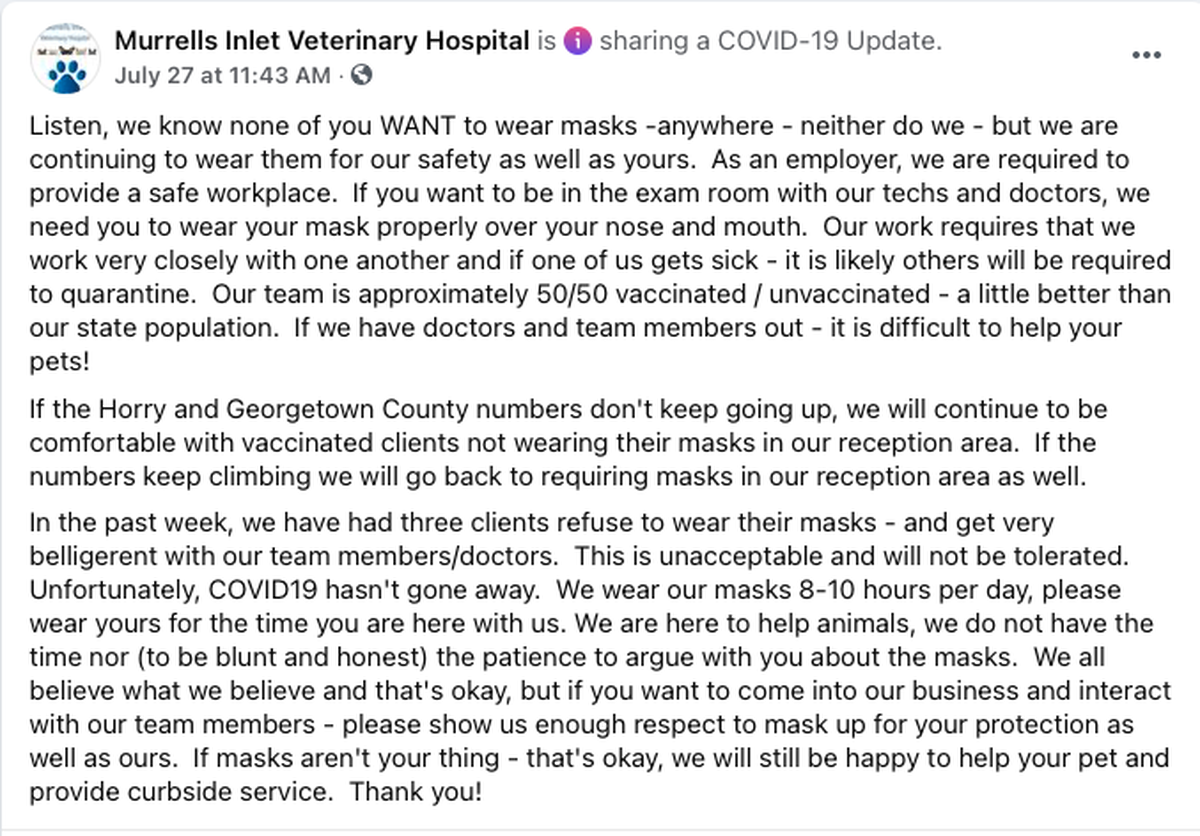
“We are here to help animals, we do not have the time nor (to be blunt and honest) the patience to argue with you about the masks,” the animal hospital wrote in a Facebook post.
The hospital, which could not be reached for comment, detailed its mask requirements in a lengthy post on July 27. All employees and customers now have to keep masks on at all times due to the recent spike in coronavirus cases. The veterinary hospital, like many businesses, is again grappling with how and when to require masks inside its doors, but also with the even more difficult part — enforcement.
“Listen, we know none of you WANT to wear masks -anywhere - neither do we - but we are continuing to wear them for our safety as well as yours,” the hospital wrote in its post. “As an employer, we are required to provide a safe workplace. If you want to be in the exam room with our techs and doctors, we need you to wear your mask properly over your nose and mouth. Our work requires that we work very closely with one another and if one of us gets sick - it is likely others will be required to quarantine.”
Yet despite having a clear mask policy, the hospital said it has been berated by clients who refuse to wear masks. It said in the week prior to the post, three people refused to wear their masks and became belligerent with hospital staff when asked to put one on.
“This is unacceptable and will not be tolerated. Unfortunately, COVID19 hasn’t gone away. We wear our masks 8-10 hours per day, please wear yours for the time you are here with us,” the hospital said. “We all believe what we believe and that’s okay, but if you want to come into our business and interact with our team members - please show us enough respect to mask up for your protection as well as ours.”
Government mandates disappear
The hospital’s experience with struggling to enforce its mask policy is anything but unique. As the pandemic has worn on for 16 months, masks have become a cultural flash point. The Federal Aviation Administration has seen more violent incidents reported on flights in the U.S. than ever before, with the vast majority of them related to a passenger’s refusal to wear masks on airlines. There’s no shortage of viral videos of customers yelling at retail and restaurant workers over mask-wearing policies.
The issue isn’t one that started a few months ago, it’s gone on for the entire last year. Businesses, particularly their employees, were often the ones enforcing mask wearing, not the state and local governments requiring masks.
Back then, however, those businesses could hide behind government mandates. In much of South Carolina, that’s no longer the case. The University of South Carolina’s attempt on July 31 to reinstate a mask policy inside all buildings was short-lived following a warning from state Attorney General Alan Wilson on Monday, Aug. 2. But two days later, the Republican majority leader of the state Senate rebuked Wilson, giving room for a possible revival of the mask rule.
An executive order from Gov. Henry McMaster in June also appeared to bar local governments from requiring masks through a state of emergency. However, his office has recently changed its stance, stating that local governments could do so if it is within the bounds of their “any authority they may have as local officials.”
McMaster has reiterated time and again that mask wearing should be an individual decision made by businesses or customers, not one handed down by the government.
This week, the conversation about mask mandates has turned into a public fight between McMaster and his own capitol city, Columbia, which plans to require masks in schools.
Leaders in Horry County said Wednesday they don’t have any plans to bring back mask mandates. Several Grand Strand cities have also declined to reinstate mask protocols, with some citing that it’s a personal responsibility and has not been a topic of discussion in city governments. Without these mandates, USC tourism professor Robin DiPietro said that it becomes much harder for businesses to enforce mask wearing because they no longer have the government to blame as a sort of protectionary scapegoat. Businesses can say it’s not themselves requiring masks — it’s the government.
“If I’m a business that wants to mandate masks, I know that I’m going to have to be alone out there,” said DiPietro, the director of USC’s School of Hotel, Restaurant and Tourism Management and International Institute for Foodservice Research and Education. Without a higher entity to blame, “Business owners are going to have to be stronger and really stand by their convictions.”
If anything, DiPietro said, a fan of limited government, she would rather require masks as a private business owner than have a government mandate. Anyone with similar beliefs should think of the issue the same way, she said.
Drew Terrranova, a Coastal Carolina University psychology professor, agreed, though he admitted that government mandates don’t always help. Despite the longstanding mask mandate in airports, hundreds of people passing through the Myrtle Beach International Airport in recent weeks have done so maskless, including airport employees and Horry County Police officers.
Advice for businesses
DiPietro and Terranova both said that trying to require masks again isn’t going to be easy, and it will be much harder than when mask mandates first went into place last spring and summer. But that doesn’t mean it will be impossible.
Mask requirements are already becoming more common. The Myrtle Beach Area Chamber of Commerce, in an email to members Wednesday, said it is now requiring all of its staff to wear masks and that anyone visiting its building wear a mask and social distance in all areas, regardless of vaccination status. In Columbia, one restaurant started requiring masks again this week while two others now require proof of vaccination for dining in.
Doug OFlaherty, the vice president of operations for the S.C. Restaurant and Lodging Association, said mask rules start from a point of safety. The health of employees and customers is “paramount,” he said, because a business can’t function without one or the other.
“We’re already in a tight labor market as it is right now,” OFlaherty said. “Your employees have to feel safe, and they have to feel safe coming to work if you want them to come to work. You can’t operate without employees.”
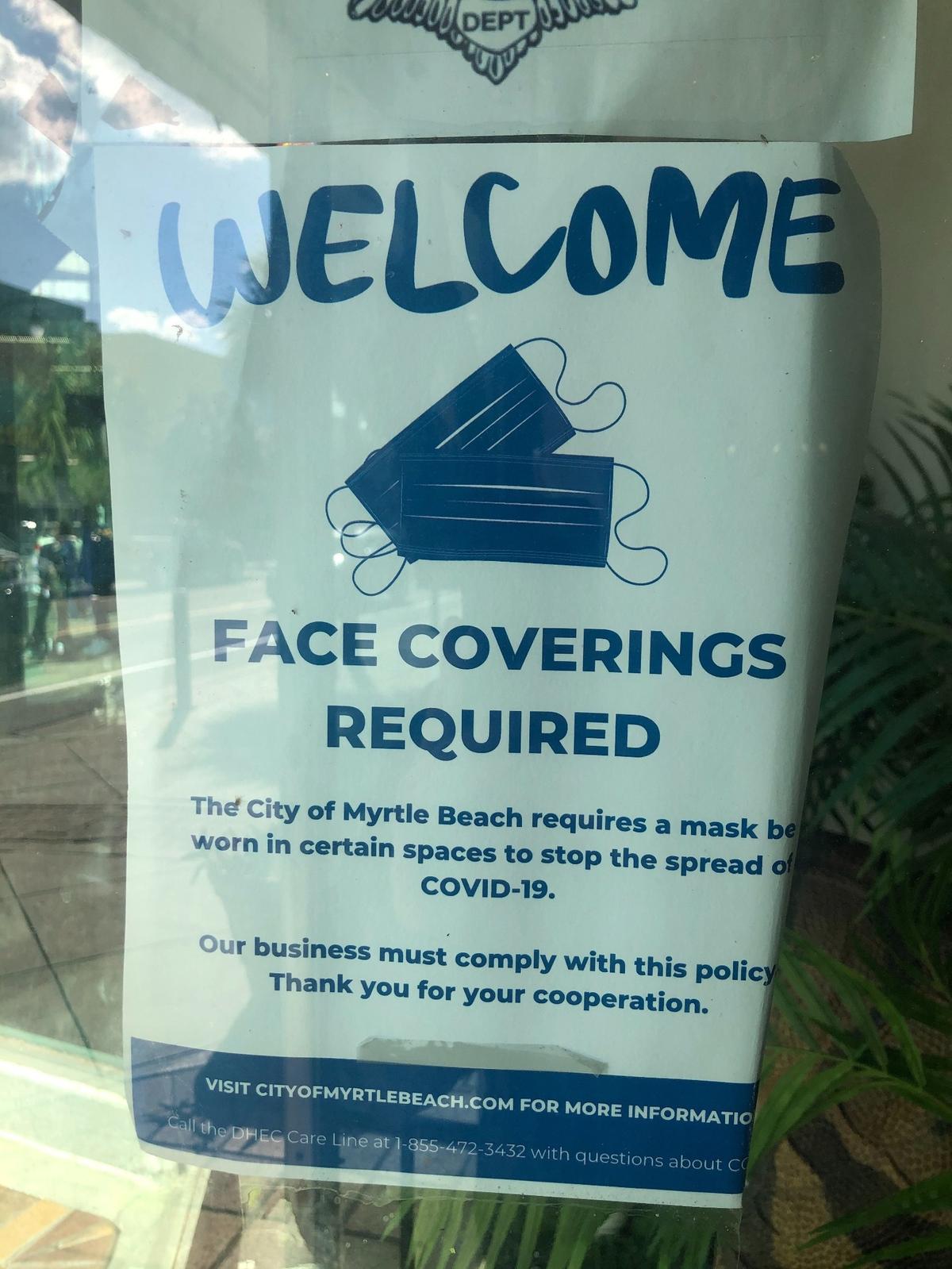
Terranova said it’s important for businesses to start by reminding people of their mask rules from the second they walk in the door with signs, free masks by the door and reminders from employees. Businesses have to also practice what they preach, DiPietro said. Every employee inside needs to be wearing a mask if there is any expectation of customers doing the same.
Businesses should also work with their employees to remind them of how to handle angry customers in these situations. Terranova and DiPietro said it’s important to not browbeat customers. Be as kind as possible, and if someone says they don’t have a mask, have some at the ready to offer them. As soon as a customer gets defensive, the chances of them listening to your request they put on a mask drop significantly.
“It’s better not to take sort of a direct approach where you’re trying to change their mind and prove them wrong and instead try to encourage them to just do it for everybody else’s safety,” Terranova said. “Say, ‘Wouldn’t it be better to do everything we can, even if some of it is ineffective, than to take the chance of harming vulnerable individuals,’ taking that sort of approach where you don’t attack the person or their belief system.”
At the same time, businesses need to make sure they have empathy for their employees, many of whom have been on front lines of mask enforcement for much of the last year.
“They’re overstressed, overworked, usually underpaid, and now they’re having to deal with customers who are going to potentially be belligerent,” DiPietro said. “And it’s really above their pay grade to have to deal with people that are so angry.”
Hope for the future
For businesses and employees who are exhausted after the last year, and exhausted by maskless and belligerent customers, Terranova said it’s important to remember that there’s more in life.
Talking with each other, with coworkers, is an important tool for coping through these times, because it serves as a reminder that you’re not alone, Terranova said.
“Oftentimes you get hung up on the negative customers, complaints and the negative experiences,” Terranova said. “But step back and think of all the people you helped ... It’s just those few that seem to be upset.”
And while some angry customers might threaten to never come back to a business, DiPietro said that’s highly unlikely. Some might decide to do business elsewhere, but not enough to kill a business. She saw this herself back in the 1980s, when businesses and governments started to ban smoking. She said it was a terrible experience to go through as the manager of a fast-food restaurant.
“It was amazing because we had this fear of all of a sudden being slow and dead and it didn’t happen. They learned that they needed to smoke outside,” DiPietro said. For example, “People need to realize it is a luxury to go out to eat. We didn’t used to go out to eat as often as we do now. Having that luxury requires a small price to pay, and right now it might be wearing masks.”
Any business has the right to turn away customers for almost any reason in America’s economy. And refusing to wear a mask doesn’t qualify as discrimination.
Murrells Inlet Veterinary Hospital said it is doing everything it can to make clients happy and meet everyone’s needs. It’s not turning away maskless customers entirely. The hospital offers curbside service to those who would prefer that. But the business’ plea for help makes DiPietro wish that Americans, and South Carolinians, could “all be more human with each other.” The pandemic has been a crushing burden and killed millions of people around the globe, being cruel to one another, and the businesses in our communities, doesn’t help anyone.
“I hope a year from now ... we’ll say, ‘Hasn’t it been nice the last eight to 12 months that we haven’t had to wear a mask everywhere?’” DiPietro said. “But we’re still in a tricky time. I think a lot of people think we’re out of the pandemic, and I don’t feel like we’re done yet.”
This story was originally published August 6, 2021 at 6:30 AM.