Coronavirus by the numbers: DHEC labels Horry County a ‘hot spot’ after cases spike
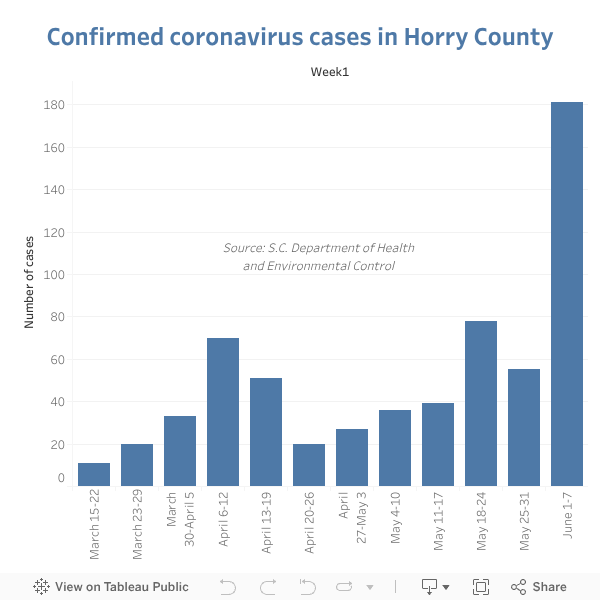
Horry County had a large spike last week in confirmed coronavirus cases, likely aided by a combination of increased testing availability and businesses being allowed to reopen.
There were 181 confirmed COVID-19 cases June 1-7 in Horry County, more than twice as many as any week since South Carolina began collecting data in early March, according to the S.C. Department of Health and Environmental Control, which also reported a new daily high of 61 local cases Monday.
DHEC also reported six patients last week in Horry with the virus who died, another weekly high.
The county has continuously ranked near the bottom in the state in terms of confirmed cases based on population size, but DHEC now considers Horry County a “hot spot” for the virus, meaning it’s being targeted for increased monitoring, according to Dr. Brannon Traxler, a DHEC physician consultant.
State officials warned in early May that total case numbers would likely rise as they set goals to aggressively increase testing availability, but the increased testing was projected to result in a lower percentage of those testing positive, and that hasn’t happened.
A chart on DHEC’s website shows that the percent positive among those tested has been steadily increasing — with various peaks and valleys — since early May, with daily positive rates as high 9.2 percent on Friday.
It’s unknown whether that rate is increasing specifically in Horry County because DHEC does not track testing by county.
Traxler said it’s become clear that more and more residents aren’t following DHEC and Centers for Disease Control and Prevention guidelines regarding social distancing and wearing a mask while in public.
Testing and reopening
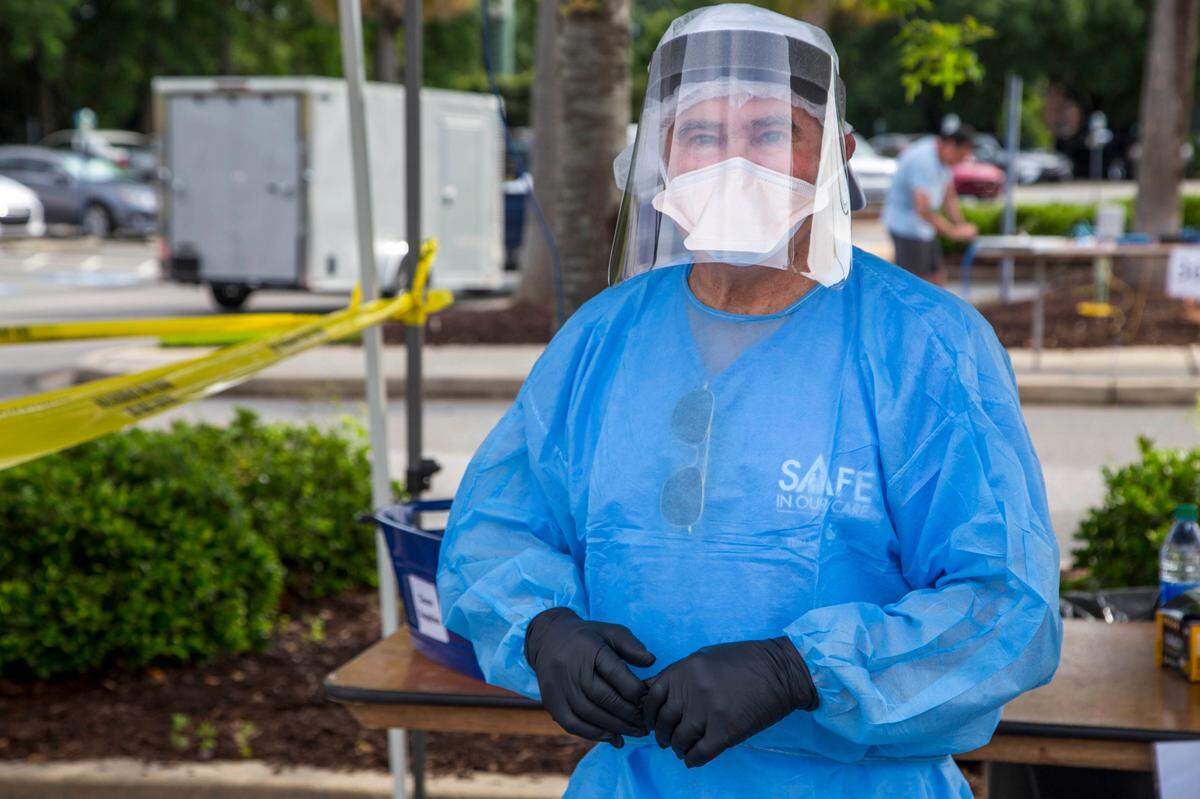
A major part of the increased testing statewide has been free pop-up testing clinics, and the first one locally was hosted by Tidelands Health May 30 at TicketReturn.com Stadium at Pelicans Ballpark in Myrtle Beach, where more than 1,000 were reportedly tested.
But that clinic doesn’t appear to be the primary cause for the local spike, as Tidelands has administered 2,613 tests since May 25, with 78 of those testing positive, representing a positive rate below 3 percent, according to data provided by Tidelands spokeswoman Dawn Bryant, who noted those figures also include numbers from two free testing clinics held last Thursday and Friday.
Dr. Gerald Harmon, vice president of medical affairs at Tidelands, said these testing clinics have been important because the medical community needs access to reliable data to help make recommendations to leaders in choosing the best path forward. This virus is particularly scary, he noted, because up to one-third of patients testing positive are asymptomatic.
Harmon, who was recently selected as president-elect of the American Medical Association, emphasized that people still need to take this virus seriously and the longer people ignore medical guidelines about social distancing and wearing face masks, the longer it’s going to take to return to normalcy.
No other local healthcare providers have hosted free testing clinics yet, though Conway Medical Center and McLeod Health have similar testing clinics scheduled for this week.
CMC has had 357 coronavirus tests resulted — meaning the tests were administered and results reported — since May 27, with 37 of those testing positive, representing a positive rate of 10.4 percent, according to data provided by CMC spokeswoman Allyson Floyd.
Grand Strand Health has administered 676 tests since May 22, with 51 testing positive, representing a positive rate of 7.5 percent, according to data provided by spokeswoman Katie Maclay.
After lengthy closures ordered by S.C. Gov. Henry McMaster, businesses statewide have been allowed to reopen in recent weeks, including close-contact businesses such as salons and gyms on May 18 and attractions on May 22, just in time for Memorial Day weekend.
Traxler said it’s impossible to say how big of an impact Memorial Day weekend had on Horry County’s recent spike in case numbers, but she admitted the timing does line up.
CMC Chief Medical Officer Dr. Paul Richardson wrote in a statement that they knew the reopenings could potentially lead to an increase in case counts, but the numbers are manageable so far, and they have adequate staffing and personal protective equipment to take care of the community’s needs.
Hospital occupancy
Horry County’s hospital occupancy rate is about 80 percent, which is among the highest in the state, according to DHEC, but Harmon noted that occupancy rates are usually much higher in the summer, often as high as 90 percent during busy tourism months.
Harmon said restrictions and education have done a good job “flattening the curve” so as to not overwhelm the medical community, and he’s actually concerned about patients forgoing doctor visits because a range of other diseases could see increases without regular maintenance.
Tidelands currently has six patients who have tested positive or are waiting on test results, CMC has 12 such patients and Grand Strand Health has seven, according to their respective spokespeople.
Statewide, 507 inpatient hospital beds are currently occupied by patients who have tested positive for coronavirus or are awaiting test results, according to DHEC’s latest news release, and Traxler warned that experts nationwide have found that hospitalizations and deaths typically lag behind by a week or two compared to case counts because patients often get more sick during the second week of showing symptoms.
Broken down by zip code, the highest case numbers through Sunday in Horry County are in 29569, with 131, and 29568, with 78, which represent the Loris and Longs areas, respectively, according to DHEC data.
A sizable chunk of the Loris area cases come from the Loris Rehab and Nursing Center, which has reported 50 COVID-19 cases to DHEC among its residents and 21 cases among its staff, though its unknown how many of the staff members also live in Loris.
Correction: An earlier version of this story incorrectly stated that Dr. Harmon said restrictions and education have not done a good job flattening the curve.
This story was originally published June 8, 2020 at 5:48 PM.