
Grand Strand Fishing Report: It’s nearing prime time in the ocean, freshwater rebounding
Estuary
Look For: Flounder, red drum, spotted seatrout, black drum, sheepshead, bluefish, Spanish mackerel.
Comments: While plenty of flounder are available and being caught in Murrells Inlet and the Little River area, the issue is finding keepers. Flounder have a 15-inch minimum size limit in South Carolina waters and the majority of fish encountered have been in the 12-14 inch range. Flounder are closed to harvest in North Carolina waters for recreational anglers, with the 2021 season set for a short stretch from Aug. 16 to Sept. 30. Capt. Dan Connolly of O-Fish-Al Expeditions has caught numerous flounder in Murrells Inlet this week, but few keepers. “There are lots of flounder, all under-sized,” said Connolly. “(You’d) be lucky to catch two keepers or so out of 20 fish.” Connolly has found a slow bite for redfish and black drum. Capt. Chris Ossman of Fine Catch Fishing Charters has been focusing on the near-shore reefs when possible in his new 248 Sea Pro, but has worked the waterways around Little River some this week. “Lot of short flounder,” said Ossman. “I came in after being on the reef Tuesday, and we caught five short flounder in an hour. There are a few big ones around (near) shell flats around creek mouths. There are some nice reds in the (Intracoastal) Waterway channel. We’re catching a few trout on shell banks and in some of the bigger creeks on mud minnows.” Capt. Mike McDonald of Gul-R-Boy Guide Service targeted bull red drum on Wednesday, using live menhaden in the 3-4 inch range for bait in Winyah Bay. McDonald’s crew caught several, as he calls them, channel bass,with most measuring around 40 inches plus one 44-inch fish. In general, conditions are just now getting right for late spring fishing in the bay, McDonald said. “The water is just getting to where the fish are starting to bite,” said McDonald. “This (cooler) weather and then all the fresh water we’ve had has things messed up.” McDonald noted a water temperature of 73, down from a previous reading of 76 before last week’s cool spell.
Inshore
Look For: Spanish mackerel, bluefish, king mackerel, spadefish, cobia, weakfish, flounder, black drum, whiting, pompano.
Comments: With late May and warmer weather finally arriving, it’s getting to be prime time for spadefish and cobia along with king mackerel on the near-shore reefs. Spanish mackerel made the scene over a month ago. “Fishing some of the near-shore reefs, we caught some spadefish on the wreck on jelly balls,” said Ossman. “I had to start chumming them with smaller pieces of jelly ball to get them to bite. For once, there were plenty of jelly balls (available) when the spadefish are around.” Ossman’s crew caught five sizable spadefish in the 18-20 inch range. Ossman also targeted flounder on the reefs using live menhaden (pogys) and had a cobia encounter. “We caught a 27-inch juvenile cobia while flounder fishing with live 4-5 inch pogys,” said Ossman, who produced five keeper flounder including a 24-inch doormat. “Using a bigger bait out there gets you on a better class of fish,” said Ossman. “Those 14-15 inchers will eat a 4-inch pogy in a heartbeat too.” On a reef about 10 miles offshore, Ossman noted lots of activity. “There are tons of cigar minnows, herring, there’s so much life out there,” said Ossman. “Cobia should be thick any day now. It’s almost prime time - very soon now for cobia.” King mackerel are available at their typical warm-weather spots such as Belky Bear and The Jungle, with some fish also showing up near the beach. “King mackerel fishing is getting into its standard pattern as we are seeing school-size kings in abundance in the 50-70 foot depth range,” said Capt. Brant McMullan of Ocean Isle Fishing Center. Spanish mackerel can be found around the near-shore reefs, inlet passes and along the beach. “Spanish mackerel fishing has been exceptional along the beach front in 15-25 feet of water in particular near the schools of menhaden,” said McMullan. Catches of Spanish mackerel have also been very good off Apache Pier. “They’ve been knocking the heck out of Spanish out there,” said Norma Madaras of the pier. Madaras also reports bluefish, whiting and croaker have been caught by pier anglers, but no king mackerel have been landed yet. The Apache Pier is staging a one-day king mackerel tournament Saturday. On the south end, a persistent northeast wind has stirred up murky water along the beach and put a damper on Spanish fishing. “All this northeast wind just shut the Spanish bite down,” said Joe Nelligan, a regular angler on The Pier at Garden City. “Two weeks ago we were catching them really well.” Nelligan said whiting have been the main catch at the pier this week. When the water clears up, look for the Spanish action to pick back up at The Pier at Garden City. The ocean water temperature Wednesday was 75 degrees at Apache Pier.
Offshore
Look For: Dolphin, blackfin tuna, yellowfin tuna, wahoo, king mackerel, grouper, red snapper, amberjack, cobia, vermilion snapper, triggerfish, porgy, grunts, black sea bass.
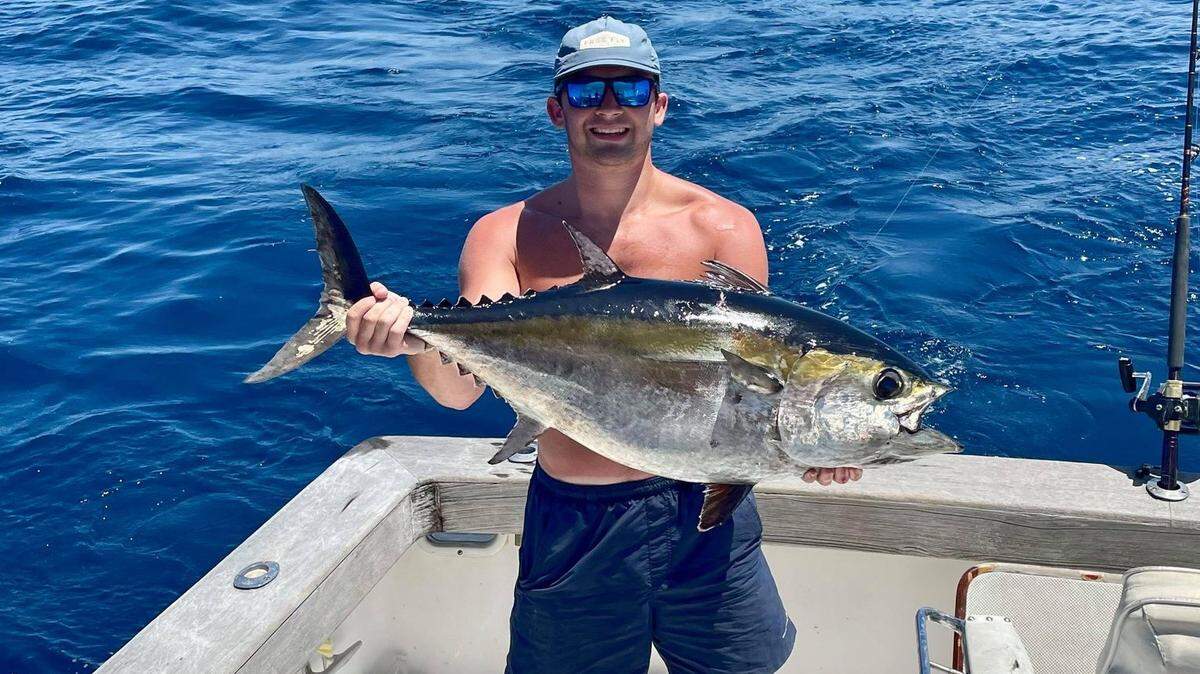
Comments: The persistent wind has been a detriment to anglers eager to get offshore for superb late spring trolling action, but there are plenty of fish to be caught when conditions allow. Spring action for dolphin is reaching a peak, schools of blackfin plus yellowfin tuna are around and scattered wahoo are on the prowl. Then you have billfish action ramping up, as May and June are the top months for blue marlin encounters off the South Carolina coast. “In the Gulf Stream (dolphin) fishing will continue to be very good for the next few weeks,” said McMullan. “(Then they) will scatter inshore to depths of around 100 feet but the majority of the fish will be deeper, in particular offshore of the 100-fathom curve in the core of the Gulf Stream where the main migration occurs. There will be scattered wahoo and blackfin tuna that will continue (to be found) along the edge of the break as well.” The crew of Sea-Batical found a window of opportunity earlier this week and worked the vicinity of the Georgetown Hole. Sea-Batical, out of Murrells Inlet, came home with 18 tuna and two dolphin, with the hottest lure a green/yellow alien. Two of the tuna were yellowfin in the 25-30 pound range and one blackfin was a monster, approaching 40 pounds. The South Carolina state record blackfin tuna is a 40-pound, six-ounce specimen caught in 2005 out of Charleston. Bottom, or reef, fishing is also excellent as spring transitions into summer. Aside from the typical reef fish such as vermilion snapper, black sea bass, grey triggerfish, red porgy and white grunts, there are plenty of big bruisers to be caught. Grouper season opened on May 1 and continues through the rest of the year, plus May is a prime month to find cobia roaming the ledges and hard bottom areas. Then there are amberjack, known as reef donkeys, and the restricted red snapper, which certainly aren’t difficult to find despite an ongoing ban on harvesting the species in the South Atlantic Region. “The supposedly extinct red snapper are so abundant that they will eat any bait intended for a grouper before it can get to them,” said McMullan. “However, the federal government remains firm with their red snapper regulations for a zero catch allowance and thus (they) must all be released.” Murrells Inlet Fishing Charters produced the bruiser of the week, an 86-pound amberjack.
Freshwater
Look For: Bream, catfish, bass, crappie.
Comments: Local rivers have been plagued by consistently high levels over the last several years, leaving residents dealing with flooding and anglers wishing for some sense of normalcy and better fishing conditions. The rivers are currently at their lowest levels in, well, seemingly forever, and the fishing reflects that. “Finally all of them are in phenomenal shape, it’s the best it’s been in years,” said Ronald “Catfish” Stalvey of Stalvey’s Bait and Tackle in Conway. “Everywhere is doing good right now, the Waccamaw, the Little Pee Dee, Big Pee Dee, Black, Santee. The fishing is phenomenal everywhere right now.” Bream are in summertime mode, hitting crickets and worms in depths of 2-4 feet along the bank. Bream have been spending plenty of time in the woods out of reach of anglers thanks to the constant high water levels, and the size of the fish is superb. “They’re catching some of the biggest bream they’ve ever caught,” said Stalvey. Catfish action has also been excellent with fish hitting a variety of baits including cut eel, large shiners and large bream. “You can focus on from a foot to 50 feet of water (for catfish),” said Stalvey. “(They) are going to move up shallow targeting food sources. A lot of the bigger fish have been caught shallower.” The spring spawn is fading away for bass, but some quality fish are being caught. Mike Harrelson of Conway won Stalvey’s weekly bass tournament held Tuesday out of Conway Marina with a bass weighing just under four pounds, two ounces.
This story was originally published May 20, 2021 at 1:13 PM.