
A beautiful day on the water and a yellowfin tuna to boot off Murrells Inlet coast
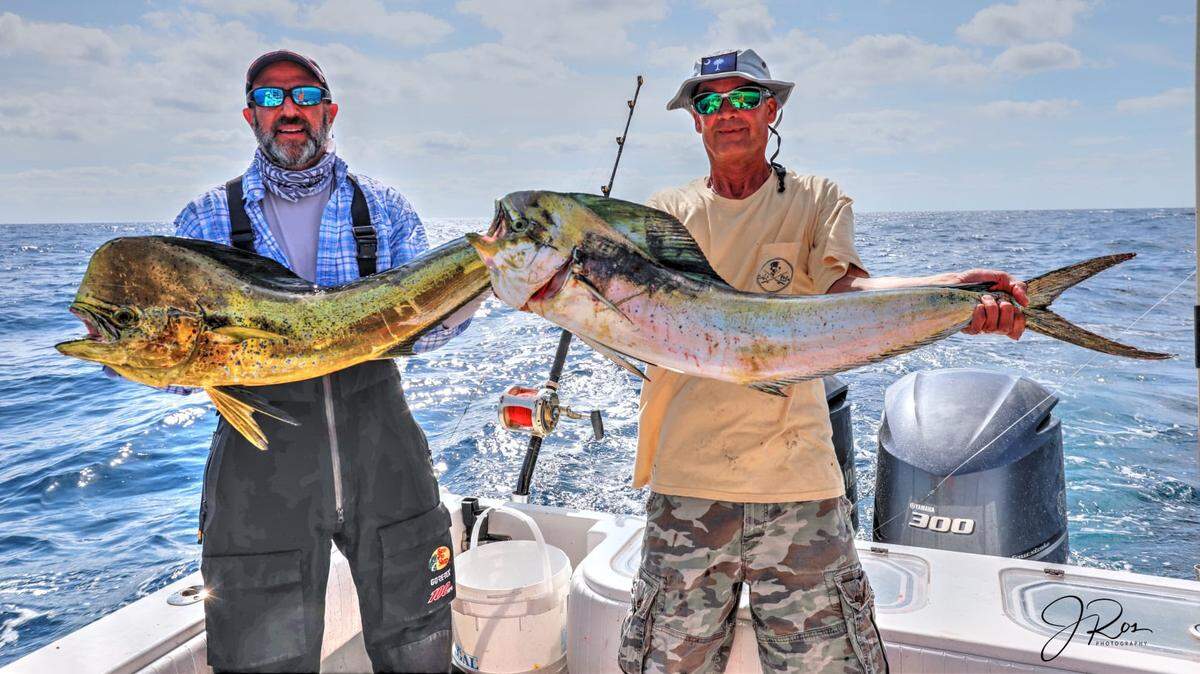
With the calendar reading late April, it was prime time for an offshore trolling edition of Dr. Jason Rosenberg’s “Wednesday Fishing With Friends” escapades.
A moderate south-southwest wind and choppy seas was not enough of a deterrent when a Carolina Slam of wahoo, dolphin and tuna, hopefully yellowfin tuna, is a distinct possibility on the ledges of the Continental Shelf, known as The Break.
Capt. Jay Sconyers, owner of Aces Up Fishing Charters, was at the helm aboard Rosenberg’s 32-foot Contender, Painkiller, and headed to the south-southeast in a choppy, 1-2 foot sea a little after 6 a.m.
Sconyers was only able to run 30 mph, and about two hours later the crew arrived to the area of the Winyah Scarp along The Break, a little over 60 miles from the Murrells Inlet sea buoy.
Also along for the trip were Rosenberg’s son, Zachary Rosenberg, and Damon Loucks of Pawleys Island.
The mood of the Atlantic changed the last 10 miles or so of the trip, and the seas went from choppy to rough. The Gulf Stream clearly had a swirl in the area surrounding the Scarp, and the current turned back toward the southwest, right against the 10-15 knot wind.
The result was choppy 2-4 foot seas tightly stacked, making for a very sloppy ocean. The 72-degree water was a deep blue with scattered patches of sargassum dotting the surface. Despite the rough ride, conditions looked excellent for wahoo, tuna and dolphin.
At about 8:15 a.m., the crew deployed a seven-line trolling spread with a mix of ballyhoo/skirt combos, trolling plugs and a No. 4 planer with a ballyhoo/skirt on the leader down deep.
About 30 minutes later came the first bite, on a ballyhoo/skirt combo at the surface. There was hope the first fish was a wahoo, in this case a small wahoo, or weeho. But five minutes later Sconyers hand-lined a king mackerel in the 12-pound class into the boat.
The next bite also came on a ballyhoo/skirt up top, but this time the fish peeled line off the reel. Multiple anglers battled the strong fish, and 20 minutes later Sconyers boated a yellowfin tuna, to the delight of the crew.
Yellowfin have a minimum size limit of 27 inches in U.S. waters, and Sconyers measured this specimen at 27.5 inches. Into the box it went, where Sconyers bled the fish to optimize the quality of the meat.
About 30 minutes later, things went haywire in the trolling spread. One line snapped out of the outrigger and about the time someone yelled “Fish On” a second line snapped.
Within a moment a dolphin cleared the water over 100 yards behind the stern and the crew knew a double hook-up of dolphin was on, with Rosenberg and Loucks manning the rods.
Despite the anglers best efforts, the sizable dolphin did a dance about 50 yards out and wound up crossing the lines 3-4 times. Sconyers managed to uncross the lines and keep the two fish hooked up.
Soon, after a feisty 15-minute battle, Sconyers had gaffed both dolphin and both fish in the 15-pound class wound up flopping wildly on the deck. After the fish calmed down, they were placed in the below-deck fish box.
Suddenly, all that was missing from the Carolina Slam was a wahoo.
Roughly an hour later, there was a hookup on the bent rod setup with the No. 4 planer, and Sconyers said “There’s our wahoo!”
But a few minutes later, Sconyers released an Atlantic bonito that could have rivaled the state record of 7 pounds, 11 ounces, but two anglers handled the rod.
Soon, the same planer rod bounced sharply and a quick rip of line zipped off the reel. As soon as Sconyers jerked around to tend to the rod, the line went limp.
The entire setup – planer, leader and ballyhoo/skirt – was gone.
Sconyers surmised a wahoo attacked the planer instead of the bait and snapped the entire rig off. The captain shook his head and bemoaned the loss of the shot at what could have been a monster wahoo the rest of the day.
The action was slow for the next few hours, then it was time to head to the hill.
The ride back to the inlet was better with the wind and seas generally at our back, and Sconyers was able to reach the sea buoy in less than two hours.
Yellowfin 101
After nearly 15 years of yellowfin tuna being extremely rare in South Carolina’s offshore waters, the return of the yellowfin is being heralded by Palmetto State anglers.
While the number and size of the fish isn’t ideal, any yellowfin is certainly better than none at all.
Longtime anglers recall that 2005 was the last year a nominal number of yellowfin were landed from South Carolina waters. From 2006 until 2019, virtually no yellowfin tuna were reported landed.
That changed in 2020 when yellowfin once again began showing up at docks along the Carolina coast, and the trend has continued in 2021.
The question is, what has changed for the much-desired species of tuna to begin showing up once again?
Wallace Jenkins, a South Carolina Department of Natural Resources biologist, has extensive experience with highly migratory species such as yellowfin tuna, having served on the U.S. Highly Migratory Species Advisory Panel for the National Marine Fisheries Service/NOAA since 2008.
Jenkins has also been on the U.S. Advisory Panel to the International Commission for the Conservation of Atlantic Tunas as an ex officio member since 2018.
Jenkins has also noticed the trend of improving numbers of yellowfin, but is still clearly concerned with the status of the species.
“U.S. landings from all segments remain less than half of what they were in the 2000’s,” said Jenkins. “(There has been a) slight increase in abundance in the north Atlantic.”
Jenkins attributes the increase in tuna in South Carolina waters to better yellowfin tuna management in the far eastern South Atlantic Ocean, off the west coast of Africa.
“There have been increasing restrictions including closed seasons and Fish Aggregating Devices (FAD) number cap per vessel on the purse seine fishery in the Gulf of Guinea where recruitment overfishing - all ages and stages of maturity being harvested - on yellowfin has been occurring for some time,” said Jenkins.
While yellowfin tuna are governed by the 27-inch minimum size limit in U.S. waters, Jenkins says that still doesn’t enable the species to reach spawning size.
“The U.S. is the only country with a minimum size which is not even at a level to protect juveniles that haven’t had a chance to spawn,” said Jenkins. “Life history data indicates they don’t spawn until they are about 37 inches (in length). So this also plays a role in their population status in the rest of the Atlantic Basin.”