
Having some reel issues as spring fishing approaches? Call Captain Crumb to the rescue
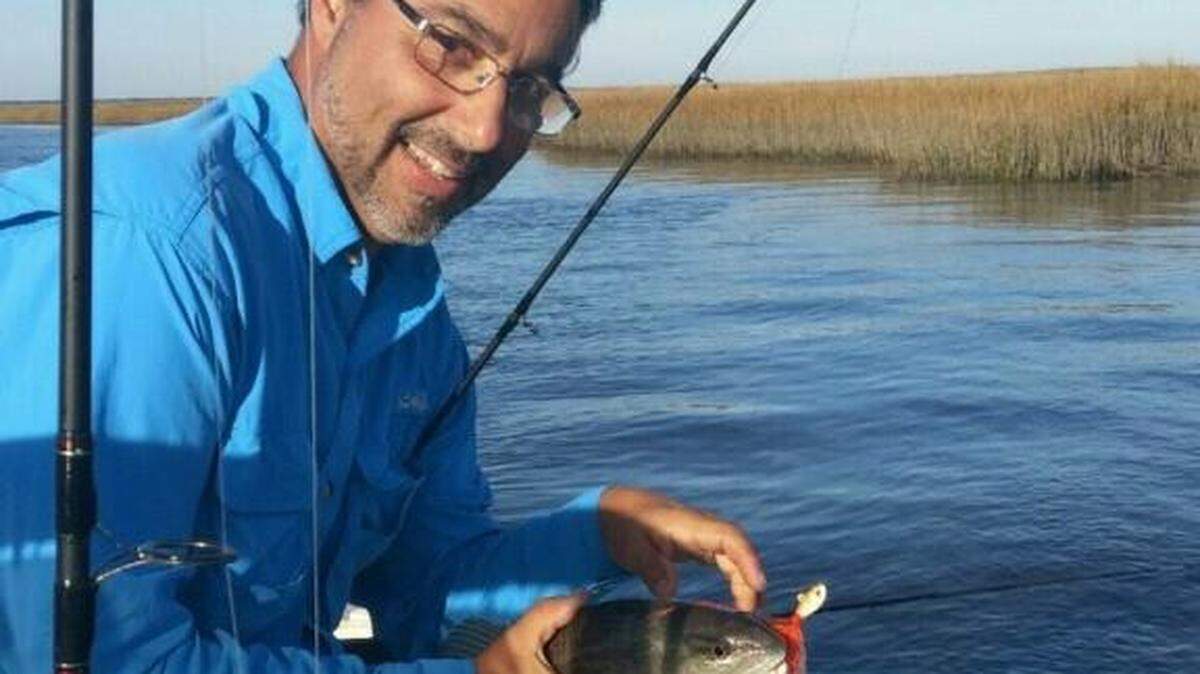
Picture this. The spring fishing season is fast-approaching. Spanish mackerel, pompano and flounder, among other saltwater species, are due to arrive en masse within a few weeks.
You take your rod-and-reel setups out of winter storage to get rigged up, and your favorite spinning reel is stuck, frozen, the handle won’t turn.
The situation isn’t hopeless, and it’s Captain Crumb to the rescue.
Capt. Jerry Condenzio Jr. of Myrtle Beach has earned a sterling reputation as a rod-and-reel maintenance and repairman. Nicknamed Capt. Crumb, Condenzio is a busy guy as winter turns to spring and the fishing season gets rolling. Capt. Crumb has got some advice for reviving that frozen-up reel.
First, don’t turn the reel handle to try to unlock the reel.
“When the reels do lock up if they force it (by turning the reel handle), they usually ruin the bearings and gearings,” said Condenzio.
In such a case, Condenzio recommends his simple go-to product for neutralizing and breaking down the corrosion that is such an issue for boats and fishing tackle used in saltwater – regular white vinegar.
“Submerge the whole reel in white vinegar to help unlock it,” said Condenzio. “But at that point, now you’ve got saltwater infused into the grease. It turns it into a glue. It does then have to be disassembled and then re-greased. The corrosion factor is always going to be there. The further south you go the more corrosive the saltwater gets.”
Condenzio can save reels from even the most extreme cases of saltwater intrusion – including a reel that spent about a month on the bottom of Murrells Inlet.
“(A customer) lost a reel off his dock throwing a castnet and there was actually growth on the reel,” said Condenzio. “He eventually found it and brought it to me, a Penn. I got it back to normal.”
Condenzio operated Capt. Crumb’s Outpost on 3rd Ave. South in Myrtle Beach for five years, selling bait and tackle along with offering his rod and reel repair service but was forced to close the business. He also offers charter fishing trips, mainly out of Murrells Inlet and Georgetown.
“COVID and the fact we couldn’t get a lot of product,” said Condenzio, regarding the closing of the business. “It pretty much buried us, especially a small business. Even sinkers were hard to come by. Now I’m doing fishing charters, rod and reel repair, and boat maintenance.”
Back to reel maintenance, most anglers have a ritual of dousing their reels with regular water from a hose after a fishing trip, thinking that resolves the saltwater and corrosion issue. Not so fast, says Condenzio.
“The city water has certain metals in it, and chlorine,” said Condenzio. “It has the same corrosive value that saltwater does. If you hit them with straight-up tap water, and then you hang them up, all kinds of corrosion gets pushed into the reel.
“When I get back in from a charter at the end of the day, and back (the boat) into the driveway or into the slip, I take a spray bottle with straight white vinegar you get off the shelves from Dollar General, Walmart, anywhere,” said Condenzio. “I’ll spritz everything, all my rods, maybe a light rinse with the hose. As far as the white vinegar is concerned, you can use that on everything in your boat because it blocks the salt, crystals the salt and turns it into a powder. It doesn’t have any properties that corrode the metal and the chromes.”
Condenzio has some tips for winter reel storage.
“When you’re storing them for the winter, back off the drags, take all your lures and hooks off the guides,” said Condenzio. “Coat the whole outside of the reel with a nice coat of silicon. Reel Magic is a good one, you can even spray your braided line with it and it won’t discolor the braid.”
And don’t forget about reel maintenance during the fishing season.
“You should break them down, take them apart, at least twice a year and soak them,” said Condenzio. “Take everything apart and soak them. It’s a learning curve (to take reels apart). It does pay to have a professional do it who has done it for a long time because he can see problems you wouldn’t see.”
Terrell’s Tautog
What started out as a forgettable day turned into a very memorable one for Capt. Jay Sconyers and 15-year-old angler Malachi Terrell of Indiana.
Sconyers, owner/operator of Aces Up Fishing out of Murrells Inlet, had planned to take Terrell and crew offshore bottom-fishing on the March 6 trip but the weather didn’t allow it.
“It was probably blowing 25 knots out of the northeast – it was horrible,” said Sconyers.
Sconyers opted for a near-shore reef – North Inlet Reef – to target black drum, sheepshead, black sea bass and perhaps that winter-time visitor from the north – tautog.
Using fiddler crabs for bait, Terrell had a good fish on and Sconyers quickly knew just how good when he saw a sizable tautog appear at the surface beside the boat.
On trips in previous years, Sconyers had produced tautog that would have possibly qualified as a state record but the captain hooked both of those fish and handed the rod to his customers. Suffice to say, Sconyers knows what a quality tautog looks like.
“I knew it was a state record as soon as I saw it in the water, it was way bigger than the other two,” recalled Sconyers. “I was like, get that net! They have to do it unassisted and this young man did it all himself.”
Sure enough, on certified scales at Seven Seas Seafood in Murrells Inlet, local South Carolina Department of Natural Resources biologist Kris Reynolds recorded a weight of 6.4 pounds for the tautog, which measured 21 inches long. The weight of 6.4 pounds equates to approximately 6 pounds, 7 ounces.
Terrell’s fish weighed nearly a pound more than the current state record tautog of 5 pounds, 8.4 ounces, which was also caught out of Murrells Inlet by Jason C. Williams of Myrtle Beach.
The fish is currently a pending state record, awaiting the governor’s signature.