Golf rounds in the U.S. have surged during the COVID pandemic. Why, and is it sustainable?
* Editors Note: This is one article in a two-story package on the impact of the coronavirus on golf in 2020. The other story can be found here.
The coronavirus pandemic has been debilitating for many businesses and industries across the United States.
For golf, it has spurred a national resurgence.
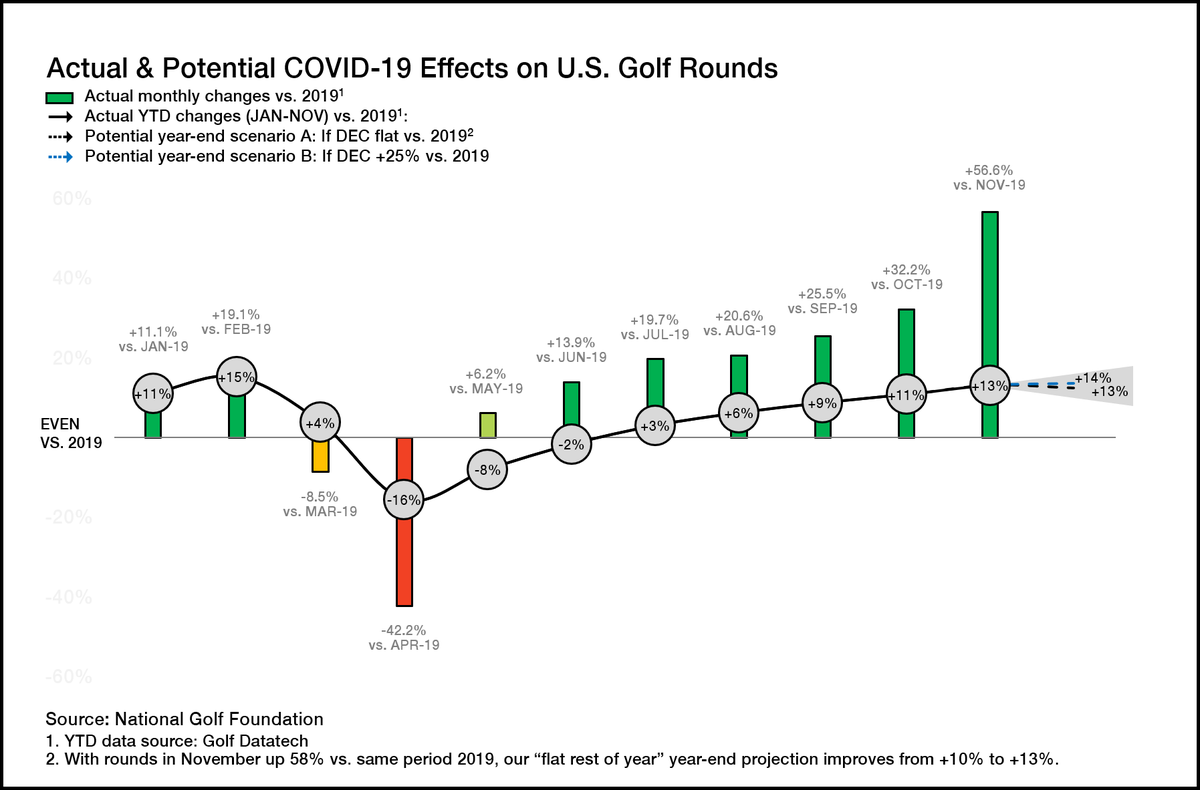
Golf rounds played in the U.S. were up more than 13 percent in 2020 compared to 2019 through November despite the industry losing an estimated 20 million rounds due to coronavirus-related course shutdowns in March and April, when more than half of the 16,000-plus courses in the country were temporarily closed, according to the National Golf Foundation.
And the increase in rounds has been accompanied by record-setting golf retail sales.
After nearly two decades of declines and stagnation, golf enjoyed a renaissance in 2020.
“People’s choices of recreation became so limited so fast, and golf is just perfectly positioned to safely fill the void in outdoor activity and social benefits, so golf really perfectly filled that need at a time when people were going a little bit stir crazy,” said NGF chief business officer Greg Nathan. “. . . So it’s fantastic that golf has benefited from its intrinsic values and some of the things that make it great: being outdoors, using your own equipment, the social aspects with social distancing built in. It’s been very good in that regard.”
Golf fit into the allowances of the coronavirus, including outdoor exercise and inherent social distancing, and largely remained a constant across the country as other activities were limited or forbidden.
With most businesses shutting down around them via government mandates, courses in the Carolinas were never forced to close last year.
“People had the ability to go out and enjoy being outside and being with others and enjoy a passion maybe they hadn’t been able to participate in previously to the degree they were this [past] year,” said Bill Golden, president of the Golf Tourism Solutions marketing and technology agency that promotes the Myrtle Beach market. “I’m excited about golf’s future.”
Industry leaders in the Myrtle Beach market, which is one of the world’s premier golf destinations with nearly 90 courses, including more than 75 public courses, join national leaders in being thankful for the revival and trying to determine how to capitalize on it in the near and long-term future.
“There is pent-up demand that we’ve seen to play golf at a local level in 2020,” Golden said. “When travel restrictions begin to fall away and the vaccine is in place somewhat universally, we feel that same pent-up demand to travel to play golf will be there. The fact that golf is experiencing this rebound can only mean for the tourism industry that we will participate in that rebound when the time is right.”
Golf industry sees 8-month boom
Beginning in May, rounds in the U.S. increased year-over-year in eight consecutive months, and were up in every state in the continental U.S. for the months of June, July, August, September and October, according to Golf Datatech, an industry market research firm that tracks rounds, retail sales, and consumer and trade trends.
The largest single-month increase in 2020 of 57 percent then occurred in November.
From May through November, there were 70 million more rounds played in the U.S. than last year, when 441 million rounds were played. National statistics in December aren’t yet available.
Golf’s time requirement has been acknowledged as a deterrent, but a lot of non-retirees had more time on their hands in 2020 because they either worked from home, lost their jobs or were furloughed, had fewer family activities such as youth sports because of cancellations, and had other activities taken away from them.
“Before this year we were talking about the issues that confront golf, and the industry looked at it as maybe it’s too expensive, maybe it’s too difficult, we need to make the game easier, we need to make the game shorter,” said Golden, who has been in the golf industry for three decades and was an NGF board member for nine years from 2011-19. “To me the game hasn’t changed in centuries and this year proved it doesn’t need to change. The issue is certainly time, and when people had more time and fewer options, golf experienced that rebound.”
The national increase seemed unlikely through April, when rounds were down 16 percent.
The industry hasn’t seen a year-over-year increase of 5 percent or more since 2012, when an early-season heatwave contributed to a major uptick in parts of the country usually in their offseason for the sport.
The effect of good weather
Last year was another exceptional weather year for golf, which contributed to the increase in play, particularly from the Midwest to the northern East Coast, where Nathan said nearly 45 percent of the courses in the country are.
“Nothing impacts rounds of golf more than good weather,” Nathan said. “So we had that tailwind as well. Even without COVID and the positive effects that had on golf activity, we would have had a positive year with rounds anyway.”
U.S. golf courses are on track for an increase of about 57 million rounds over 2019. The only bigger increase on record was in 1997, when a 21-year-old Tiger Woods won the Masters by 12 strokes and the number of rounds jumped by 63 million compared to 1996.
Golf retail sales have followed rounds played and broken records, according to Golf Datatech.
Golf equipment, apparel and accessories sales topped $1 billion in July, August and September combined to establish the highest measured third quarter on record.
It was 42 percent higher than the third quarter in 2019, and is the second-highest quarter ever recorded behind only the second quarter in 2008, which included Woods’ last U.S. Open win and the popular Father’s Day sales period.
“The affluence of golfers, they were less impacted in this pandemic,” Golden said. “. . . Golfers still had the financial ability to play golf and spend money on equipment.”
The records followed a tough first half of the year, as sales were down more than 31 percent compared to 2019 entering June after retail channels were particularly disrupted in April and May due to COVID-19, according to Golf Datatech.
Palmetto State progressing
Myrtle Beach didn’t experience the same boost in rounds most of the country did, as rounds were down 7.8 percent in 2020 in the market, according to Golf Tourism Solutions.
Although local play greatly increased, the Grand Strand, like all golf destinations, suffered because of the stunted travel caused by COVID.
In fact, South Carolina, which features the coastal golf destinations of Myrtle Beach, Charleston/Kiawah Island and Hilton Head Island, joins Nevada as the only two states in the continental U.S. in which 2020 play was down through November compared to 2019, according to NGF.
The Palmetto State was down 21 percent through May and cut that to 1.8 percent through November as play increased between 12 and 23 percent in each month from June through November, so the state could still finish in the black for 2020.
NGF consumer research released in August indicated overall golf trip volume was likely down 35 percent to 40 percent in 2020, though nearly one-third of golfers said they’d be willing to drive more than 8 hours each way for a golf trip, and more than 75 percent said they’d spend at least four hours in the car each way to get to their destination.
That’s one reason Golf Tourism Solutions has been focusing its marketing almost entirely on drive market customers. The NGF says Myrtle Beach has more than 6 million golfers within a 500-mile radius.
“Our messaging is that South Carolina is open and Myrtle Beach is open, and we’re ready when you’re ready,” Golden said. “We continue to keep Myrtle Beach top of mind that way, then those messages will evolve. As those travel restrictions fall away we’ll get a little more aggressive nationally and in our fly markets to return to where we were prior to the pandemic.”
Sustaining the surge
What’s the sustainability of the surge in rounds, and how can the golf industry capitalize on the increase in activity?
According to NGF studies, the game peaked with approximately 30 million players in the pre-recession years of 2002-07, and golf course closures have outpaced openings in the U.S. for 14 consecutive years, so interest in the game has clearly waned.
Nathan said there are approximately 24 million green grass golfers in America, and in each of the past few years an estimated 2.5 million first-time golfers played at least one round of golf. But they generally haven’t been retained.
Nathan estimates that in 2020 the game attracted an additional 500,000 to 1 million players above the typical annual influx of people who were either new to the game or returned to it.
A 2020 golf shopping/purchasing study released in November by Golf Datatech revealed the surge in equipment sales has been driven by new, returning and casual players rather than committed “serious” golfers that traditionally play and spend the most.
“Them being exposed to that experience of course is a huge plus. You can’t sell any product without trial,” Nathan said. “[But] that’s been the case for several years and the overall number of golfers has not grown in a meaningful way. That’s because the experience at the golf course is very intimidating for novices, beginners, those who are not already in the franchise.
“In order for the game to have some sustainable positive benefit from this, it’s going to be from a higher retention of new players and lapsed golfers who returned in 2020 to play.”
Nathan believes the experience at the country’s approximate 14,145 facilities that contain its approximate 16,125 courses will need to improve for newcomers in order to take advantage of the momentum gained in 2020.
“It really comes down to the operators of the golf courses to deliver the experience to take advantage of these new golfers,” Nathan said. “. . . The more these additional rounds are taken for granted, the less likely it is for there to be a long-term residual benefit. This is an incredible opportunity for exposure to green-grass golf, and it’s really up to golf’s 14,500 front doors to make golf an experience that’s not so intimidating, that’s welcoming, that’s accommodating, makes people feel comfortable. And that’s not new. That’s the answer for golf’s growth in general.”
Golf organizations including the NGF and Golf Tourism Solutions have created programs designed to make the game more inviting and welcoming to new players.
GTS, through its Project Golf grow-the-game foundation, created “An Introduction to Golf” in 2019 for new players, and NGF is executing a pilot program at a number of facilities across the country called “Welcome2Golf.”
Nathan credits golf entertainment venues including Topgolf for increasing interest in the game, which may have translated into more people getting onto golf courses with the limited options during the pandemic. He said NGF studies show 10 million non-golfers visit those type of venues annually.
“The benefit of having the rise in Topgolf and Drive Shack, golf entertainment participation has been so significant,” Nathan said. “It just has built a little bit of a bridge between the couch and the golf course. . . . That’s 10 million prospective golfers who have had that experience of hitting a real ball with a real club, where the transition to the golf course became a little bit less intimidating.”
GTS is being careful about the tone of marketing messages because of the misery COVID-19 has caused, but for the second half of 2021 the agency wants to focus on the rewards of a golf vacation.
“Once other activities become available and people tend to resume their typical recreational habits that may have been taken away from them, how do we ensure that golf remains as popular as it was in 2020 in 2021 and beyond?” Golden said. “We need to remind consumers that post-pandemic it’s still OK to play golf. It’s OK to spend five hours outside in nature participating in a passion, with friends, with family.”
This story was originally published January 14, 2021 at 6:55 AM.