27 colleges in NC won’t have an NCAA title to play for. Some may try to play anyway
The NCAA’s decision to cancel fall championships in Divisions II and III on Wednesday landed on Chris Colvin’s desk with a thud, making the Conference Carolinas commissioner’s job all the more difficult.
Last month, his league decided to push fall athletics back to mid-September because of the coronavirus pandemic. Now he had a few days before the next conference board meeting next week to figure out whether the Division II conference with five schools in North Carolina was going to play at all.
“In a nutshell, the cancellation of the NCAA fall championships does not directly mean we would cancel our regular season or conference tournament,” said Colvin, a Raleigh native. “We’re in the process of exploring whether there’s a way to still have safe athletic competition.”
At the time of the NCAA’s announcement, 11 of the 23 Division II conferences had already announced they were canceling or postponing fall sports because of COVID-19, including the CIAA. But neither Conference Carolinas nor the South Atlantic Conference — the two other big Division II conferences in North Carolina — have gotten there yet.
“It has changed the conversation a little bit for sure” SAC commissioner Patrick Britz said. “But we have not changed anything at this point.“
There are 18 Division I schools in North Carolina, in conferences from the ACC to Conference USA to the MEAC to the Colonial to the Sun Belt to the Big South to the Southern. They get almost all of the attention — and almost all of the money. But the state also has a long, flourishing tradition of Division II athletics, with 18 schools in four different conferences, twice as many as are in Division III. Many of the schools that are now Division I got their start in leagues like the CIAA, Conference Carolinas or the SAC.
The NCAA Board of Governors this week decided to leave it up to each of its divisions whether to hold fall championships as normal. Division I decided to proceed. Division II and III, lacking the same level or resources, decided they would not.
“The Division II Presidents Council made the difficult decision that holding fall championships in any capacity was not a viable or fiscally responsible option for Division II,” South Carolina Aiken chancellor Sandra Jordan said in a statement released by the NCAA. “This decision was discussed thoroughly, and I assure you, it was not made lightly.”
Now Division II and Division III have until Aug. 21 to decide whether to allow fall sports at all, and it’s a very different equation at these levels than it is at Division I, where athletes may represent a small part of the student body. At many Division II schools in North Carolina, athletes make up the majority of it — and are essential to their viability. If fall sports are canceled, how many will still enroll?
“If you’re a school of 30,000 students and 600 of them are athletes, it’s not that big a deal,” Britz said. “But if I’m a school of 1,100 students and 600 are athletes, it is. It’s an enrollment driver. That’s not to say that’s the only reason we should do this. The health and safety of our student-athletes and coaches and staff and everybody, that’s first and foremost. If we put precautions in place and we’re doing everything we can, you’d like to think your governing body would support that in some way, shape or form.”
The CIAA (Elizabeth City State, Fayetteville State, Johnson C. Smith, Livingstone, St. Augustine’s, Shaw, Winston-Salem State) didn’t wait for the NCAA. It pulled the plug on fall sports competition last month, hoping to have the option of playing football, volleyball and cross-country in the spring.
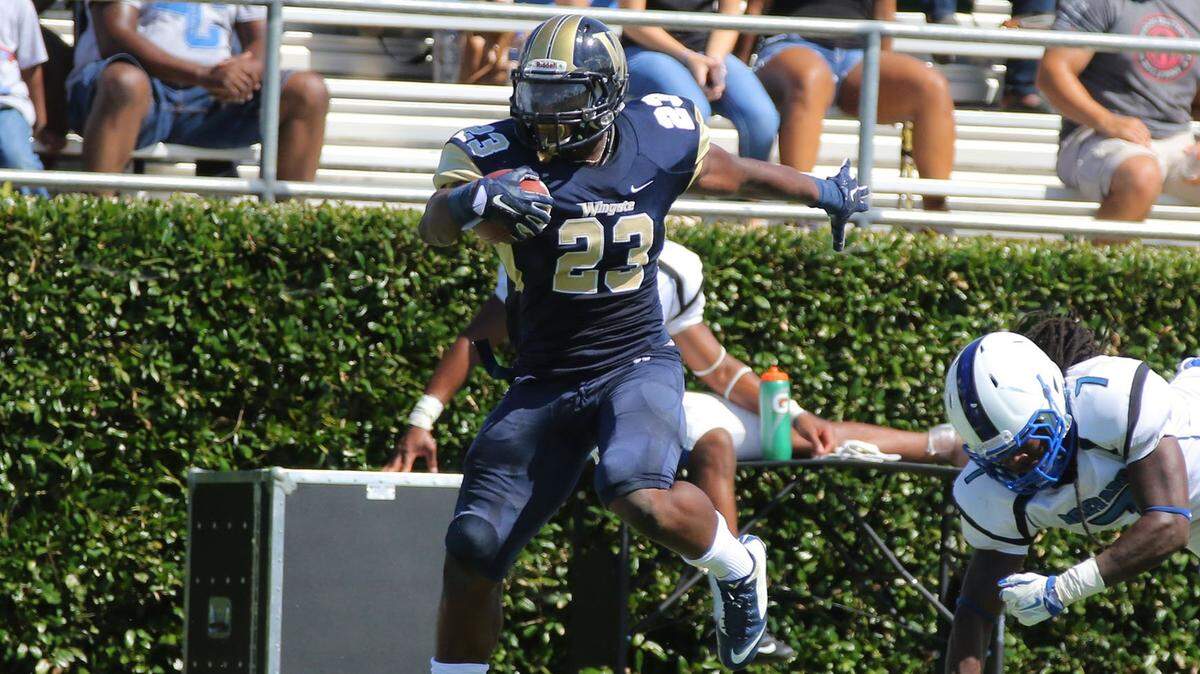
Now Conference Carolinas (Barton, Belmont Abbey, Chowan, Lees-McRae, Mount Olive) and the SAC (Catawba, Lenoir-Rhyne, Mars Hill, Queens, Wingate) have to decide whether to follow the lead of the NCAA and CIAA or go it alone. Queens has already decided it will be online only with no athletics.
The biggest hurdle is testing. Division II conferences have been concerned about their ability — in terms of funding and availability — to meet the NCAA’s recommendations, which include weekly testing of athletes and staff. On Wednesday, those recommendations became requirements.
“The ability to do testing hinges on so many other things in our society right now,” Colvin said.
Britz said there could also be issues with the NCAA’s insistence that schools cover COVID-related medical expenses, given his schools’ limited resources.
If either conference can find a path forward, it would likely be limited to in-conference competition concluding with a conference tournament. Without NCAA championships, they could even play later into the fall.
There could also potentially be a co-op among neighboring Division II leagues like Conference Carolinas, the SAC and the Peach Belt, with a regional championship at the end instead of an NCAA-sanctioned national championship.
“It would hinge on those conferences being essentially on the same page as each other and competing on the same schedule,” Colvin said. “If we’re all willing to do that, it’s certainly possible. The first thing that has to be determined is if the conferences can move forward and in a similar way.”
This story was originally published August 7, 2020 at 2:00 AM with the headline "27 colleges in NC won’t have an NCAA title to play for. Some may try to play anyway."