CCU benefits from football team’s success. But how much will that cost the university?
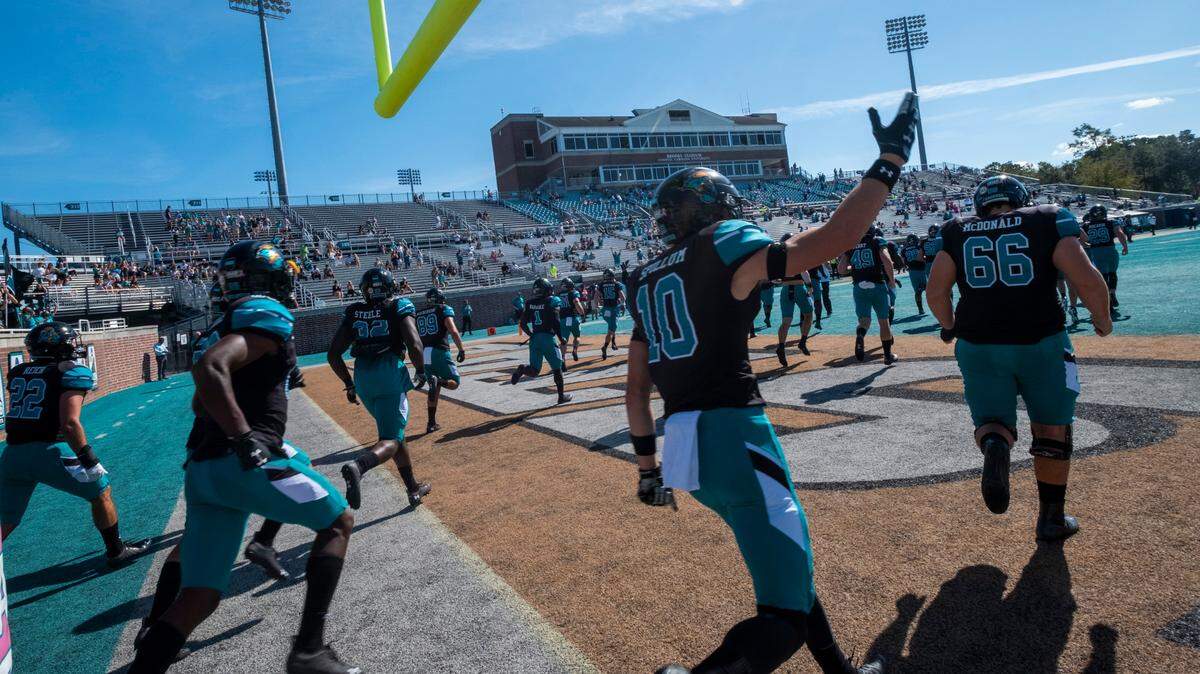
The success of the Coastal Carolina football program is paying dividends for the university.
The team is 5-0 and ranked 20th and 21st in the two primary national rankings, the AP Top 25 Poll and USA Today Amway Coaches Poll.
The Conway school is enjoying perhaps the most national media and social media attention it has ever received, which can be translated into a monetary value, and the fundraising for athletics is reaching new highs.
But all this winning may end up costing the university as well, as it may have to pay well over $1 million in incentives to the football coaching staff per head coach Jamey Chadwell’s contract.
Accounts receivable
Coming off a record-breaking fundraising year, the Chanticleer Athletic Foundation is off to an even better start to the 2020-21 fiscal year in money raised for Coastal Carolina’s athletic programs.
CAF executive director Chris Johnson said the foundation, a nonprofit affiliated with the university that supports CCU athletics, raised $852,000 in member donations for the 2019-20 fiscal year, which ended June 30, to set a new foundation record. The goal was $735,000.
The total is more impressive considering the final legs of the fundraising came in the midst of the coronavirus pandemic. In February, just before COVID-19 began to impact the U.S., Johnson said the CAF was well below its goal at about $580,000.
“In early February and March I was not confident that our goal would be met, but the community and our members have just come through and really shown that they’re keeping their support behind the Chanticleers,” Johnson said. “So that’s been a real pleasant surprise and that’s a trend I think we’re going to build on.”
The coronavirus has been challenging financially for many and has also caused uncertainty for the school’s athletic programs, which had seasons canceled in the spring and truncated in the fall, and are still unsure about playing games later this school year.
For the 2020-21 fiscal year, the CAF has already raised $572,000, which is largely unrestricted membership donations, Johnson said. He believes much of that is accountable to the football team’s success.
“That’s a pretty solid start to the year considering everything going on in the world,” he said. “There’s no question that the more successful our programs are the more support financially we gain, so there is a correlation between the two.”
Johnson said the CAF’s membership donations in 2015-16 totaled $436,000 and have increased at least $60,000 every year since.
“The positive movement is trending in the right direction and I firmly believe in the next couple years we’ll reach a new milestone of that $1 million mark in membership donations,” Johnson said. “That’s so critical because the membership donations represent unrestricted funds so we can apply those funds to where they’re most needed.”
Money raised by the CAF through members – who contribute as part of season ticket or parking spot purchases, in direct donations or through other means – is unrestricted and can be used as the foundation chooses.
The foundation is also involved in large donations such as naming rights and sponsorships, and accepts donations earmarked for specific programs, but those dollars are categorized separately from what are considered member donations.
Additional benefits
Statistics from the media monitoring company Meltwater that CCU utilizes shows the university has benefited greatly from increased media exposure this fall, and a large part of that is attributable to the football program.
CCU director of athletics Matt Hogue gave a report to the Board of Trustees last week that detailed the university’s earned media impressions and media value from Sept. 10 through Oct. 19, a span that included the team’s first four games and initial national ranking, and the announced hire of incoming president Michael T. Benson.
The figures essentially reflect the amount Coastal would have to spend to purchase ads for the amount of television time, radio time or print/online space it has received through broadcasts, stories, etc.
The earned media value the week of the first game at Kansas was more than $9 million, each subsequent week was at least $7 million, and it peaked at more than $10 million the week of a win over Arkansas State on Oct. 3, which coincided with Benson’s announcement.
“So it’s more than simply a guess on what type of value you’re generating on the success you’re having and the attention you’re receiving. That system pulls together analytics,” Hogue said. “It’s significant. I would put it on par with the (2016) national championship in baseball and in some respects it’s drawing more intense numbers than that. I believe we’re enjoying as much sustained attention as we’ve probably ever had.”
Often relegated to online broadcasts of its games over the past few years, the Chants have been on national television broadcasts in each of their first five games, and are scheduled to be again for at least their next two.
The effect of the pandemic on college football, which includes late starts for the Power 5 Conferences, has created opportunities for more exposure for the Group of Five Conferences teams such as Coastal of the Sun Belt Conference.
That has combined with CCU’s success to make the Chants a more coveted television product. Twice this season Coastal was involved in the only college football game being played on a particular day in games that were broadcast in prime time on ESPN – on a Friday against Campbell and Wednesday against then No. 21 Louisiana.
Coastal has been the subject of numerous national online, print, radio and television media interviews and stories over the past two weeks, since they earned their first ever FBS top 25 ranking on Oct. 18.
ESPN, for instance, sent a film crew to the CCU campus this week for a feature on the football team by reporter Gene Wojciechowski that will air Saturday morning on the popular College GameDay show.
The attention can produce a myriad of benefits, including attracting more applications to attend the university and improving athletic recruiting.
“Recruiting-wise it’s been huge,” Chadwell said. “There are a lot of doors you’ve been trying to get into and you couldn’t get in them, and now some of those doors are opening up. So I really think it’s going to pay dividends for us down the line, especially as you get into the 2022 class and some of those [afterward].”
Accounts payable
Chadwell’s contract updated in April 2019 pays him a $375,000 base salary this season, which is last among the 122 listed salaries of the 130 FBS head coaches in a report by USA Today.
His pay this year will be reduced by 40 unpaid furlough days – 20 mandatory and 20 voluntary – as part of coronavirus-related cuts, according to CCU Assistant A.D. for Media Relations Kevin Davis. Chadwell’s 10 assistants make between $80,000 and $152,000, with the exception of defensive coordinator Chad Staggs, whose salary is $240,000.
Staggs was elevated from $155,000 after the 2019 season, prior to which he was promoted from linebackers coach to defensive coordinator late in the summer with the departure of then-defensive coordinator Marvin Sanders but did not immediately get the bump in pay.
Chadwell’s contract calls for a $200,000 bonus for a Sun Belt East Division title, $300,000 for a conference championship, $150,000 for a bowl invitation and $200,000 for a bowl victory. Those are all cumulative, so he could collect them all totaling $850,000.
Chadwell also has incentives for season-end rankings in the AP poll, coaches poll or Sagarin rankings. A top 25 ranking earns a $400,000 bonus while a top 50 ranking garners a $250,000 bonus.
Chadwell’s contract also includes incentives for classroom performance measured by the Academic Progress Rate that considers eligibility, graduation and student retention of scholarship recipients within the program. An APR between 950 and 965 garners a $50,000 bonus, between 966-980 is worth $100,000, and 981 or above is rewarded with $150,000.
The bonus will be based on the 2019-20 APR computed by the NCAA. Hogue said the team’s APR did not reach a bonus threshold in the 2018-19 school year, which is the most recent that has been computed.
The team’s APR reportedly hit an all-time high at 979 in the 2016-17 academic year, and the NCAA’s report for the four-year multi-year score from 2014-17 was 965.
If Coastal were to win the Sun Belt championship game, win a bowl game, finish the season in the top 25 and have an APR above 980, Chadwell and his staff would be due $1.4 million.
The contract calls for 50 percent of the incentive payments to go to Chadwell, and 50 percent to be distributed to his assistants, staff and “program contributors” at the discretion of Chadwell and athletics chairman and former head football coach Joe Moglia, with required approval from the university president.
Success incentives like Chadwell’s are common for FBS head coaches, and coaches of other sports as well.
Last season, seven Group of Five teams were ranked in the final AP Top 25 Poll following the College Football Playoff championship game between Nos. 17 and 24: Memphis, Appalachian State, Navy, Cincinnati, Air Force, Boise State and Central Florida. With the exception of App. State (13-1) of the Sun Belt, they all had at least two losses.
“We plan for these contingencies,” Hogue said. “Those incentives were put in there for a reason and we expect to make good on them. It’s important also to point out it’s a contract that had a lot of incentives in it because the general base salary is on the lower end within the FBS scale.”
How would CCU pay the bonuses?
Hogue said the payments must come from athletics-generated revenue. That would include Sun Belt Conference distributions, bowl game payments, ticket sales, royalties, sponsorships, licensing and potentially CAF contributions.
Coastal’s athletic department received approximately $1.2 million from the Sun Belt in the 2018-19 school year, according to Davis. That included money from bowl participation, TV contracts, NCAA men’s basketball tournament participation and other revenue. Last year’s NCAA men’s basketball tournament was canceled, however.
The one big carrot that each Group of Five Conference (Sun Belt, Mid-American, Conference USA, American Athletic and Mountain West) covets is the single berth reserved to them collectively in a New Year’s Six bowl, which comes with a payout in excess of $6 million.
Hogue said the team representing the Sun Belt in the game would receive “the lion’s share” of the conference distribution.
The team is chosen based on the highest ranking among Group of Five schools in the final College Football Playoff Rankings created by a CFP selection committee.
The Sun Belt has affiliations with five bowls that annually choose conference teams with at least six wins, though bowls have more freedom in 2020 because of the unusualness of the season. The bowls have changed with new contracts beginning this year, but the payouts to both participants combined in the Sun Belt-affiliated bowl games in 2018 were between $250,000 and $1.5 million.
Coastal was also set to receive $1.4 million from South Carolina for a season-opening game with the Gamecocks that was canceled because of the coronavirus, and Hogue said negotiations are ongoing to resolve that situation. “We’re currently in discussions about what to do with the game,” Hogue said.
Coastal puts it undefeated season and perhaps some of the coaches’ bonuses on the line at noon Saturday at Georgia State in Atlanta, and the exposure continues with a national broadcast on ESPNU.
“I think we’re more than prepared to deal with what the outcome could be with those bonuses, just as we would be for any other coach that reaches bonuses,” Hogue said. “I don’t foresee it being an issue and I’m also excited about the doors it opens up. The success is not just about spending money, the success is also about opportunities it creates. . . . You have to factor in revenue streams that we maybe have never had a chance to enjoy before that can become a part of this calculation.”