How the Coastal Carolina men’s basketball program rose from the ashes of NCAA sanctions
Coastal Carolina was the class of the Big South Conference in the early 1990s.
That meant the Chanticleers ruled the conference’s most high-profile sport: men’s basketball.
In the four seasons from 1989-93, the Chants won three Big South tournament titles and basked in the glow of March Madness, making the program’s first NCAA tournament appearances in 1991 and ’93 to face the storied programs of Indiana and Michigan.
“Back in that period of time Coastal kind of was the supreme school in the Big South Conference, not only in basketball but in other sports – baseball and a lot of women’s sports too,” said Buddy Sasser, Big South commissioner from 1989-96 and Coastal’s athletic director from 1996-99. “They were kind of the outstanding program in that conference.”
That’s what made the basketball program’s fall from grace so precipitous.
Following a 15-11 season in 1993-94, the Chants would go 12 years before recording another winning season and 21 years between NCAA tournament appearances.
The program under coach Russ Bergman was found to have committed numerous NCAA violations, and was shamed and heavily penalized in 1994 by the NCAA.
Twenty-five seasons after the NCAA imposed stiff sanctions, they may seem but a memory. But they stunted the growth of the program for many years, led to multiple coaching changes and required a rebuilding of CCU men’s basketball.
The findings
The NCAA found the CCU men’s basketball program guilty of academic fraud and 10 other major violations and announced the findings and penalties in September 1994.
Charges emanating from a nine-month investigation included unethical conduct, a lack of institutional control, excessive official visits and illegal payments to student-athletes. The NCAA said it was tipped off in December 1993 by two phone calls.
The program was placed on probation for four years, was stripped of three of its normal 13 scholarships per year over two years, and was banned from postseason play and televised play for the 1994-95 season.
The school had already self-imposed penalties in 1993-94 by sitting out postseason play, reducing official visits from 15 to 10, and forfeiting all games in which ineligible forward Mohammed Acha participated over two seasons, including the 1993 Big South championship.
Further penalties included reducing expenses-paid visits from 12 to 10 in 1994-95, issuing a public reprimand and censure, and requiring CCU to develop a comprehensive athletics compliance education program.
The NCAA said its penalties were tempered by CCU’s self-corrective actions in 1993-94, which included Bergman’s forced resignation on March 19, 1994, the hiring of a full-time compliance assistant and monthly compliance seminars for all coaches.
Bergman was essentially banned from college coaching for five years – the NCAA would have to approve his hire at an NCAA institution over those five years. He hasn’t coached in college since.
David Swank, chair of the NCAA Committee on Infractions at the time, said: “The violations were serious and numerous enough to cause major concern. That a member of the institution was directly involved [in academic fraud] compounded the situation.”
The NCAA reported that between 1990 and 1993:
▪ Bergman arranged for Acha to take two independent study courses taught by CCU professors so he could graduate from Vincennes Junior College in Indiana and qualify to transfer to CCU, paid $1,300 to cover Acha’s summer-school tuition, and solicited at least two people to complete the course work while Acha was home in Nigeria.
▪ Bergman paid airfare for Acha and forward Dennis Pierre, another basketball staff member paid for another flight, and Acha received other benefits.
▪ Bergman provided cash for tuition in 1990-91 to Pierre, then only a partial qualifier who also received housing and meals at no cost.
▪ CCU hosted 21 official visits by recruits, which was six more than the maximum, and Bergman used his institutional credit card in an attempt to hide the charges.
▪ Bergman arranged for free hotel accommodations for parents of players twice in 1992-93.
▪ Bergmam intentionally visited the mother of a recruit during a quiet period for recruiting.
▪ Bergman and assistants regularly broke NCAA rules by observing informal preseason pickup games, which the school’s compliance director discovered but did not report to the NCAA.
▪ Additional unethical conduct by Bergman and former assistant Chris Kristich, who cooperated in the NCAA investigation.
In February 1994, in the midst of the NCAA investigation, Bergman called then Sun News sports editor Steve Vest and confessed to paying for a flight for Acha, who died in 2002, from New York to Myrtle Beach so he could return to school.
Bergman said he was inspired to confess after taking the team to see “Blue Chips,” a movie starring Nick Nolte about recruiting corruption in a college basketball program. But the confession was for a pittance of the charges that were later divulged.
Bergman declined to be interviewed for this article, but he expressed contrition in an interview with The Sun News in 2004.
“There’s nobody that hates what I did to the basketball program and athletic programs and university more than I do,” he said. “Everything I had built up for 19 years was gone because of NCAA violations. It hurt our reputation, and I deeply regret that.’‘
Bergman said he was chasing a major college coaching job after nearly two decades at CCU, and knew he had to return to the NCAA Tournament following a 12-19 season in 1992 to have a chance of earning one.
“The only time I took a shortcut was after we were in the [NCAA] tournament in ‘91 and had a losing season in ‘92,” he said in 2004. “I wanted to get back, not only for Coastal, but for me, too. I was battling like crazy for a job at a major and I got impatient.”
“We were doing little things that everybody in the country was doing at that time. We just got turned in,” said Bergman, who went on to win a title as a head coach in the Continental Basketball Association and coach in the NBA Developmental League, Qatar and Russia.
Bergman’s finale
Bergman essentially built the CCU basketball program from the beginning. He coached Coastal for 19 seasons from 1975-94 and compiled a 306-246 record. He remains Coastal’s winningest coach.
He led the program into Division I and his teams’ performances peaked late in his tenure, as the Chants won Big South Conference tournament titles in 1990, ’91 and ’93, going a combined 36-6 in conference play in those seasons.
The Chants were a 15 seed in 1991 and played a second-seeded Indiana team coached by Bobby Knight close before succumbing 79–69. Local high school product Brian Penny scored a career-high 34 points against the Hoosiers.
In 1993, the 16th-seeded Chants lost 84–53 to Michigan’s famed Fab Five during their sophomore seasons when they reached the NCAA championship game for a second straight year, but the Wolverines later vacated the first-round victory as part of NCAA sanctions.
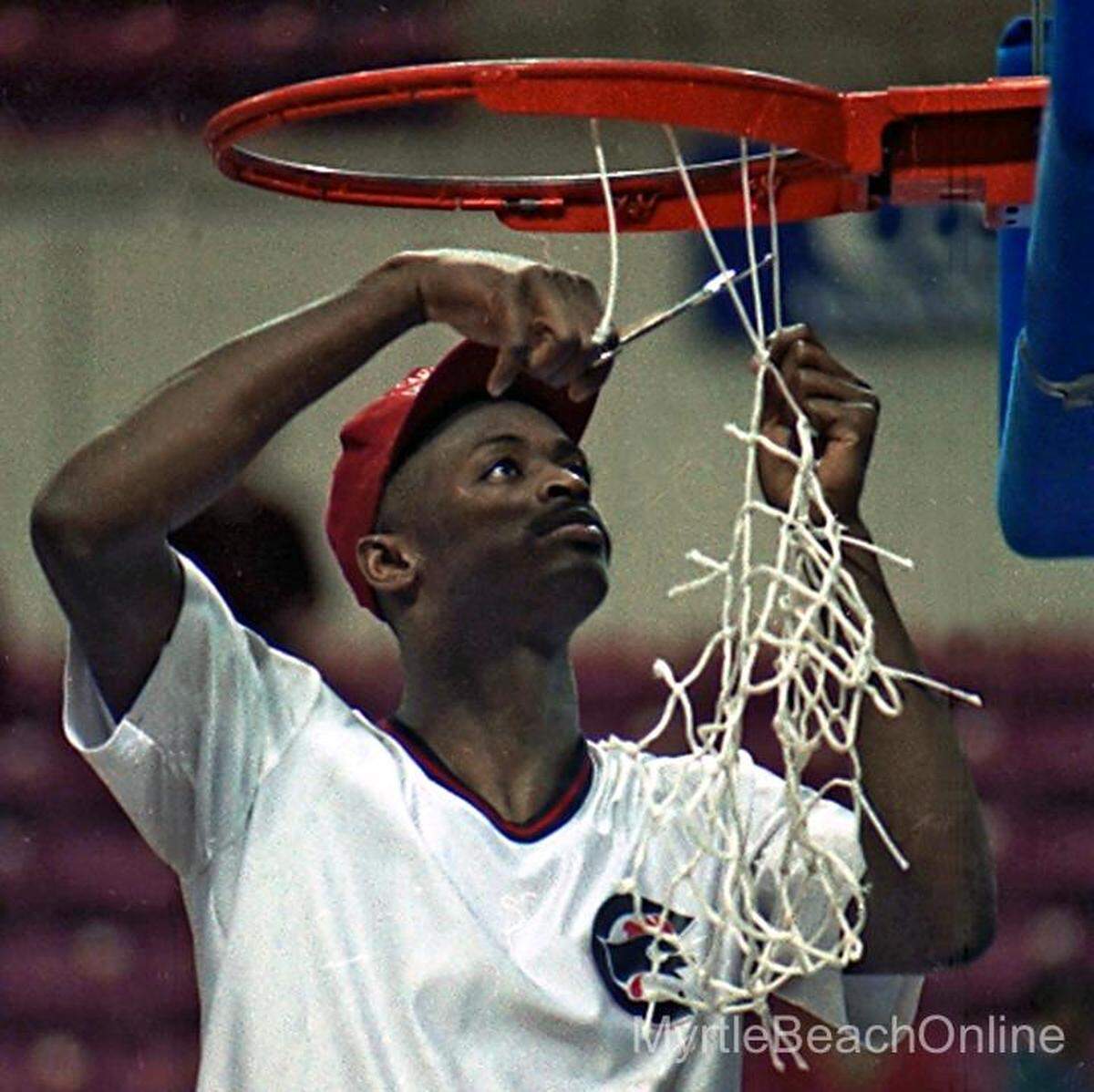
Keke Hicks, who led CCU in scoring as a redshirt sophomore in 1992-93, recalls the fab five clowning on the Chants throughout the game, repeatedly calling one of his teammates fat and mocking the Chants when they barked out offensive play calls.
“When we called a play or something, they’d be looking like, ‘That’s not going to work,’ ” Hicks said. “They just cracked jokes the entire game. When they went out to shake hands Chris Webber told Tony Dunkin, ‘We’re going to kick your [butt].’ Then Tony came back to the huddle all fired up. They were laughing, man. It was a joke to them, to be honest.”
Had it not been for the turmoil of the 1993-94 season and CCU’s self-imposed penalties, Hicks believes the Chants would have returned to the NCAA tournament. “We were having the same season we had the year before where it was okay, okay, okay, then by the end we knew we could beat everybody,” Hicks said.
Much of the NCAA’s information came from interviews with former CCU part-time assistant coach Chris Kristich, whom Bergman fired prior to the 1993-94 season. Hicks said Kristich was upset that he was bypassed for a promotion in the coaching hierarchy and began bad-mouthing Bergman to players and at least one prospective assistant before he was fired.
Hicks said he was interviewed by the NCAA and the questions he was asked were largely based on information provided by Kristich, who died in 1998. “I told them that he was lying as far as my part. I was really shocked he told them some of the things he told them,” Hicks said. “Then I found out he was upset with coach Bergman and was trying to hurt the program. A lot of it was true but some of it wasn’t and some of it was exaggerated.”
Hicks said he received some residual benefits of playing for Bergman at CCU, but nothing direct.
He transferred from coach Billy Tubbs’ Oklahoma program and had to sit out a season, and said during that year he served as Bergman’s chauffeur, since Bergman did not want to risk drinking and driving after two prior arrests for DUI, neither of which resulted in a conviction.
Hicks said he wasn’t paid to chauffeur and never received any illegal benefits from the CCU program, though through driving Bergman he formed relationships with restaurant and bar operators who would give him discounts.
“It wasn’t like Russ gave me anything in my hand,” Hicks said. “I didn’t really get anything, but what was probably illegal back then was I used to chauffeur Russ when I was sitting out. That was how I met everybody in Myrtle Beach, so that’s how I was able to get some extra benefits. But it didn’t come because Russ said, ‘Hey, give Keke this.’ The relationships were built with those people who I met through Russ. . . . And I never really took a whole lot of advantage of it anyway.”
Hicks said he was unaware of the benefits other players received. “When all that stuff came out I was like, ‘Oh.’ ” said Hicks, a former Georgia Tech assistant who owns a business in Atlanta involving team building for colleges and high schools, basketball skills training and speaking engagements.
The aftermath
Bergman’s former player, Michael Hopkins, was hired as his successor in April 1994, five months before NCAA sanctions were announced. It was his first head coaching job after serving as an assistant at Western Carolina and East Carolina.
“It was tough. Taking the job I knew something was going to happen [with the NCAA],” Hopkins said. “Like I told my assistants, it was going to get bad before it got better.”
Hopkins coached the four years of probation from 1994-98 and went 30-76 overall and 14-46 in Big South play including the conference tournament. The program bottomed out in 1995-96, going 5-21 overall and 1-13 in the league.
The Chants were bounced from the first round of the Big South tournament three consecutive years from 1996-98. Six players left the program prior to the 1997-98 season and Hopkins resigned with a year left on his contract following an 8-19 season.
Hopkins said there were false reports and rumors about the penalties CCU was assessed, so administrators wrote a clarification letter to give to recruits so they would know they weren’t as damaging as some reports indicated.
“That was the first challenge. We had to get into the homes of the guys we were recruiting to make sure the story was told right,” Hopkins said. “Then with the scholarship limitations, you’re always going to have guys that want to play Division I basketball, so we tried to find the right guys who would overlook that and were up for the challenge.”
Hopkins said he doesn’t recall other programs using the NCAA sanctions against Coastal in recruiting battles, though it likely happened. “It’s all fair in love and war I guess with recruiting,” Hopkins said. “If they were it was nothing we were hiding from. I would tell kids the truth and if that would hinder them then so be it, we would know that and move on to the next guy.”
Hopkins inherited most of his team and had only a few scholarships to give his first year, when he went 6-20.
Hicks recalled Hopkins playing younger players with him while limiting the playing time of the more experienced players on the roster.
“The new staff, it was almost like they came in with the attitude that they were going to clean up everything, but nobody there was dirty,” Hicks said. “The team was very demoralized [from sanctions], and there wasn’t a lot of experience on the staff. In my opinion we still could have won that [first] year when we were under probation. There’s no way it should have been the way it was. . . . The atmosphere just got bad.”
Hopkins believes the sanctions “without a doubt” factored into his lack of success, as did the Chants’ home arena Kimbel Gymnasium, which was nicknamed “The Chicken Coop” by those in the program. The cramped, barely 1,000-seat gym would hamper his successors’ attempts to build the program, as well.
“I think it was more the stigma then too. We still had the same facilities,” said Hopkins, Conway High’s coach who led the Tigers to the state Class 5A semifinals this season. “We weren’t spending any more money on basketball then.
“Kids never came to Coastal and had a bad visit, but the thing that really mattered to an 18- to 20-year-old, they wanted the facilities, scheduling, type of [apparel] they were wearing, those type of things, and we were behind the eight ball when it came to facilities. When we turned the lights on in there, it was what it was.”
Continued losing
Pete Strickland, who had been an assistant at VMI, Old Dominion and Dayton, succeeded Hopkins.
Strickland coached seven seasons from 1998-2005 and went 70-127, never recording a winning record either overall or in Big South play.
“Michael really took the brunt of the fallout,” Strickland said. “In his years at the helm I think he was really hamstrung by the sanctions, the Scarlet Letter if you will. His four years it was just a matter of trying to get back head over water.
“When I got there, pretty much the recovery period was ready. We were ready to step forward.”
The Chants went 7-20 in Strickland’s first season (1998-99), though Steve Miles was named Big South Freshman of the Year. Strickland said he inherited eight seniors his first season, including seven who had been junior college transfers.
How bad were the Chants that season? As a first-time collegiate head coach, Strickland regularly fought for his team by harping on officials. He recollects receiving a phone call that January from Fred Barakat, the head of officials for multiple conferences including the ACC and Big South.
“He said, ‘You have to lay off my referees. You’re getting all these referees angry. They’re calling me after every game,’ ” Strickland recalled. “I said, ‘What do you mean?’ . . . I was totally unaware. He goes, ‘You guys suck. You’re not very good. So make some friends.’ And it was the best advice I ever got.“
Though Miles transferred, CCU went 10-18 in Strickland’s second season in 2000 and improved to 7-7 in the conference, and he was named Big South Coach of the Year.
“We were kind of on our way. I think we had exorcised all the demons and we had a bunch of guys that were coming in as freshmen and we had Torrey Butler, who was a really good player and ended up being Player of the Year in the league (twice). Then we couldn’t get healthy.”
Strickland said eight to 10 CCU players suffered mid-foot injuries in about 18 months, leading to every player in his large 1999 recruiting class taking a medical redshirt season.
So the school had the Kimbel floor analyzed and discovered “it had the resiliency of a concrete slab,” Strickland said. He said he started two walk-ons for two seasons because of the rash of injuries before the floor was replaced.
“That stemmed the Coastal development, because had that not kind of hamstrung us for a couple years . . . we were ready,” said Strickland, who had four athletic directors in his seven seasons.
The arena also continued to hamper recruiting. Strickland recalled a prospect from Louisiana that Georgia Tech was also recruiting walking into Kimbel on a visit.
“I thought we were going to steal this kid if Georgia Tech didn’t offer him,” said Strickland, who knew the player’s high school coach. “He asked, ‘This is where you practice?’ I said, ‘Absolutely. Absolutely. Hey let’s get to lunch,’ just trying to avoid that next question. Eventually on the visit he did ask where we played, and I had to answer that one unfortunately.”
Strickland’s late record at Coastal was impacted by playing more games to earn checks at teams from major conferences. “They came to me and said, ‘We’re going to start football, can you play a few more money games?’ “ said Strickland, whose teams played Florida, Clemson, Georgetown, Virginia, North Carolina and Tennessee in his final three seasons.
In Strickland’s final season, Pele Paelay was the Big South Player of the Year as a junior and was returning, and Jack Leasure was the conference Freshman of the Year and would be the Player of the Year as a sophomore.
Buzz Peterson took over the program in 2005 and went 20-10 in his first season including 12-4 in the conference to lead the Chants to a tie for second in the regular season. They nearly returned to the NCAA Tournament, falling 51-50 to Winthrop in the Big South tournament championship game.
Peterson went .500 both overall and in the conference in his second season in 2006-07 before being hired by former University of North Carolina teammate and roommate Michael Jordan as Director of Player Personnel for the NBA’s Charlotte Bobcats.
“I would say all the probation, etcetera, by Buzz’s first year where those guys came back and played well for him was completely exorcised and now you’re back to square one,” said Strickland, who recently coached the Irish National Team for two years and is now a speaker who stresses leadership and team building.
The resurgence
Cliff Ellis took over coaching duties in 2007 and is in his 13th season. His Coastal resume includes a 245-180 record through the 2019-20 regular season and a pair of NCAA Tournament appearances.
Ellis also got the coveted new arena in his sixth season in 2012-13 that helped elevate the program, the HTC Center, which seats more than 3,300 and has several other amenities including a fitness facility and coaches’ offices.
“It had been awhile [since the sanctions], but what I did know was there had been one winning season in whatever the number was,” Ellis said. “Facilities were poor. There was a lot of apathy. It had just been down for so long there was nothing exciting.
“But it’s the reason that I came here because I’ve always been a builder – try to get something to recover. . . . There was nowhere to go but up.”
During his interviews, Ellis, who was previously the head coach at South Alabama, Clemson and Auburn, was convinced CCU’s administration and board of trustees were committed to building a winning program and improving facilities.
“That [HTC Center] was a game-changer because we had the second-worst facility in Division I basketball (after Charleston Southern),” Ellis said. “I thought there was a desire to come out of this, and my desire was to take Winthrop off the top [of the Big South] because they were the one.”
After Ellis went 13-15 and 11-20 in his first two seasons, Coastal had notched just one winning season over a 15-year span.
The Chants won 28 games in each of the next two years to compile a 56-13 record, however, beginning a stretch of eight consecutive seasons from 2009-17 with winning records in conference play.
CCU won the Big South regular-season title in 2010 and 2011 but lost the conference tournament championship games to drop into the NIT Tournament.
A 22-game winning streak in 2010-11 was the longest in the nation at the time and got the Chants within three and two spots of being ranked in the Associated Press and USA Today/Coaches national top-25 polls for the first time.
But the 2011 season was derailed late when sophomore point guard Kierre Greenwood was lost for the season with a torn ACL, senior forward Mike Holmes was suspended from the team for a rules violation (fighting) and junior leading scorer Desmond Holloway was suspended indefinitely because of an NCAA investigation into his eligibility, leaving CCU with eight players including a walk-on.
The NCAA eventually determined CCU committed a secondary violation because Holloway received “an institutionally-issued shirt, valued at $25 . . . from the residence of another student-athlete,” and did not further penalize the program.
Holloway, a transfer from Wabash (Ill.) Valley College in his first season in Conway, told The Sun News in 2011 that he repaid the money for the shirt, which he wore for his CCU signing ceremony, and he turned pro in the midst of the investigation.
Coastal finally ended its two-decade NCAA tournament drought when it won the Big South tournament title in both 2014 and ’15 to earn berths into the NCAA tournament for the third and fourth times in program history. Coastal lost first-round games to Virginia and Wisconsin by 11 and 14 points in those seasons.
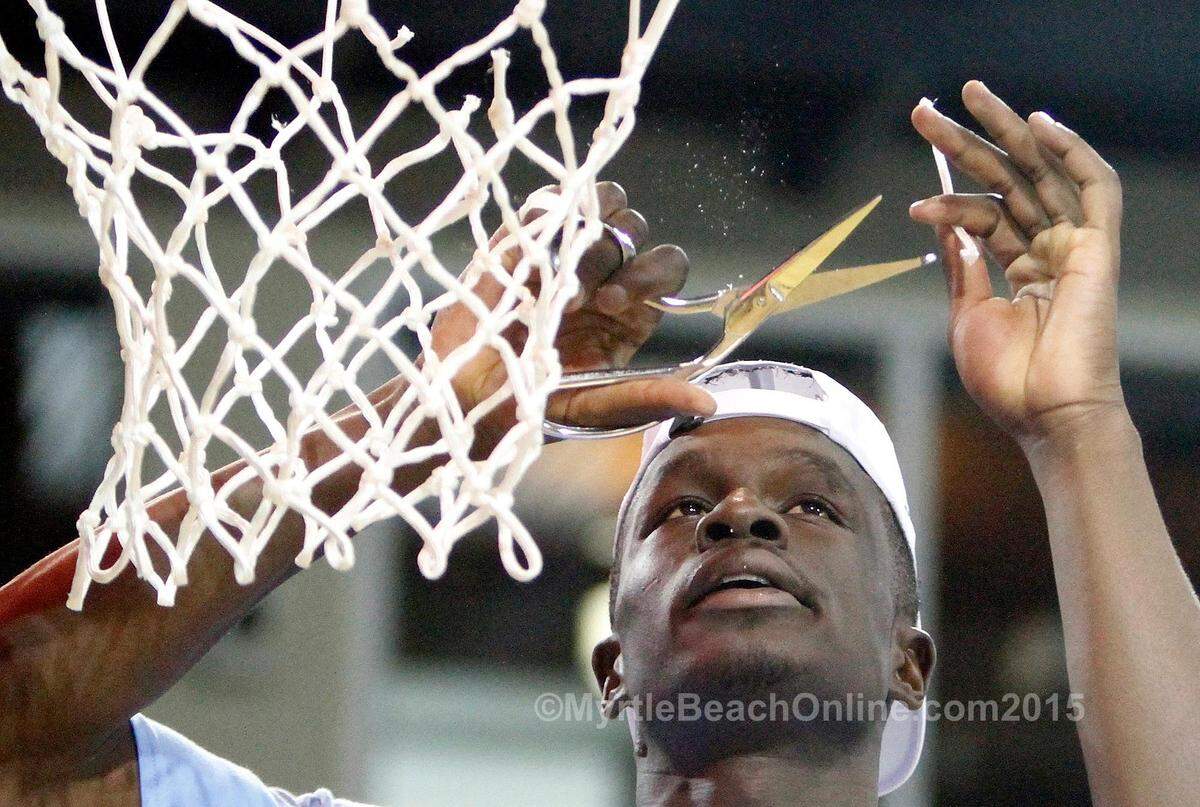
The Chants had unseated Winthrop, which had taken the Big South’s NCAA berth in nine of 12 seasons from 1999-2010, atop the Big South.
“The first two years I was here was rough,” Ellis said. “We had to battle just to compete but we got better. From there until the time we left the Big South we won four championships, we knocked Winthrop off the top of the roost, and when we left the Big South it wasn’t Winthrop they were talking about, it was Coastal Carolina.”
Bringing well-known programs to the Coastal campus was one of Ellis’ strategies to create more interest in his program, and he called on his connections in the game to lure LSU, Auburn, Clemson and Mississippi to Conway – LSU played at Kimbel before the HTC Center was built.
“I told them we were building a new facility and we thought it was going to be done and it didn’t get built, and we played them at Kimbel and won,” Ellis recalled. CCU has beaten Clemson both at home and in Clemson.
“When you look at the elevation of the program, our schedule has been elevated and we’re trying to get it at a big-time level,” Ellis said.
Now the Chants are trying to climb to the top of the Sun Belt Conference.
Coastal is 35-39 in four years of Sun Belt play, during which the Chants have finished between sixth and 10th in the 12-team league. “The Sun Belt is another level, and we’re trying to do the same thing we did in the Big South, and I think if we can ever get healthy we will,” Ellis said.
The Chants were off to a promising start this season at 3-2, were coming off a 22-point win over Utah in the first round of the Myrtle Beach Invitational and held a six-point lead over Baylor, which is ranked fourth in the nation, four minutes into the second half in the second round That’s when talented sophomore guard Ebrima Dibba tore knee ligaments and was lost for the rest of the season.
Second-leading scorer Keishawn Brewton left the team in late January and is seeking a transfer, and the Chants enter the Sun Belt Conference tournament on Saturday at 15-16.
“I know that our team has elevated itself to where it’s a recognized program, and it’s still got a long ways to go,” Ellis said. “We did it in the Big South, now let’s do it in the Sun Belt. . . . There’s no question the talent level has been elevated.”
This story was originally published March 7, 2020 at 1:02 PM.