
Do more men actually get vasectomies this month as an excuse to watch March Madness?
We’ll find out Sunday who makes the cut for this year’s NCAA March Madness basketball tournament.
And somewhere out there are an unknown number of American men prepping for a different kind of cut altogether.
Urology lore has it that March is the busiest month for vasectomies because men want a good excuse to watch hoops while they recover at home.
Media stories about the phenomenon pop up every year about this time. Haven’t you seen the picture of the guy watching a basketball game with a bag of frozen peas on his lap?
There is some data to support the trend, but not much. And on Friday, Dr. Ajay Nangia, who has debunked this myth year after year, season after season, called a foul yet again.
“No, it’s not true,” Nangia said during The University of Kansas Health System daily medical news briefing. He is a urologist at the KU health system.
Turns out Nangia has firsthand knowledge about how basketball became linked with male birth control.
About a decade ago, he said, a former student starting his own urology practice on Cape Cod, Massachusetts, came up with the idea of marketing vasectomies during March Madness.
Possibly, it was the same urology group that offered patients pizza coupons and ran ads that said: “Want to watch college basketball guilt-free?”
“Next thing you know, media, social media took off,” Nangia said. “Anderson Cooper on CNN reported it. So then all of a sudden, copycats, urban legends.”
In a 2018 study of vasectomy rates in the United States, researchers reviewed more than 500,000 procedures from 2007 to 2015 and concluded most vasectomies were performed at the end of the year — and March.
“The highest numbers are actually in October, November and December for very practical reasons,” Nangia said. “Men have often met their deductibles for their insurance. It’s financial.”
NCAA not a fan
In 2010, a urology practice in Eugene, Oregon, ran a “Snip City 2010” campaign encouraging potential patients to “take care of the equipment and lower your seed for the tourney.”
Bags of frozen peas were tucked into recovery kits.
In 2014, a urology group in Austin, Texas, promoted “It’s Hip to Get Snipped” during March Madness with longer office hours during the games and “a pledge to have patients ‘ready for love’ by the postseason,” according to ESPN.
In 2019, Buffalo Wild Wings introduced the “Jewel Stool” at its locations in Los Angeles and Times Square. With a cooling system in the seat, a chilled cup holder and a “beer me” light, the chair was a throne for customers recovering from vasectomies during the tournament.
It’s all fun and games until the NCAA says it’s not.
Last year the NCAA filed a federal trademark complaint against a Virginia urology practice that trademarked the phrase “Vasectomy Mayhem,” because the NCAA said it was “confusingly similar” to March Madness.
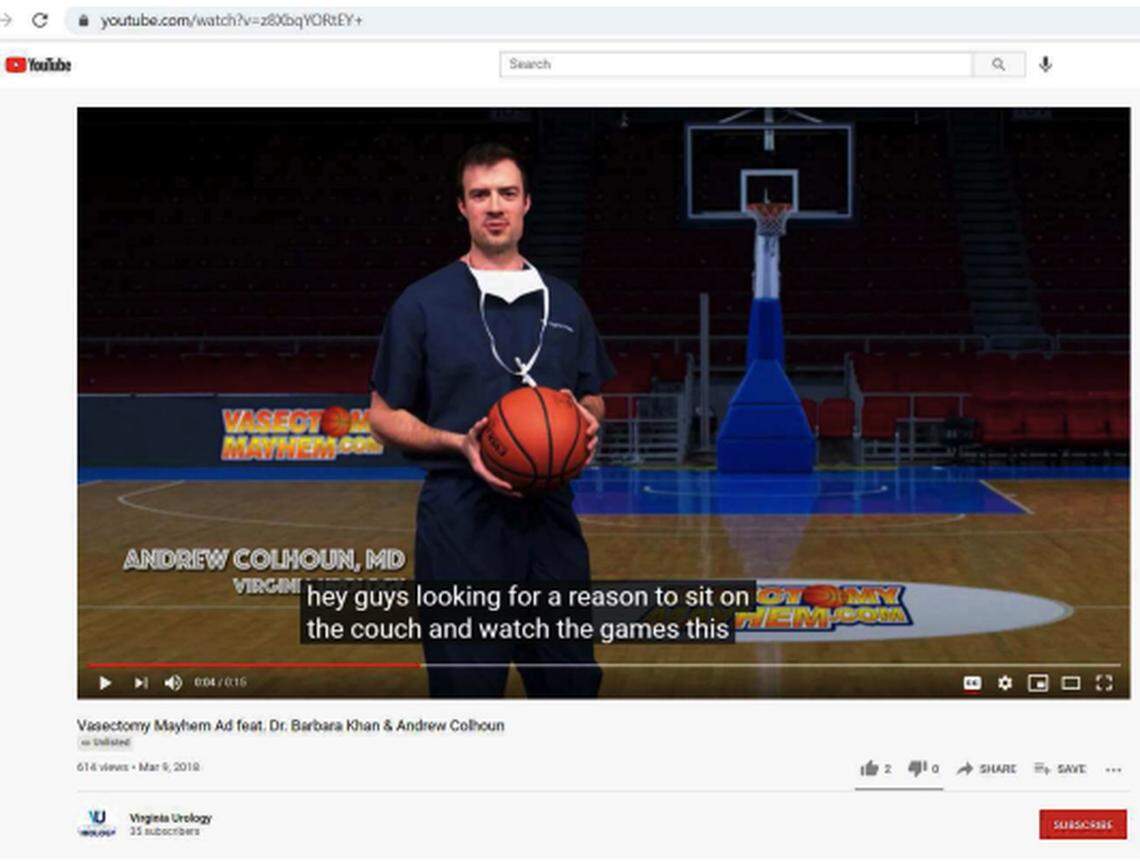
Some men have no follow-through
A vasectomy is done in a doctor’s office, under local anesthesia, and takes about 10 or 15 minutes. The tubes that carry sperm are cut and sealed.
Doctors recommend patients stay off their feet for a couple of days — which is why many men often have them done on a Thursday or Friday, so they can go back to work on Monday — and use an ice pack, or that bag of frozen peas, to calm inflammation.
Nangia was asked Friday if the procedure is painful.
“Men are like deer in headlights sometimes when it comes to that part of the body, understandably,” he said. “I always argue that women are more stoic and tolerate a lot more than men ever do.
“Injection is involved, they’re a very small needle, so (you) can’t say the word needle and the area down there in the same sentence without people freaking out. So that’s why they get the Valium. …
“And I won’t say everybody, but a lot of the guys at the end do say that was ‘better than I expected.’”
A vasectomy isn’t just snip and go. Patients are generally told to continue using birth control for the next three months and to return for a follow-up to check their semen, he said, so there are no surprises nine months down the road or later.
But they don’t all return as advised, said Nangia, clearly frustrated by that. “And some of them don’t follow the rules. And I don’t know what to do. I’m beyond the point where I can lead them into the clinic. … Some personal responsibility has to happen,” he said.
“We’re talking about sporting analogies. I call it falling at the last hurdle.”
He said he’s had patients as young as 18 ask for a vasectomy. “I won’t do that. That’s my personal decision,” he said. “They may be of legal age to have their own health care, but I truly struggle with that. Now that is a moral decision I guess as opposed to an ethical decision.
“I’ve had college students at 21 come in thinking that maybe a little bit earlier may be easier. There’s an interesting statistic. If men have it done (before) the age of 30, here’s a 12.5 times higher chance that they’ll want it reversed than if they had it after 30.”
Though his office doesn’t have the March Madness traffic that others around the country apparently do, he said, it’s a good plan if you can get an appointment. His are booked months in advance.
“If you really think you want to do a vasectomy in March and sit on your keister for about a week and get your honey-do’s put aside by your partner, good, take advantage of it,” he said.
This story was originally published March 11, 2022 at 1:55 PM with the headline "Do more men actually get vasectomies this month as an excuse to watch March Madness?."
.jpg)