Coming home: How a Gamecock and his family left Haiti to pursue their dreams
Each sunlit morning in Everett, Massachusetts pushes the memories of Webb Camille’s birthplace and the homeland of his brother, South Carolina defensive back Carlins Platel, slightly deeper into the shadows.
The Camilles’ house in Port-au-Prince, Haiti was larger than most. The family inherited it from a wealthy grandfather who’d made a healthy haul as a businessman before his untimely death. The Camilles continued to live in the house after his passing, but money became increasingly short.
Even purchasing a soccer ball was a tall order. Webb and older brothers Marcken and Yrv instead blew up a balloon and wrapped it in enough trash bags to weigh it down as a way to quell their competitive streaks.
“A lot of my memories are not very pleasant of Haiti,” Webb said, taking a subtle breath as he continued his thought. “I can remember seeing so many poor people — lots of people who are homeless and naked. It was not uncommon to find a deceased person on the street in the middle of the day.”
One day remains seared into Webb’s mind. He sat in his mother’s lap in their home in broad daylight. Armed with a plate of spaghetti, he twisted and twirled the fork in his hand to secure bites of the yellow pasta. In the distance, a faint tapping noise grew with each passing second.
Pop. Pop-pop. Pop-pop-pop.
The sound neared. Webb’s mother, Gerda, whisked him off her lap as they ducked for cover. The spaghetti shot into the air. The ceramic plate holding Webb’s meal cracked into scattered pieces on the floor.
Pop. Pop-pop. Pop. Pop-pop-pop-pop.
Bullets flew. Pieces of lead nestled into the drywall.
“That’s it,” Gerda thought. “We need to get out of here.”
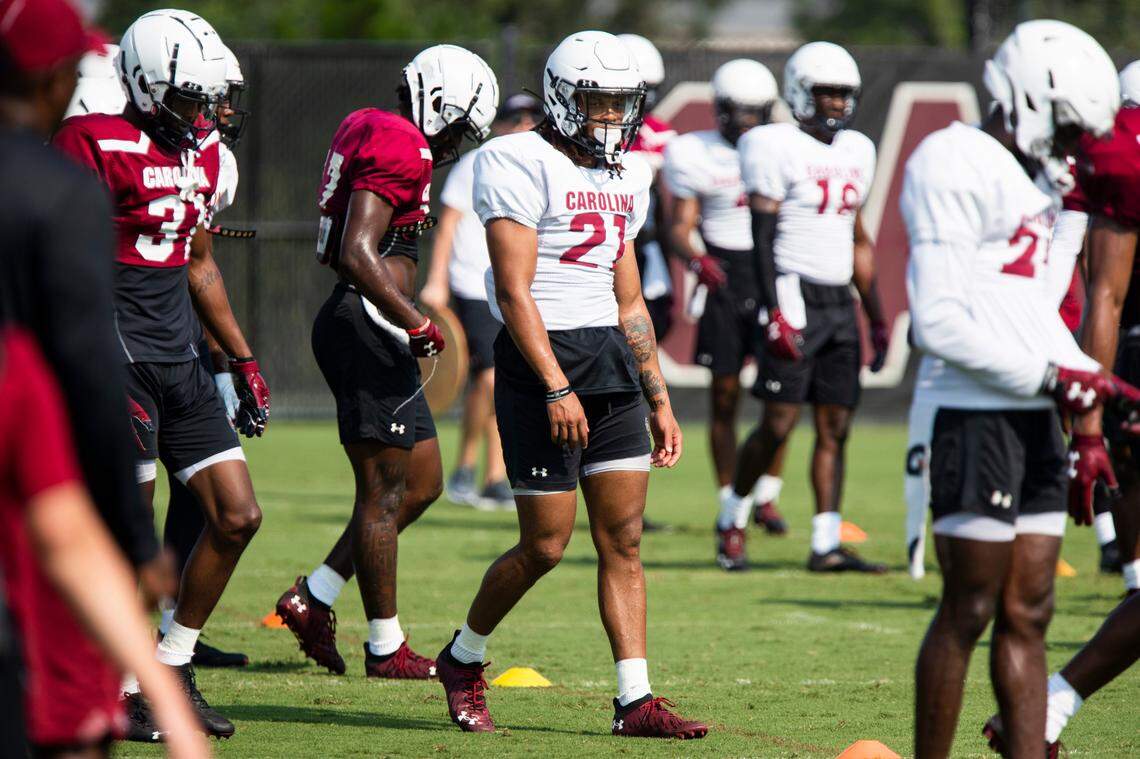
Tuesday, Carlins blitzed off the right edge of the line on the South Carolina practice fields behind the Jerri and Steve Spurrier Indoor Practice Facility. Tucked into his mind, under his white team-issued helmet and flowing dreadlocks, sit scattered memories of the country he and his family left when he was just a boy.
“It was tough (to leave),” Carlins, who was born in Brooklyn, New York but lived in Haiti until he was 4, told The State. “But it was just something that had to be done.”
Leaving Haiti for the United States
Gerda Camille and her six children departed Port-au-Prince on a plane bound for the United States in September 2002.
The family bounced around for several years. They briefly settled in the Mattapan neighborhood of Boston, a Caribbean enclave. The following year was spent in Orlando, Florida. Then came two years in Clermont, Florida and spells in Roxbury and Everett, Massachusetts. The family lived in Everett for three years before settling in Maldin, Massachusetts in 2009.
With six children to raise, Gerda balanced multiple jobs at a time. Most of her work came as a caretaker for the elderly, a job whose shifts could run all day and all night.
“I didn’t have nobody in Boston,” she told The State. “It was just me living there with the kids, but I worked two (or) three jobs (and) I always found a way to take care of them.”
“It was hard to see,” Carlins added. “She worked hard. She worked a lot of jobs. She worked overtime. Sometimes we didn’t see her for days.”
While Gerda worked long hours to support her children, Marcken took on a more central role at home. Not yet a teenager when the family departed Haiti, he’d help cook dinner, put down his younger siblings at bedtime and ensure everyone got to school on time the following morning.
One evening, he left a dish in the microwave longer than needed. A fire nearly caught in the kitchen. The boys decided cereal would be a tolerable regular meal moving forward.
“I remember we started off with some really bad cereals,” Webb said through a laugh. “... We were having Kix — no offense to Kix and people who eat Kix and Wheaties — but we didn’t have quality cereal until we were a little bit older and realized, ‘Oh, well, Reese’s Puffs are actually good.’ ”
Although disagreements with landlords and rising rents forced the family to change scenery regularly, there was still a general ease and camaraderie at home.
The boys shared a tight-knit bond. Fights and arguments were limited. Carlins was the quieter of the children. He was focused and determined, but shy. The only real trouble he ever found himself in was as a 3-year old back in Haiti when he got a hold of a pistol that belonged to his uncle, who worked as a police officer.
“Carlins is probably the most goal-oriented person I know,” said Sabrina Moreta, Carlins’ girlfriend of two years and former high school classmate. “The first thing that I could describe him as is very nonchalant, very clear-headed. His focus is really just football and his loved ones.”
School presented its own challenges.
With minimal English-speaking ability, the language divide created a wall between Webb, Carlins and their peers. The two middle children, despite their four-year age gap, were put in the same English as a second language (ESL) class.
Webb said he wouldn’t play with other children at recess because he didn’t know how to interact. Lunches were spent alone because no one could effectively communicate with the boys.
Anime cartoons initially helped Carlins and Webb along. Each afternoon, they watched “Toonami” on Cartoon Network. Shows like “Dragon Ball Z” and “YuYu Hakusho” were their earliest introductions to the language.
“English was totally new to us,” Webb said. “In Haiti, they taught us three words: red, white and blue.”
Money, too, created issues. The boys missed field trips because the family couldn’t afford to send them. Hand-me-down clothes were a necessity. Shoes had to last as long as three years, even if they grew tight.
“There were real, tangible ways that we could see that our lives were much different than our peers,” Webb continued. “We (wanted) to experience the same things and that lit a fire underneath us and kind of gave us the incentive to do better.”
Landing at Assumption, heading to South Carolina
Carlins was off in coverage, backpedaling toward his goal post when he broke on the receiver in front of him.
As the receiver secured the ball, Carlins bore down like a hawk. The pair collided. The crunching of shoulder pads rang out. Falling to the ground amid the tackle, Carlins landed awkwardly on his right shoulder. The receiver came down on top of it.
Carlins’ right collarbone was caught in the violent collision. It broke upon impact.
“I was kind of smiling in shock,” he said. “I told my trainer, ‘I think I broke my collarbone.’ And then they went and cut my jersey and took the pads off.”
With his collarbone broken on the third play from scrimmage that season, Carlins lost the bulk of his junior year at Everett High School — a Massachusetts football powerhouse that won five state titles between 2010 and 2020 and was named the state’s team of the decade by MaxPreps last year.
Once healthy, Carlins earned first team All-State honors as a senior, intriguing a handful of FCS programs. Only a couple, though, extended offers.
Among the offers Carlins sifted through was an opportunity at Assumption University, a Catholic Division II school in Worcester, Massachusetts with an enrollment of less than 2,000 students. A handful of his Everett teammates planned on playing at Assumption, so there was some familiarity with the program. The chance for Carlins to stay close to his family was an added bonus.
“It just came down to where I felt most comfortable,” he said. “I know everybody wants to go (Division I), but I just felt like Assumption was the best option for me.”
Former Assumption receiver Deonte Harris saw a cool and calm demeanor in Carlins as an underclassman. At 6-foot-1 and 185 pounds, Carlins was long and physical for a cornerback at the Division II level. Harris, by contrast, was listed at just 5-foot-6 and 170 pounds.
Day after day, Harris and Carlins lined up across from one another. Speedier and smaller, Harris had an advantage in his pad level and off breaks. Carlins, though, could size him up at the line and limit his ability to move into the open field.
“He didn’t really care about who was in front of him, or who was behind him,” Harris, who now plays for the New Orleans Saints, told The State. “... That’s why his whole mindset was, ‘I just want to play.’ He came to camp, he worked. He was always up with me and our No. 1 receiver and he just proved that he was one of the best on the team, if not the best, and that he belonged.”
It took four or five days into his first fall at Assumption before Carlins consistently repped with the first-team defense. He never surrendered that spot.
In three years with the Greyhounds, Carlins was named to the Northeast-10 Conference All-Rookie Team and later earned first-team all-league honors as a junior. He finished his career with seven interceptions, 30 pass breakups and 96 tackles.
“He has a knack for making plays,” Assumption head coach Andy Mackenzie told The State. “He’s in the right spot at the right time and he makes the plays when you need him to.”
Entering the transfer portal after three seasons in Worcester, Carlins’ phone rang regularly. Division 1 offers poured in. Murray State, Austin Peay, Coastal Carolina and South Alabama showed interest. So too did South Carolina and Mississippi State.
Cornerbacks coach Torrian Gray and defensive coordinator Clayton White helped spearhead Carlins’ recruitment in Columbia. With an unsettled secondary and an opportunity for more exposure in the Southeastern Conference, Carlins pledged to USC on Feb. 17 — three days after the Gamecocks offered him and a little more than 18 years after he and his family left Haiti.
“I’m very proud that he’s going to go to South Carolina,” Gerda said. “That’s the thing he wants. That is life. He wants to go far with (football). I just pray to God to help him to continue to go wherever he wants to go.”
Pressure makes diamonds
Hanging on the wall of Webb Camille’s old bedroom was a photo of him and his siblings. The image is from 2002, just weeks after Gerda and her six children moved from Haiti to Massachusetts. The ground around the family is coated in a fresh layer of snow — the first they’d ever seen.
The excitement of the family’s first snow beams on their faces. But the wintry conditions and chilly temperatures of that day bring back memories of a past life; a life of Christmases spent at home, without Gerda’s presence, as she toiled to support the family.
“That’s one of the reasons why I do want to go to the NFL,” Carlins said. “So I can have her not worry about anything anymore and be able to provide for my family.”
In a journey that began in Port-au-Prince, bounced around Massachusetts and Florida, headed to Assumption and is entering its next step at South Carolina, Carlins is a productive season away from realizing his boyhood dreams. If drafted, he’d be one of the first players of Haitian descent selected by an NFL team.
Carlins was just a child when he left Haiti. He wants to return, but hasn’t been back since.
As the years wear on, the memories of his family’s home country become more faded with time. Out of those fleeting memories, though, Gerda, Carlins, Webb and the rest of their family have found light.
“It’s amazing to sit back and look at all of our growth and see all those pressure points led to the creation of five diamonds,” Webb said, referencing his five siblings “We’re all doing really well for ourselves and we could never take back all of our experiences. (They) really shaped who we are today.”
This story was originally published August 12, 2021 at 5:00 AM with the headline "Coming home: How a Gamecock and his family left Haiti to pursue their dreams."