
The reality of Gamecocks attendance numbers: How many fans really fill USC’s venues?
This Saturday wasn’t lining up to be a great attendance week for South Carolina football.
The opponent, Charleston Southern, wasn’t a big draw. The previous week against North Carolina was disappointing. There’s was the threat of a hurricane during the week, which created some instability around the state. The game was at noon in the heat. There was the benefit of it being the home opener and the curiosity of quarterback Ryan Hilinski’s first college start.
The announced attendance ended up at 70,698, the lowest for a home opener since 2010. And with a lot of empty bleachers in the upper deck, there was still some skepticism from fans and media about the accuracy of those figures. And that’s because whatever number is announced during the third quarter doesn’t reflect the actual number of people in the building.
The same phenomenon might happen on a cold, midweek baseball game, or a 9 p.m. Wednesday basketball game.
It’s an inherent quirk of the way attendance is tracked at colleges everywhere. The publicly announced figures reflect tickets sold, not the actual number of people in the venue.
South Carolina of late has posted strong attendance numbers in football, baseball and both men’s and women’s basketball, and there’s a bit of an art to how those numbers are reached.
Through a public records request, The State obtained the University of South Carolina’s internal numbers that shed a different light on the Gamecocks’ ticket situation and how many fans are actually coming into USC’s stadiums.
The athletics department also tracks “scanned tickets,” i.e. tickets with a bar code that can be scanned when a fan enters. It paints a different picture, one more reflective of the crowds fans actually see at the games and a baseline for the ups and downs that come with the kinds of schedules college teams have.
The first question is a simple one: Why go with the announced attendance number? The answer is close to what you might expect.
“The number is going to be higher if you go with the issued tickets vs. the scanned tickets,” South Carolina senior associate AD for ticketing and customer relations Lance Grantham said. “That’s the first thing. You want to announce the biggest number. And that helps the overall program. … Secondly, you check with your peers. If the peers in the SEC start doing that, you’re going to follow suit.
“That’s a tradition and the rules, and then also the reporting requirements for the NCAA. When you get to that point, you’re careful to make sure you’ve got everything issued the right way to (the NCAA).”
Grantham explained the school tracks the scanned number for reasons of staffing and concessions. Administrators set goals for how full the stadium might be. They take into account things such as weather and opponent, or the flow of the season. (Grantham said he counts on a downtick whenever there is rain.)
During the 2018 season, USC’s regularly scheduled football games ranged between 54% and 85% of tickets that could be scanned actually making it in. USC had a rainy game, a cold evening game against an FCS foe and a hurricane-makeup game on a rainy afternoon.
It’s a harder time for all teams and all colleges these days in terms of selling season tickets. The viewing experience at home is better than it’s ever been. Some fans on the fringes see less appeal in attending the games that aren’t against big-name opponents.
Eric Nichols, the school’s Chief Marketing Officer and senior associate AD for marketing and branding, said the department takes aim at certain areas of the fan experience, noting how much a school can and cannot affect different things.
“As far as motivating factors, obviously team performance matters,” Nichols said. “Time of game matters. Day of the week matters in basketball. But we don’t really control any of those, so we don’t focus on those. We try to make the experience as great as it possibly can be.”
Grantham spoke of the NFL season ticket package as the perfect product on this front because there simply are few, if any, truly bad games in such a balanced league.
To meet customers on their terms, USC offers “mobile passes” on phones or more flexible (and smaller) ticket packages. South Carolina’s staff at times must leverage its biggest games, move tickets as it can and just work to meet or exceed last year’s numbers in a world where listed attendance seems to slip each season.
“Our (method of operation) in the last 10 years has always been trying to meet the market,” Grantham said. “There is a lot less demand for a full seven-game season ticket, seven games of parking and all the costs associated with that. So we’ve done things to sell people tickets in the way they want to be sold.”
Football
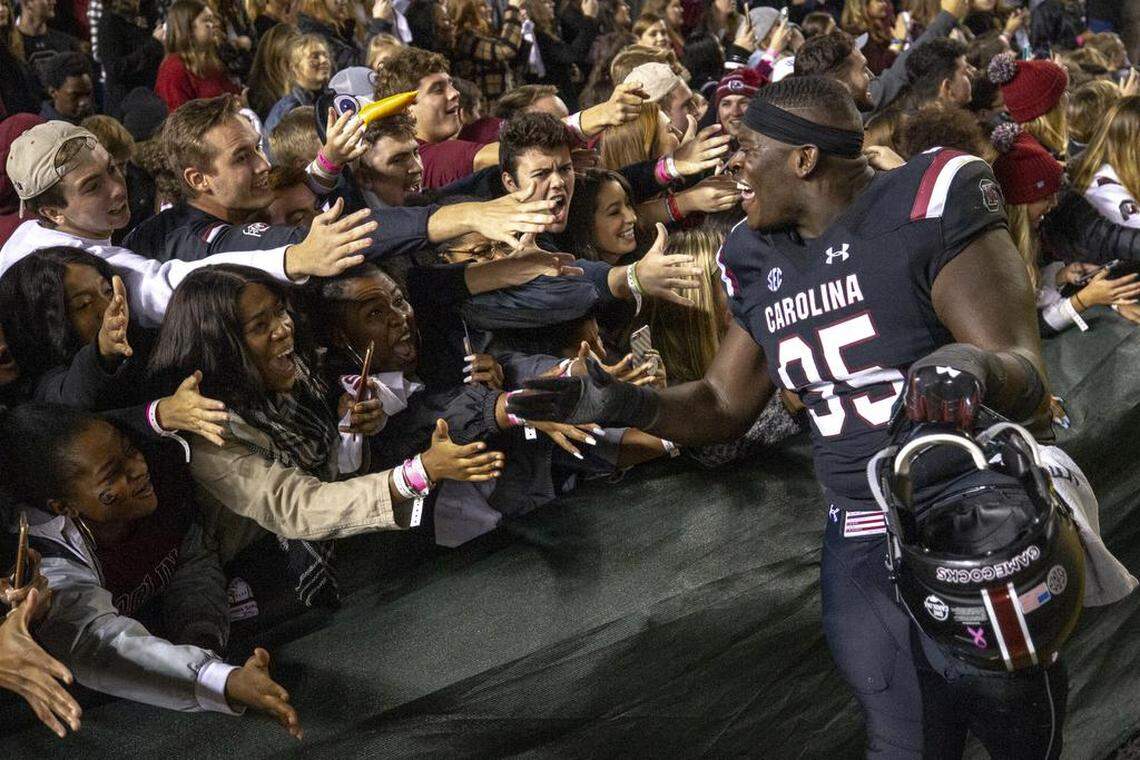
The 2014 Gamecocks football season stands as one of the most disappointing on the field in the program’s recent history. A team that opened in the season in the top 10 ended in the Independence Bowl in Shreveport, Louisiana.
But from a ticket perspective, it provides a fascinating window into how enthusiasm carries weight and how the flow of the season affects fan interest.
Grantham said the school aims for a scan rate of 80%, meaning the combination of standard scanned tickets and scanned student tickets is 80% of the total scannable tickets issued.
In the 2014 season, USC hit that 80% mark in its first four games. It had the advantage of a big Thursday home opener (Texas A&M, 84.1%), its first Saturday game against East Carolina (84.8% off an opening loss), an always well-attended opponent in Georgia (81.4%) and finally Missouri (86.4%) coming off an upset of the Bulldogs when USC was 3-1.
By the time USC started to fully disappoint, losing to Kentucky and eventually falling below .500, the three home games left included a pair of lesser opponents in Furman and South Alabama, both under 70% full, while the Tennessee game tipped in at just 72.1%.
That year’s total of 80.7% scanned is a high for the past five seasons, the years that South Carolina said it has data on hand. Since, the numbers dipped along with the team’s fortunes.
Judging the numbers year over year is tricky because Clemson is always a swing game. No matter how bad things are going or how the weather looks, Williams-Brice should be relatively full. Of South Carolina’s six games the past four seasons above that 80% mark, two have been Clemson games, three have been season openers and one was the much-hyped showdown with Georgia last season.
Last year’s overall percentage of tickets scanned was around 73%, discounting the rescheduled Akron game, which pulled the number down to 69.6% (far and away the worst attended game in the past five years). That first number was about in line with 2016, the previous season without a Clemson home game.
The overall calculus for the announced attendance includes between 2,500 to 4,000 tickets that can’t be scanned. That includes a range of non-ticket buyers, past the 78,500 capacity by seats.
“Stuff like the band,” Grantham said. “The entire band is a calculated number added to the bottom line. It goes in the attendance number because it’s required by the NCAA to report your band. That’s just added to the bottom.”
There’s the media in the press box and on the sidelines, the staffers in the concession stands, the police helping direct things in the building.
Even the players and coaches on the field get counted.
The bulk of the raw attendance numbers across most sports remains rooted in season tickets. USC sold 47,381 last season, a dip from the time when the program was riding high under Steve Spurrier. As of Tuesday before the home opener, the total for 2019 stood around 47,500, the first increase since 2014.
Percentage of football tickets scanned in (includes unused season tickets)
2014 | 80.6% |
2015 | 75.4 % (Clemson at home, lost LSU home game) |
2016 | 73.8% |
2017 | 78.6% (Clemson at home) |
2018 | 69.6% (73.2% without rescheduled Akron game) |
Nichols said that while the school monitors the show rate at football games, it’s almost always at the critical mass needed for a strong atmosphere. He equates that, and the home-field advantage it produces, as a key part of improving a team’s chances for victory.
Neither Grantham nor Nichols would speak about the impact of a possible change in alcohol policy, but Williams-Brice Stadium is getting some upgrades with more premium seating areas, and there’s hope that creates one kind of change.
“It would either eliminate one reason why we hear people aren’t coming,” Nichols said, “or it would validate that reason. I personally think that the club experience will be a phenomenal addition to gameday.”
That said, there have been some bumps the school wants to flatten out.
“We continue to focus on the experience,” Nichols said. “We’re not there yet. We’ve had hiccups from time to time with some of the gameday experience temporary staff that isn’t quite giving the service that we want.”
It’s another world from even just over a decade ago, when television was a different beast and the team still had a pay per view game on the schedule (the 2009 team had one PPV game, the 2008 team four). As Nichols pointed out, the school invested in improving phone service in the stadium and would still like to make it better. When asked about Wi-Fi, he said it could be a $7 million to $8 million investment that might need to be replaced only a few years down the line.
This year, South Carolina should be in line for a strong season when it comes to moving tickets. Clemson comes to Williams-Brice, as does Alabama. Instead of a late November FCS game, USC will face Appalachian State in the early part of the month. That game is traditionally Military Appreciation Day, when the school distributes in the range of 10,000 comp tickets that usually have as scan rate between 25% and 40%, according to Grantham.
To leverage the two big home games, early in the process the school linked those single-game tickets to the neutral site opener in Charlotte, but later on Gamecock Club members could buy those single-season tickets on their own. The Florida home game is being put in a publicly available mini-plan with Kentucky and any one of Appalachian State, Charleston Southern and Vanderbilt.
“Every year we get a new package,” Grantham said. “Every year we say, ‘These are the games you want to see,’ or ‘These are the games you might not want to see,’ and package those things up. We’re honestly taking what’s available. You have to be really, really smart about that stuff.”
Football season tickets sold
2008 | 54,347 |
2009 | 47,851 |
2010 | 45,985 |
2011 | 47,591 |
2012 | 49,195 |
2013 | 51,967 |
2014 | 54,005 |
2015 | 51,167 |
2016 | 50,395 |
2017 | 49,700 |
2018 | 47,381 |
2019 | 47,500 |
Men’s basketball
On Nov. 11, the South Carolina’s basketball game at Colonial Life Arena had an announced attendance of 9,083 against Norfolk State. Only 2,880 tickets were scanned.
Such is life for a college basketball team where uneven schedules, evening contests, TV demands and “buy games” make for some wild ups and downs.
Grantham said his measure for men’s basketball attendance success is less built on the overall number and more on the atmosphere.
“The students are a key part of that because they get almost 3,000 tickets available to them for basketball,” Grantham said. “Even if we have a lower attendance season ticket number for basketball, for any one game, if the students show up, it makes a huge difference in the atmosphere.
“If we’ve got a really high student show rate, maybe a little bit less of a season ticket show rate, and it’s still a great atmosphere.”
The Gamecocks were 24th nationally in average attendance in 2017-18, the year they came off a Final Four. The average announced attendance dipped by more than 1,000 a game, moving USC to 28th in the NCAA’s statistics site, no doubt hurt in part by a 4-7 start that included losses to Wofford, Stony Brook and Wyoming.
The scanned numbers went as low as 2,587 (North Greenville on the last day of the year) and as high as 13,456 against highly-rated Tennessee. The percentage of scanned tickets to total attendance (a rough estimate of how many are used), was around 52% the past two years, down from 55.4% the year South Carolina made the NCAA tournament for the first time in more than a decade.
Percentage of men’s basketball tickets scanned in (includes unused season tickets)
2016-17 | 55.41% |
2017-18 | 52.54% |
2018-19 | 52.21% |
The students can provide a bit of a question because the system to request tickets requires a little more foresight, and sometimes students come in with non-student tickets.
For Nichols, improving the crowd at Colonial Life Arena was more paramount. There aren’t any true “actionable” plans focused on football, just monitoring and watching data.
Things are different for basketball.
“The show rate is not where we want it to be,” Nichols said. “We did start some pilot programs to hopefully learn more about it and get more people to go to more games.
“The main thing that we do is, make sure that they’re educated on all the ways they can use their tickets. And that it’s important that there’s someone in their seat, whether it’s the seat owner or not. So what I mean is, either donating the ticket, sharing it with a friend, returning it to us. There’s lots of different options.”
Overall, the basketball program was at 7,755 season tickets last season, a dip from the previous few seasons and the third highest since 2009-10.
But, again, if the overall numbers are good, filling the building isn’t as important as something else.
“All the coaches want is the best home-court advantage they can get,” Grantham said. “How they get there, if the number is low but the atmosphere was great. Remember the atmosphere; they don’t remember the number.”
Men’s basketball season tickets sold
2003-04 | 8,967 |
2004-05 | 9,357 |
2005-06 | 9,491 |
2006-07 | 8,751 |
2007-08 | 7,937 |
2008-09 | 7,192 |
2009-10 | 8,117 |
2010-11 | 7,201 |
2011-12 | 5,748 |
2012-13 | 6,144 |
2013-14 | 6,691 |
2014-15 | 6,989 |
2015-16 | 7,909 |
2016-17 | 8,321 |
2017-18 | 8,577 |
2018-19 | 7,755 |
Baseball
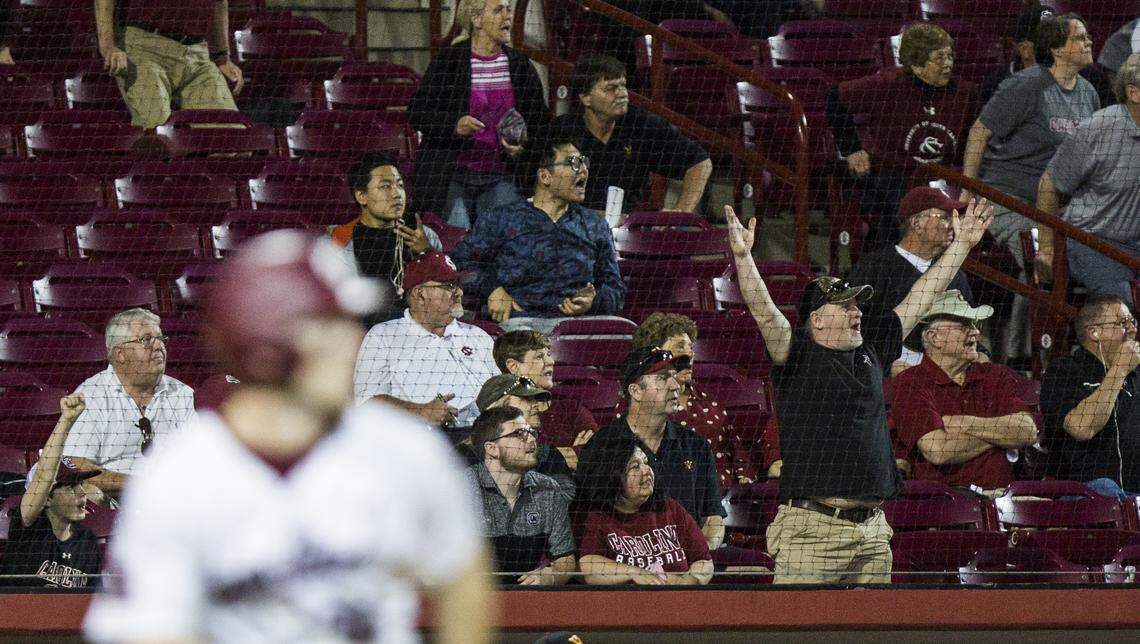
It’s a Tuesday afternoon in early March at South Carolina’s Founders Park. The Gamecocks are a few days removed from taking the annual rivalry series from Clemson, snapping a long drought both against the Tigers on the diamond and in the big three men’s sports.
The opponent is The Citadel. Weather is 46 degrees at first pitch. Attendance is announced at 5,807 of the 8,242 capacity, but only 1,135 tickets scan in. The next afternoon, attendance is announced at 5,622, but only 654 tickets are scanned in.
The baseball numbers can fluctuate wildly owing to a range of factors. There were 33 home games, more than a few on weekdays, some before the workday is over and many when the weather is still cold.
Much like basketball, the season tickets — 5,321 last season — carry the bulk of the announced attendance.
“Overall, we try to stay in the top five, six nationally in baseball,” Grantham said. “We still sell almost 6,000 season tickets. Despite the up-and-down nature of the team the past few years, our season tickets issued is really, really good. So our overall tickets is really, really good, so that’s helping our attendance.”
According to the data provided by USC, that season ticket number has slipped each year since 2015. To a degree that follows the fortunes of a program that came off a dominant run with Ray Tanner, slipped under Chad Holbrook and has been inconsistent in two seasons with Mark Kingston. (His NCAA tournament team in 2018 struggled early. His 2019 squad struggled once conference play began.)
South Carolina was again fifth in average attendance at 5,998, per the NCAA, and trailed four SEC teams, including perpetual leader LSU. That put the Gamecocks 15th in stadium capacity filled.
The school only provided scanned ticket data for the first 29 home games of 2019, but according to those numbers, 37.7% of those tickets were actually scanned. That’s the program’s lowest total since at least 2015.
The scan rate to total attendance numbers the past few seasons for baseball:
▪ 2015: 42.8%
▪ 2016: 48.6% (63.3% for five NCAA Tournament sessions)
▪ 2017: 43.0%
▪ 2018: 47.9%
▪ 2019: 37.7% (includes first 29 home games)
Examining the game-by-game data, the biggest movers to increase the numbers were high-profile SEC games, or at least SEC series where the numbers could stay near or over 50%.
As South Carolina marched to its worst conference season in program history, the Gamecocks topped 50% scan rate just twice after the opening series against Georgia, never better than 52.09%. It didn’t help that two of the four SEC series saw weather force doubleheaders on a Saturday and Sunday.
The Clemson game marked the 54th sellout in program history, the only sellout of the season and the high-water mark for the year. Founders Park sold out once last year, four times in 2017 and five times in 2016.
It’s a far cry from the glory years when the team sold out 15 times in 2012 alone.
“There’s been years where I’ve sold and issued and scanned in for baseball, and I don’t have all the records going back, but I know as I called them, I was calling the true number,” Grantham said. “We were scanning in the number of tickets that we actually issued, 7,900, 8,000 for a game. And we would call that number, and there were certain games where we would issue 8,242 tickets and we actually turned some standing-room only away.”
Baseball season tickets sold
Year | Total |
2015 | 6,073 |
2016 | 5,734 |
2017 | 5,598 |
2018 | 5,435 |
2019 | 5,321 |
Women’s basketball
When asked for scan numbers at the games for Dawn Staley’s team, South Carolina was unable to provide any.
The reason: No one had ever asked.
Grantham explained much of the tracking for women’s basketball wasn’t even done that formally until Staley arrived in the 2008-2009 season. He mentioned some games will have more attendance than tickets issued because of things such as the reading program, meaning fans get vouchers instead of scannable tickets.
Gameday managers keep counts of some of the information, but it’s not officially tracked.
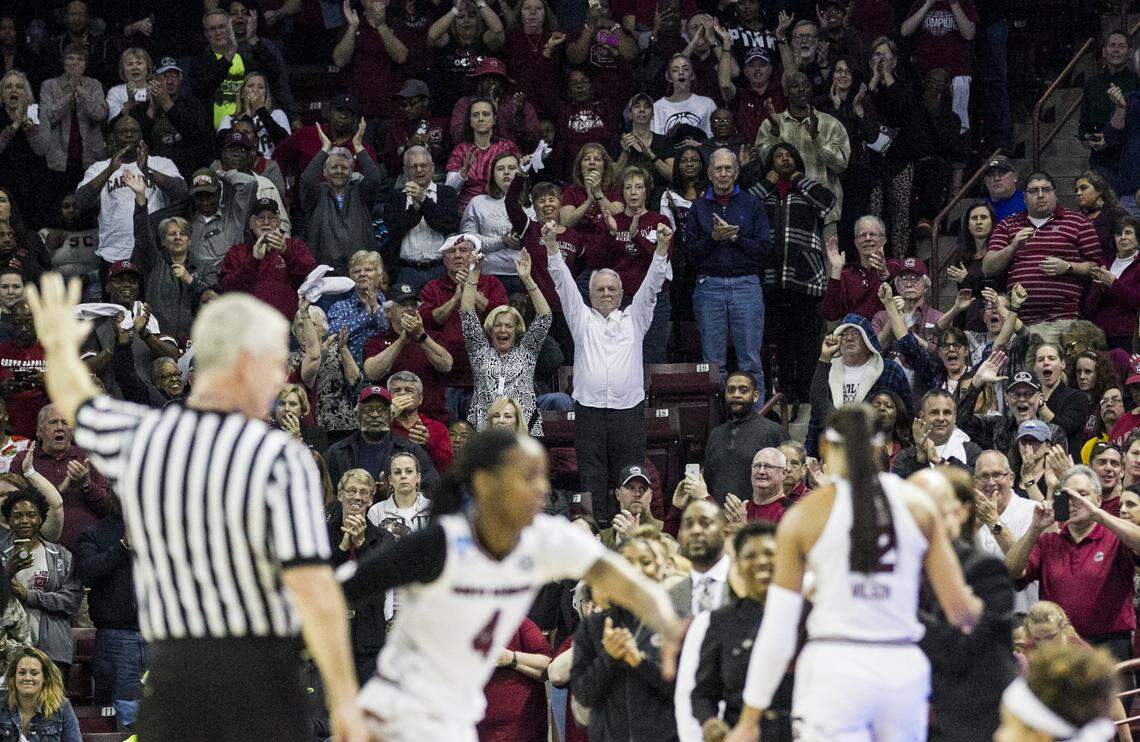
What has kept South Carolina in the upper echelon of the women’s basketball attendance world is a formidable season ticket base. It topped 10,000 from the 2015-16 season to the 2017-18 season, hitting 11,000 two of those years.
Last season, the first without A’ja Wilson, that number dropped to 9,521.
The average announced attendance settled at 11,542 in Colonial Life Arena (two “home games” were played in Charlotte for the NCAA Tournament), a dip of 1,697 fans a game.
Women’s basketball season tickets sold
Year | Total |
2015-2016 | 11,064 |
2016-2017 | 10,208 |
2017-2018 | 11,219 |
2018-2019 | 9,521 |
Fill the seats
As Grantham broke down the questions of tickets sold, seats paid for but not used, he rolled out benchmarks and overall goals. Sometimes it was atmosphere. Sometimes it was 80% scanned. Sometimes it was chasing that sellout when times were good or things just lined up.
At most football games, it’s a given some percentage of tickets simply won’t be scanned. The school will issue between 45,000 and 50,000 season tickets, and then another 10,000 to 12,000 for students. But there will always be a gap.
“They don’t get used,” Grantham said. “I don’t know if that’s because people, a family of four, brings one kid that week or what, but that’s part of the unknown that we’re always trying to solve and figure out why people don’t want to use all the tickets they’ve been issued. That’s part of it.”
Nichols fell back on a simple message when it came to filling the seats.
“You can’t affect the game at home,” Nichols said. “I think that’s a message we can do better getting out. You being excited and supporting from the stands has a direct impact on wins and losses.”
Part of that push was the $300 annual Go-Pass program the school started. For $25 a month, fans can attend any home game across the eight most prominent sports, excluding sellout situations. The barcoded tickets count toward the total and scanned attendance.
The programs offer a chance to fill out unsold seats and make the process of attending games with less notice more convenient and affordable.
The school also rolled out some new amenities for this football season, including grab-and-go food stands and an app that allows ordering concessions in advance.
The expectation is an extremely full stadium when Alabama comes to town the afternoon of Sept. 14. Last year, Williams-Brice was at 84.2% for the Georgia game despite blistering heat.
They’ll still have empty seats against non-SEC teams or when the weather doesn’t cooperate or when enthusiasm around the team is just down. The public numbers will still reflect what’s sold, and the scan numbers will still be tracked by the school because there’s value in knowing the number of actual people in the building.
“They do it internally because it gives us a true number of what’s called ‘per-cap,’ ” Grantham said. “It’s basically how many dollars per person was spent on concessions and those kind of things. That’s the reason the internal number is kept nowadays. It’s become important in the last few years to maximize concession value. We want to be able to sell concessions in the best way and the most efficient way possible.
“Oftentimes, it’s a hybrid number you give the NCAA.”
The official attendance numbers remain a little cleaner, a little more understandable in the vernacular of how fans understand them.
This year, Williams-Brice opens in the second week of the season, as the Gamecocks started off in Charlotte against North Carolina. They’re home against an FCS opponent, often a damper on attendance, though the first Saturday opener tends to do well. Then comes Alabama, a game almost sure to be near capacity, a trip to Missouri and then a return home to Kentucky.
How things go depends in part about the feelings stemming from the Alabama game, and if USC can come out on top against the Tigers and Wildcats. USC knows the baseline will be high, as always. But it remains to be seen if they’ll hit those behind-the-scenes benchmarks to get the atmosphere they want.
“We’re fortunate,” Grantham said. “We know not everybody sells between 45,000 and 50,000 season tickets in a given year. There’s a lot of programs that don’t.”
Three highest and lowest scan rate football games since 2014
Highest
Date | Opponent | Percent | Scanned to announced attendance |
Sept. 16, 2017 | Kentucky | 89.6 | 73,925/82,493 |
Nov. 25, 2017 | Clemson | 87.5 | 72,584/82,908 |
Sept. 27, 2014 | Missouri | 86.5 | 72,213/83,493 |
Lowest
Date | Opponent | Percent | Scanned to announced attendance | Note |
Dec. 1, 2018 | Akron | 38.5 | 20,548/53,420 | Rescheduled game |
Nov. 17, 2018 | Chattanooga | 54.5 | 39,672/72,832 | Cold weather |
Oct. 22, 2016 | UMass | 63.9 | 46,954/73,428 |
Three highest and lowest scan rate men’s basketball games since 2016-17
Highest
Date | Opponent | Percent | Scanned to announced attendance |
Dec. 21, 2016 | Clemson | 77.0 | 13,118/17,026 |
Jan. 1, 2019 | Tennessee | 74.8 | 13,456/18,000 |
Feb. 4, 2017 | Georgia | 73.9 | 13,229/18,000 |
Lowest
Date | Opponent | Percent | Scanned to announced attendance |
Jan 3, 2018 | Missouri | 23.9 | 2,357/9,846 |
Nov. 13, 2016 | Holy Cross | 27.2 | 2,522/9,270 |
Dec. 31, 2018 | North Greenville | 28.8 | 2,587/8,974 |
Three highest and lowest scan rate baseball games since 2015
Highest
Date | Opponent | Percent | Scanned to announced attendance |
March 12, 2017 | Clemson | 88.4 | 7,283/8,242 |
March 2, 2018 | Clemson | 84.7 | 6,979/8,242 |
March 4, 2016 | Clemson | 82.6 | 6,805/8,242 |
Lowest
Date | Opponent | Percent | Scanned to announced attendance | Note |
Feb. 19, 2019 | Winthrop | 9.6 | 555/5,771 | Bad weather |
Feb 17, 2015 | Furman | 9.9 | 665/6,652 | |
March 6, 2019 | Gardner-Webb | 11.6 | 654/5,622 |
Ben Breiner: BreinerTheState
This story was originally published September 5, 2019 at 5:00 AM with the headline "The reality of Gamecocks attendance numbers: How many fans really fill USC’s venues?."
