
10 years ago, Clemson-Wake Forest game had major ACC implications. Sound familiar?
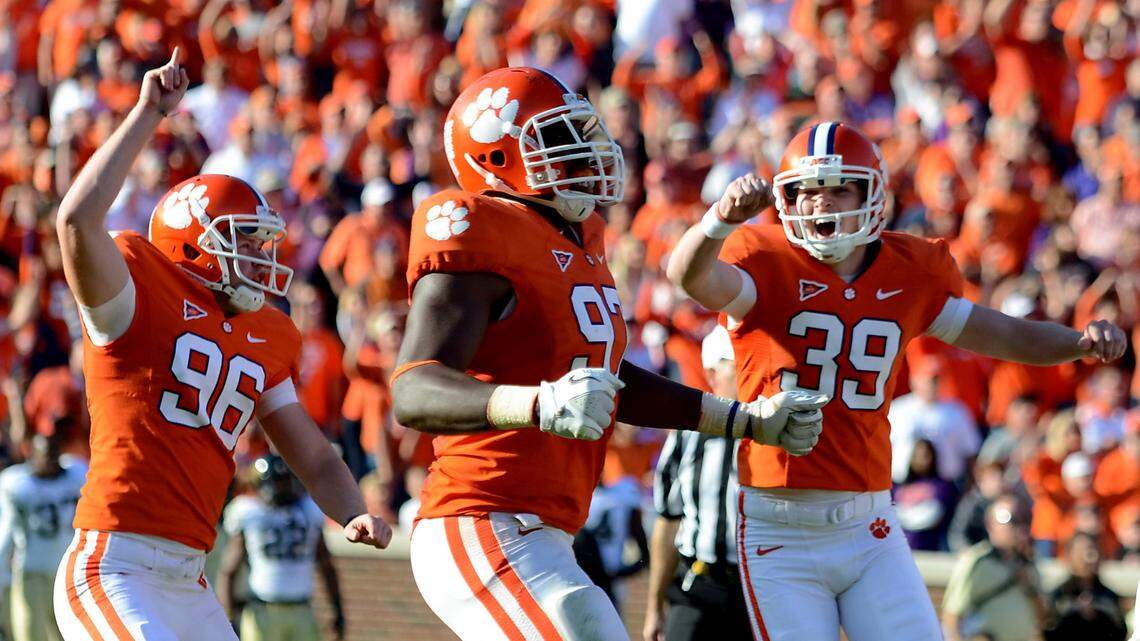
Brandon Ford played in 44 games with 14 starts during his time at Clemson. Out of all those games, playing Wake Forest in 2011 ranks in the top five, he says — if not top three.
“It was a vital point where we were either going to take that next step or not,” Ford recalled of the game sandwiched between two ACC losses. “There was no looking back. This was our time now to do it. Let’s do it.”
And, they did.
Clemson entered the game 8-1 overall (6-1 ACC) and defeated Wake Forest 31-28 on Chandler Catanzaro’s last-second field goal to clinch the Atlantic Division. The Tigers advanced to the ACC Championship Game and beat Virginia Tech 38-10 for the program’s first conference title since 1991.
Ten years later, the Tigers’ game against Wake Forest is, once again, a pivotal contest with Atlantic Division implications. In a turn of events, the Demon Deacons are the 9-1 team and averaging 44.7 points a game. They don’t have a conference loss and can clinch the division with a win in Saturday’s noon contest.
On the other side, beating Wake Forest would give the 2021 Tigers (7-3, 5-2) a chance to still be in contention for the division title heading into the final week of the regular season.
“I do remember we won (in 2011) on a game-winning field goal, so that’d be nice to do this weekend, too. Obviously, we’d like to win by a little more but, hey, we’ll take a win where we can get it,” said Tigers wide receiver Will Swinney, who was 13 that year and responsible for charting players’ touches. “The division’s still going to have to run through us right here in Death Valley, so we just want to defend our home turf and really just go attack the day and get a win.”
In addition to improving their ACC title chances for a potential seventh straight league crown, the Tigers want to keep their 33-game, home-field winning streak alive. There’s also a possibility of an 11th straight 10-win season if they win the last two games of the regular season and a bowl game.
That current streak began with the 2011 Clemson team.
Making changes
Clemson went 6-7 in 2010, a season Ford still refers to as a gut check.
It still stands as head coach Dabo Swinney’s only losing season as a head coach. That offseason, the program made coaching staff adjustments that included the firing of running backs/special teams coach Andre Powell and offensive coordinator Billy Napier. Chad Morris was brought in as the new OC and former Tiger Tony Elliott returned to Clemson to be the running backs coach.
The players, too, took it upon themselves to make sure a losing record would never happen again.
“We just bonded more so off the field and it translated,” former running back Andre Ellington said. “When I say off the field, I mean training and stuff like that, working-out wise in the offseason, so it kind of motivated us to go into the season.”
Morris and Elliott, who Ellington called the unspoken hero, provided a spark for the offense, though not right away. Ellington admits he was resistant to his new position coach at first, having been in Powell’s system for his whole collegiate career up to that point. The Moncks Corner native said he and Elliott didn’t start to click until the two had a heart-to-heart talk and found common ground.
“He sat me down and was like, ‘Look, we’re from the same place,’ ” Ellington recalled. “ ‘I’ve been through what you’ve been through.’ I think that’s what made me connect with him more. It wasn’t anything on the field. It was as a person off the field. I was able to relate to him. The corrective criticism he was giving me towards my game was making me better. I started realizing it was making me better, so that made it go as well.”
That year, Clemson started off 8-0 and averaged 40.6 points per game in that span, which included a 38-24 win over Auburn on Sept. 17, 2011, and a 35-30 win over Florida State the next week. The high-scoring affairs were a stark contrast to the group averaging 24 points the year prior.
“I think we opened a lot of eyes with the talent and production we had, especially on the offensive side of the ball because defense was always carrying us,” Ford said. “It was a lot of preparation that went into it, a lot of guys buying in and trusting each other. When you kind of hang with each other off the field and you know how guys are and you build that bond, it correlates and goes straight to the field, so it was just a lot of chemistry that we created off the field that translated on the field as well. It was a complete team effort that whole year.”
The Tigers’ winning streak ended at eight games after Georgia Tech dealt them a 31-17 loss in Atlanta, a place where Clemson’s current record stands at 15-44-2. Ellington, in particular, took the loss personally because he was out with a sprained ankle.
A late rally
After falling on the road, the Tigers knew what was at stake coming home to play Wake Forest. Yet, it was still a roller coaster of a game. They led the Demon Deacons 14-7 at halftime then gave up 21 third-quarter points to the Deacs.
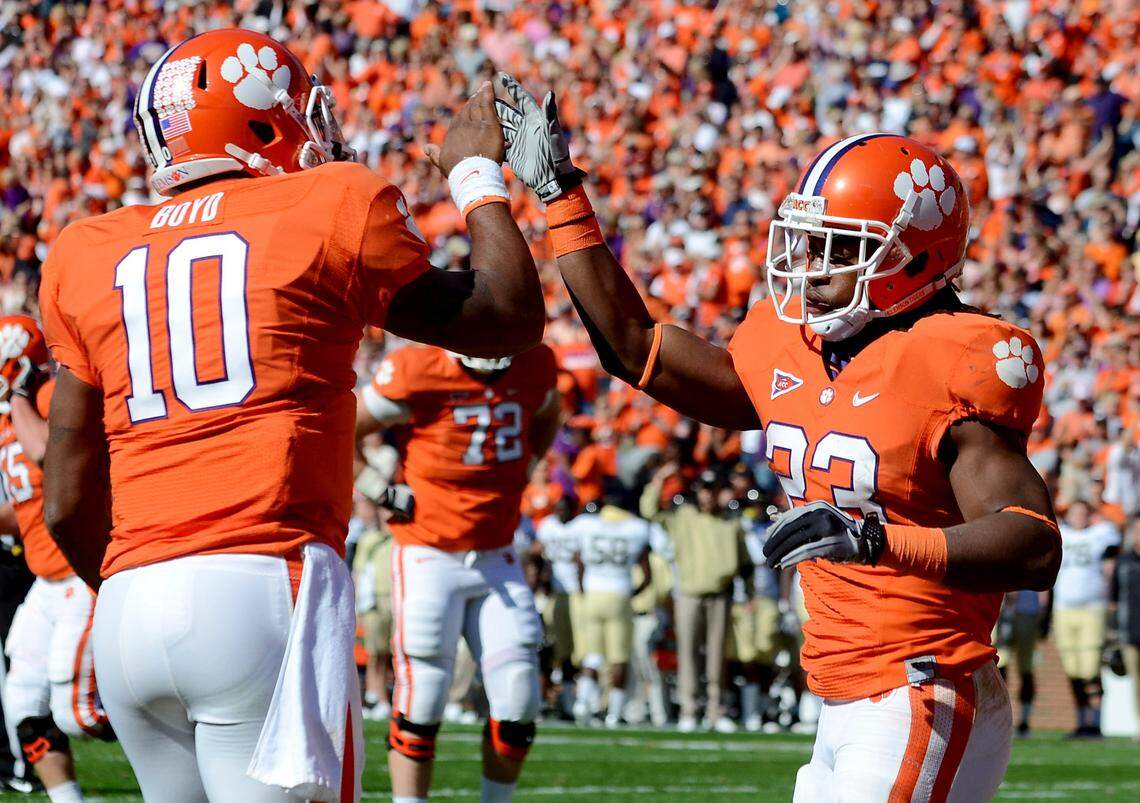
Facing a 28-21 deficit after three quarters, the Tigers’ defense shut out the Deacs in the final 15 minutes. The offense complemented that effort with quarterback Tajh Boyd’s 10-yard touchdown pass to wide receiver Jaron Brown to tie the score with about five minutes remaining in regulation.
Clemson then got the ball back with 52 seconds on the clock. Starting the possession at its 33-yard line, Boyd, now on Clemson’s support staff, went 3-for-4 passing, getting down to the Wake Forest 26-yard line. With seven seconds left, Chandler Catanzaro kicked the game-winning, 43-yard field goal, sending the football through the uprights as time expired.
Ellington, who scored twice in the first half and finished with 98 yards on 25 carries, doesn’t remember specifics about the game, though he does remember how crazy the environment was in Death Valley. He likened it to triangle offense in that fans, players and coaches were all connected and fed off one another’s energy.
For Ford, who had three catches for 51 yards in the game — which included a 7-yard, toe-tap TD grab in the third quarter — some of the details were a bit more vivid.
“We had a huddle on the sideline in the third quarter talking about how this was a game that could change a lot of things because it was actually the deciding game for us going to the ACC championship,” he said. “We pretty much rallied back off of some big plays. … That was kind of one of the things that stood out was a lot of guys who stuck together, not just on the field but off the field, were some of the main guys making the plays out there on the field.”
Clemson lost to N.C. State the next week 37-13 but still got in — and won — the ACC Championship Game, ending the year with a 10-4 record following a 70-33 loss to West Virginia in the Orange Bowl.
While it ended with a loss, that season began the Tigers’ 10-year streak of recording double-digit victories.
“A lot of people always talk about the 2008, ’09 era was the building phase, but I take it back to guys who did it before us,” Ford said, “years before that, because even though they were handling success well and still having disappointing finishes, I feel like they started that. They showed us.
“As we got to those years in 2011 and ‘12 and we started to build those 10-win seasons, I think it kind of set the standard before obviously the playoffs came along that we want to be talked about. ... We want to be the teams that are playing after New Year’s and not the teams that are playing early bowl games. We wanted to be that top 10 to top 5, if not, top team.”
A vision fulfilled
The 2011 season was only Swinney’s third full season as a head coach at Clemson. Even then, he envisioned what he wanted the program to look like during his tenure. The Pelham, Alabama, native told his players everything he wanted to see. Just about all of it has come true, Ford said.
The Tigers have won two national championships and seven ACC titles, six of which have been consecutive, in addition to the current 10-year streak of 10 or more wins.
The chance for a seventh straight ACC title is also still on the table. If Wake Forest loses its final two games and N.C. State loses one more, the Tigers will be in first place in the Atlantic Division and on their way to Charlotte on Dec. 4.
It’s a bizarre scenario considering all of the offensive struggles the Tigers have had. The unit ranks 106th nationally in total offense with 344.9 yards per game and 24.4 points per outing, which pales in comparison to last year’s numbers of 43.5 points and 502.3 yards a contest. Ellington also pointed out a slower offensive tempo this season than the ones he played in during the early 2010s.
The struggles of the 2010 and 2021 teams are similar, Ford noted.
“With the missed opportunities and big plays and just key blocks or passes being dropped or missed reads, taking sacks, missed tackles, I mean a bunch of ... miscues, whatever you want to call it. ... In 2010, we were the same way,” he explained.
Six of the group’s seven losses were by single digits in 2010 as opposed to the 2021 group having six of its seven FBS wins coming by 10 points or less.
Clemson, however, is hoping its gut-check moment happens sooner rather than later in repeating the history from 2011 against the Deacs instead. The Tigers lead the series 68-17-1.
“We didn’t know we were going to be good until we went through the bad year,” Ellington said. “They just gotta be reminded of where it all started. If they want to step in those shoes, they’ve got to do it.”
This story was originally published November 18, 2021 at 6:00 AM with the headline "10 years ago, Clemson-Wake Forest game had major ACC implications. Sound familiar?."
