
In Beaufort County, helping ICE deport immigrants will come at a cost | Opinion
Federal officials have been told to arrest 3,000 undocumented immigrants a day for what President Donald Trump is calling the single largest mass deportation program in history. That would be 90,000 arrests a month and more than a million a year.
That would be 3.5 million arrests between now and the end of Trump’s second term.
That’s a lot of workers who have helped keep the U.S. economy humming by working tough jobs such as housekeeping, landscaping, construction, berry picking and dishwashing, to feed their families who have been living safely among us for years.
Is it also a lot of serious criminals prone to murder, rape and drug deals?
To hear Trump tell it, yes.
But facts matter.
Horrible crimes have happened. Yet multiple studies show documented and undocumented immigrants commit fewer crimes than native-born Americans.
And a Gallup poll released Friday shows fewer Americans “back hard-line border enforcement measures” and more “favor offering pathways to citizenship for undocumented immigrants already in the U.S.” than a year ago.
To meet Trump’s goal, the U.S. government has expanded a program to enlist help from state and local law enforcement officers, some of whom are being deputized to detain people based on immigration status to expedite federal deportations.
This has fueled concerns about racism and people disappearing in other countries.
In Beaufort County, Sheriff P.J. Tanner applied for the program over opposition from some residents. A public hearing on the issue last week offered insight and intensity.
The crowded, emotional community meeting at the Beaufort County Sheriff’s Office headquarters on Tuesday, July 8, showed why law enforcement agencies are flocking in droves to a nearly 30-year-old program — and why many locals find it so unnerving.
Is it a tool or a trap?
As of July, U.S. Immigration and Customs Enforcement (ICE) has signed 805 memorandums of agreement with state and local law enforcement agencies in 40 states under a program commonly known for the code section creating it — 287(g).
Before this year, the most active 287(g) agreements in one year was 152 in 2021. In Trump’s first term, the program peaked at 78 participating agencies in 2020. It has now risen to 10 times that. And 39 more agencies have applied, so it’s only growing.
Tanner applied to create a local “task force” to work with ICE in February, the most aggressive of three potential partnership levels. Beaufort County also employed that model from 2008-2012, training and empowering five deputies as immigration agents to enforce federal immigration laws. This time, Tanner says, he won’t need five.
Using this model, officers can undertake the federal role of inquiring about a person’s immigration status and detain people for potential deportation. The other two partnership models only allow the investigations of people already under arrest.
Driving fears in Beaufort County is the program’s history of racial profiling in parts of the country and an unclear picture about how much the program improves public safety and how much it harms trust in the police among — and crime reporting from — Latino community members at the center of Trump’s deportation push.
Tanner said the program offers him a technological tool he wouldn’t otherwise have, access to a database listing individuals from many countries who may be in the U.S. illegally. He said it “is imperative in order for us to keep our community safe,” and that he will employ one deputy as part of the program out of the 250 working for him.
He said the deputy won’t be driving around in an unmarked car, wearing a mask with no name tags, as in Los Angeles.
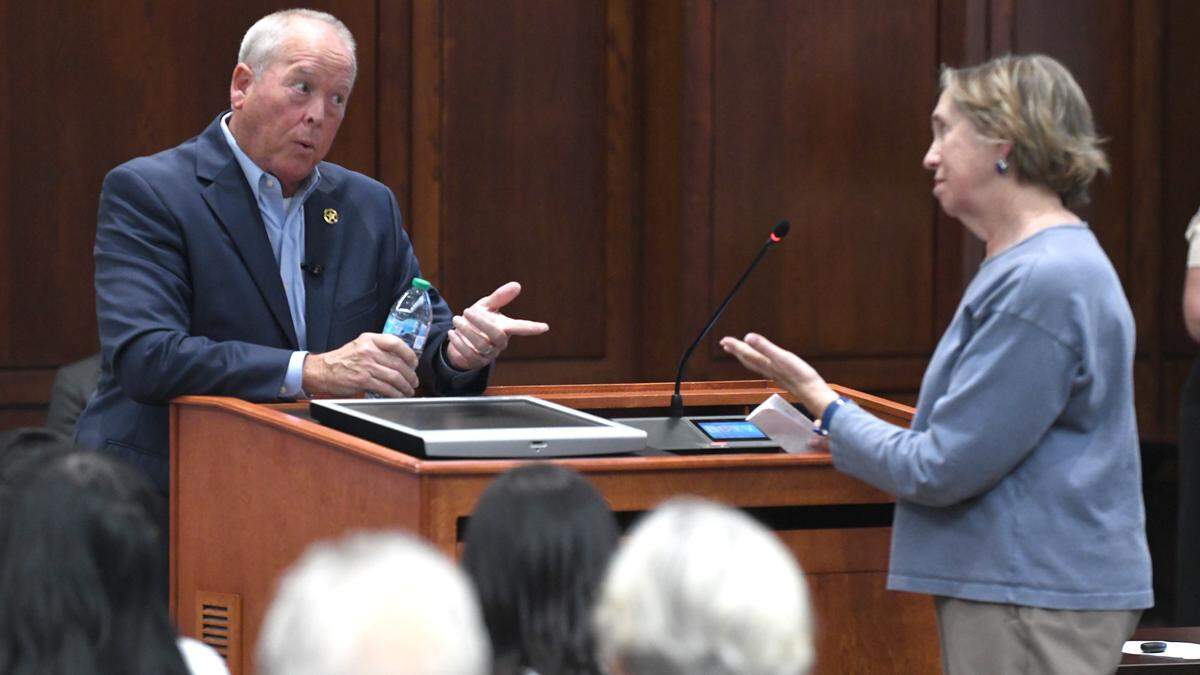
Tuesday, Tanner stood in front of about 150 people. Not one expressed satisfaction or pride about his plans to take part in the program. Every speaker who took turns stepping to a microphone criticized him as he stood close by with a mic of his own.
“The contract gives us the access to the information, OK?” he said. “Y’all are looking at this like we’re gonna have 350 deputies out here running the streets of Beaufort County, picking up people from Walmart or the Publix. That’s not the case at all, OK?”
“You’ve said you have one of the most innovative, progressive departments in South Carolina,” Ana Ramirez, a Beaufort County resident who advocates for the immigrant community, told Tanner at one point. “Your job is to protect and serve all, and right now, you are not protecting my community. You’re endangering. You’re causing my community members to go into hiding.”
Aimee Deverall, a local immigration lawyer, told Tanner that a client’s family car had been shot up the other night while parked outside a bedroom where children slept.
“There were two bullets inside the car that didn’t come out, but we are afraid to call the police because of everything that is happening with immigrants. What do you recommend that we do?” Deverall said, relaying the client’s story, fears and question.
“Normally, that would have been an easy question for me to answer, sheriff, and I’m embarrassed that it was not an easy question for me right now. The buck stops here. You did that,” she told Tanner. “We want the bad guys taken care of. But what this program does, it affects the victims. Then you have victims that are scared to come forward because they don’t know what’s going to happen to them. We can’t guarantee what’s going to happen to them when 287(g) is involved. And when people don’t report, the bad guys go free and we’re all less safe.”
Tanner has been sheriff in this heavily Latino part of the state for 26 years, at times re-elected without facing an opponent. To stay in office in 2026, he’ll have to persuade voters that he’s right about this program. That may be a tough sell in a county where Latinos and Hispanics have become a larger and larger part of the overall population and the student population in recent decades.
What will it cost us?
Tanner took part in the program from 2008-2012 when it saw new life under President Barack Obama, who was sometimes called the “deporter-in-chief” for his approach to immigration.
Tanner applied to take part in 2017 but was not accepted into the program in Trump’s first term.
Tanner applied again this year as part of the current wave of new applicants.
It’s not clear when a decision will come or why it has taken so long when other agencies have been included.

Tanner said the program won’t bring any additional direct costs to the sheriff’s department because he will just be deputizing one sheriff’s deputy with limited immigration authority.
He said the feds would pay for that officer’s training while the department covers salary, equipment and vehicle costs, which they would have been paying anyway if the officer had other priorities.
Yet a former Charleston County Sheriff once said that long jail waits for ICE detainees that can last more than a month left taxpayers on the hook for $4 million in annual obligations because federal funding only covers about 40% of the costs associated with housing ICE detainees.
That’s real money.
And it’s a real problem if people in a community are less inclined to report the crime that’s actually happening because law enforcement is cracking down on immigrants whose lone offense was the misdemeanor violation of entering the U.S. without proper documentation.
The Beaufort County Sheriff’s Office is generally doing a good job of keeping its residents safe. Those residents are right to ask the sheriff not to make matters worse.
If undocumented immigrants are committing actual crimes, especially serious crimes, they should be given due process and face appropriate punishment, no question
But is Beaufort County’s crime rate rising with its immigrant population?
The answer is no.
Vim, vigor and venom
Here is Tanner’s most compelling case for Beaufort County to participate in the federal program:
“The reality is, I know, based on my experience, what tools this agency needs to make Beaufort County a safer place, and that’s exactly what I’m going to do with those tools. If you’re worried about constitutional rights, I understand what you’re saying. I’ve been doing this for a long time.
“Have you ever been worried about someone’s constitutional rights with me in this office? The answer is no. I police citizens every day, and these men and women that work here do an amazing job, and they will continue to do an amazing job. They respect everyone in this county. They appreciate everyone in this county. But laws have to be enforced. And the 287(g) program is a small entry into a door of a lot of knowledge that’s important for this community to remain safe. You don’t know who’s living in your community. Neither do I. We always want to think the best of everyone, and we should give everyone the benefit of the doubt, but there are bad actors in every community throughout not only this county but throughout South Carolina.”
It’s a good pitch.
Yet at the contentious meeting there were also questions Tanner did not answer.
“Does Beaufort County have a problem with illegal immigrant crime?” one resident asked him. “And if so, do we have the statistics to back that up? And then from what I’ve read, illegally entering this country the first time is a misdemeanor, so are we going to be prosecuting all misdemeanors with this amount of vim and vigor and frankly, venom?”
Residents are still awaiting those answers, which Tanner should have had at the ready.
Look, he deserves credit for not just meeting with members of the public who he knew would be critical of him but also listening to them and offering the answers that he did, especially at a time when some politicians are abandoning town halls to avoid crowds and political theater.
But Tanner didn’t reassure the room as he could have.
Ramirez called Tanner’s responses “dismissive” and “unacceptable.”
Deverell told Tanner that ICE is getting the support of a new, massive spending bill with a huge budget boost for Trump’s deportation program. “They have plenty of help,” she said. “They don’t need your help, respectfully, sir, OK. We need your help.”
A man identifying himself as a Marine and a local businessman raised another issue.
“We don’t easily talk about the slavery today, right?” he said. “Even though it ended 160 years (ago). But the damage that it caused to many, many other generations in the future that still exist, we feel a shame about slavery. We don’t feel proud. Sometimes we dismiss it. ‘Yeah, my parents or my family didn’t own any slaves.’
“Well, right now we’re not seeing any chains. We don’t see any public auctions. But the same effect is going to happen in the next generation of Latinos here in Beaufort County.”
That sentiment should be troubling to Tanner. It should show him the scope of the fear, and how quickly hard-won trust can disappear. It should unnerve him that Latino residents reporting less crime may make the county less safe.
Tanner should hold another public hearing if his office is accepted into the 287(g) program to answer the questions he did not. Tanner should also provide regular updates after that, and the Beaufort County Council should require them at its meetings each month, to keep the public informed about the encounters, detentions and deportations resulting from a program that merits more scrutiny nationally.
There is a cost to taking part in this program. That will become clearer with time.
This story was originally published July 14, 2025 at 5:00 AM with the headline "In Beaufort County, helping ICE deport immigrants will come at a cost | Opinion."