
Do voters really know why they are Republicans or Democrats?
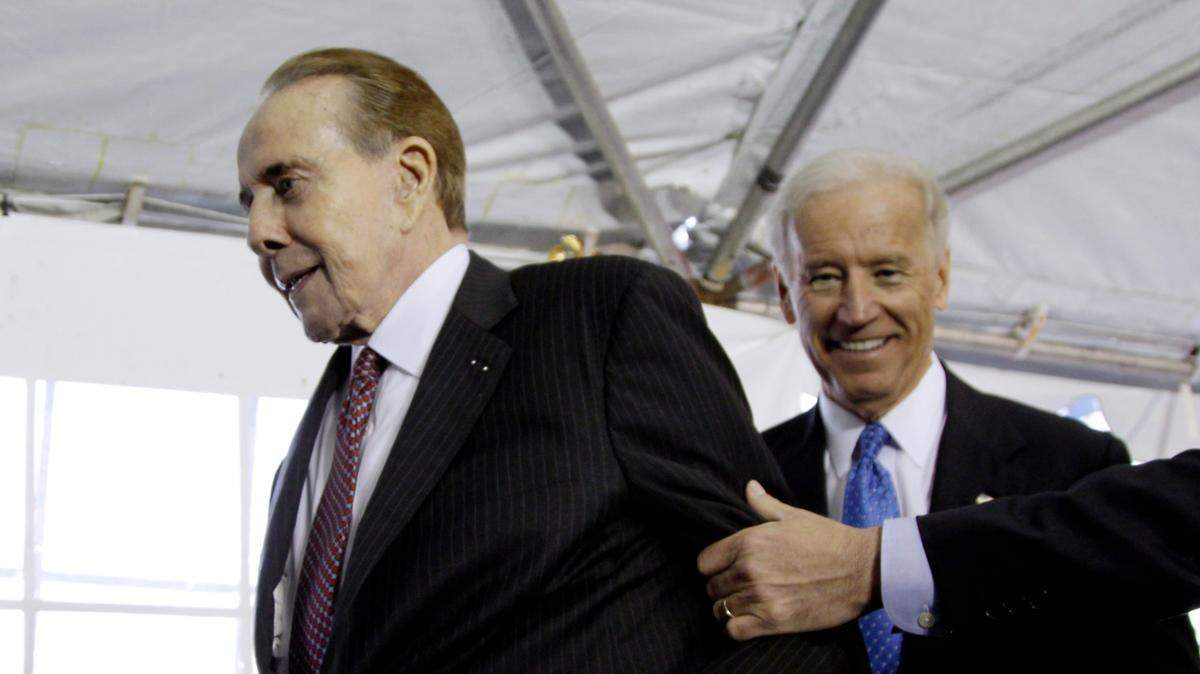
Partisanship is in the DNA of U.S. politics, and it is not necessarily always unhealthy. The late Bob Dole of Kansas, was an unabashed conservative Republican who worked across the aisle with Democrats on legislation when he was majority leader of the U.S. Senate.
Dole was witty, often sharp-tongued, but civil. He put the interests of the nation above his political party’s objectives ‑ typical of political leaders of previous generations.
I was reminded of three senators from Illinois – Charles Percy, Adlai Stevenson III, Paul Simon – in reading a manuscript for a former colleague, Bob Hartley. The book is about the presidential aspirations of the three.
Percy was a moderate Republican, Stevenson and Simon, moderate Democrats. Some Illinois Republicans of his time felt Percy was liberal; the same for some Democrats on Simon. Regardless of party leaders’ opinions, Percy and Simon had strong voter appeal.
PERSONAL POLITICS
Partisanship is hardly new, but its expansion and vociferousness are concerning. Years before I was of voting age, my so-Republican mom recited this:
“I had a little pony,
It was almost human;
I lifted its tail
And there was Truman”
Really, Mom! That likely was in the 1948 presidential election campaign. The pundits said New York Gov. Thomas Dewey had a lock on being the president – ending a 16-year run by Democrats Franklin Roosevelt and Harry Truman, who became president upon the death of FDR in 1945.
After a famous whistle-stop campaign, President Truman won in 1948 and Republicans had to wait four more years to occupy the White House. (In 1952, Dwight Eisenhower, R, overwhelmingly defeated Adlai Stevenson II, D.)
WHY SO PARTISAN?
My sister Diane Brown and I have talked about Mom’s partisanship. We don’t know why she was such a zealous Republican. Our dad was the opposite of outspoken about political party affiliation, at least when we were growing up.
Much later, he told me he had only voted for a Democratic president in 1932, when FDR won. “And I was sorry I did,” Dad added. Our parents’ Republicanism applied to national and I imagine state candidates and issues.
They often said they “voted for the man, not the party” in local, county and regional (state legislature) elective offices. Christian County, Illinois, was more Democratic than Republican.
Our maternal grandmother was outspokenly Republican. I speculate that our Mom was a Republican much more by inheritance than conscious choice. I doubt that she ever asked herself, “Why am I a Republican?”
GOP VALUES
I’ve wondered if Mom would have voted for Donald Trump. (She died in March 1976 months before Jimmy Carter was elected, defeating President Gerald Ford. He became president after Richard Nixon resigned.)
Would Mom have asked what Republican values Trump stands for? Decency? Civility? National interest? Smaller government? Equal opportunity? Voting rights? Many are asking, including for-now former Republicans who helped elect Joe Biden, or people Trump terms RINO, (Republicans In Name Only) because they challenge the former president’s big lie about the 2020 election and ask questions about his role in the Jan. 6, 2021, assault on the U.S. Capitol and attempts to overturn the election.
The most puzzling Trump supporters may be so-called “Christian evangelicals” who seem to put aside his behavior. They might ask themselves which Judeo-Christian values Trump best embodies?
The rule of law. Voting rights. Equality. Civility. Speaking out about falsehoods. These are important to U.S. democracy and to the major political parties.
Folks who consider themselves Democratic or Republican perhaps should ask why? My hunch is a huge number don’t really know.
_
D.G. Schumacher is a part-time senior writer for The Sun News