Can venomous copperheads in SC climb trees? 5 myths about the snakes debunked
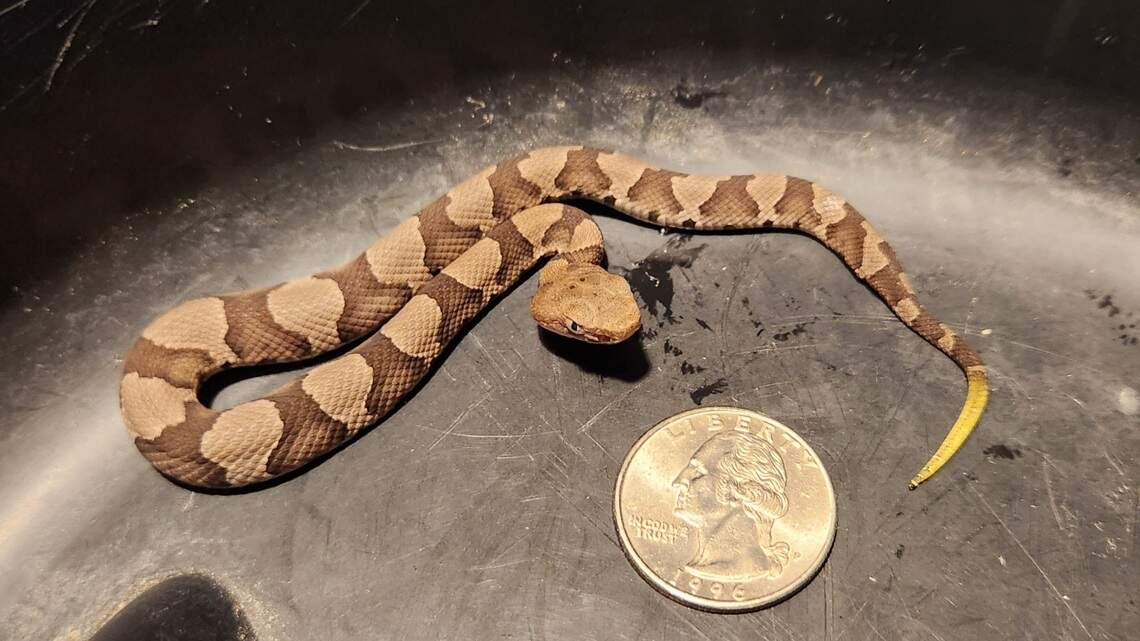.jpg "Size comparison: This picture shows a newborn copperhead next to a quarter.")
It’s hot in South Carolina again and that means snakes are once more slithering wherever they want. And in the Palmetto State, there’s no snake quite as infamous as the copperhead.
The most common venomous snake in South Carolina, the copperhead, while it prefers to avoid human contact, can often be found in yards and gardens, which can cause problems for homeowners.
Given its ubiquitous and potentially dangerous nature, some myths about the copperhead snake have developed over the years. Below are details on how to identify a copperhead, followed by five of the biggest myths about the snake.
How to identify a copperhead
When it comes to snakes, it’s important to know what you’re dealing with before you, your pet or your child have an unfortunate encounter.
The copperhead gets its name from the coppery-tan color on its head and on parts of its body, Clemson Cooperative Extension states. Copperheads have triangular-shaped heads, similar to an arrowhead and can grow up to 4 feet long.
Copperheads also feature an hourglass-shaped pattern on their bodies — from the head down to the tail. When curled up, this camouflage can make them look like a pile of leaves. And like most other venomous snakes in South Carolina, copperheads have yellow eyes with black vertical and elliptical pupils.
Are baby copperheads more dangerous than adults?
The myth is that baby copperheads can’t control their bites. As such, the little snakes end up excreting much more venom, making them more deadly than the adults.
Turns out there’s no truth to the myth, according to Critter Control of the Triad.
“This myth has been repeated forever and is not based on anything,” Critter Control states. “That doesn’t mean their bites aren’t dangerous — just not more-so than adult copperheads.”
Copperheads smell like cucumbers?
If you’re out in your yard or in the woods and suddenly detect the scent of cucumbers in the air beware — copperheads are nearby. At least, that’s the common myth.
In truth, copperheads do have a unique scent to their musk, “it does not smell like cucumbers, nor does it mean that a copperhead is near,” Georgia Department of Natural Resources states.
Can copperheads climb trees?
There is a bit of truth to this one.
Some snakes do indeed climb trees to search for prey. For instance, rattlesnakes climb trees from time to time.
Copperheads usually stay on the ground, but they will sometimes climb into low bushes or trees in search of prey or to enjoy the sun, according to Live Science.
You’ll need a limb amputated from a copperhead bite
While copperheads are venomous, their bites are rarely fatal, according to the National Library of Medicine.
“Most patients recover and resume activities of daily living within 2-4 weeks,” NLM states.
Also, copperheads will often “dry bite,” where they don’t excrete any venom, according to Critter Control.
Copperheads travel in pairs
It’s often said that copperheads are typically found in pairs. However, that is a misconception, Georgia Department of Natural Resources states.
“While it is possible to find multiple snakes in an area, this misconception likely comes from finding snakes together simply because the location had ample food or desirable shelter options.”
Copperheads prefer to live and hunt alone. They are generally ambush predators and rely mostly on their camouflage. A copperhead will simply sit and wait for prey to pass by, then deliver a swift, venomous bite.
This story was originally published May 8, 2025 at 6:00 AM with the headline "Can venomous copperheads in SC climb trees? 5 myths about the snakes debunked."