
Last defendant in SCANA/Santee Cooper nuclear power plant debacle sentenced to prison
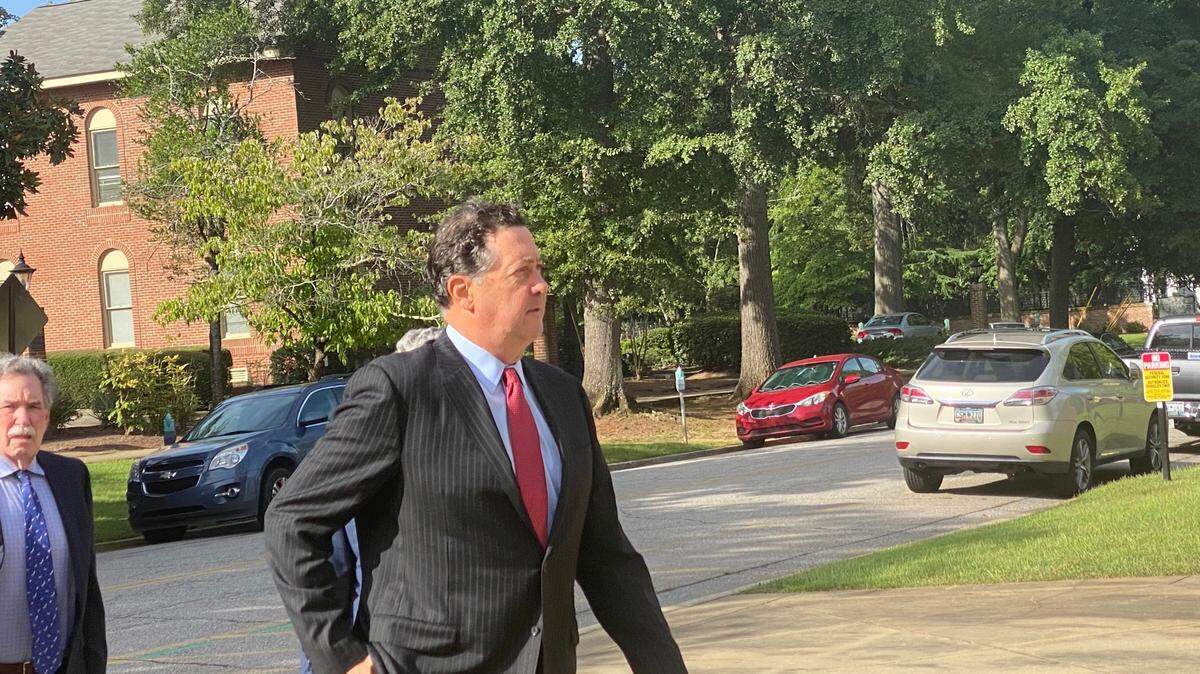
The fourth and final criminal defendant in the failed $9 billion V.C. Summer nuclear project that destroyed the giant South Carolina electric utility SCANA, raised electric bills for its customers and dashed hopes for more state clean energy was sentenced Wednesday to a year and one day.
Jeffrey Benjamin, 62, was sentenced by U.S. Judge Mary Lewis after a hearing that lasted nearly four hours in federal court in Columbia. He also must pay a $100,000 fine. Under federal sentencing laws, because the sentence is for more than a year, he may be released two months early.
Lewis said a key factor in her decision to give a prison term to Benjamin, who suffers from a severe heart condition, was to send a message to executive criminals in corporate suites that they are not above the law.
“This was not a mistake. This was an intentional act, and a crime,” the judge said. Moreover, she said, medical facilities in the federal Bureau of Prisons will be able to take care of Benjamin’s condition.
Lewis’ decision came at the end of an unusually long hearing, marked by an extended presentation of character witnesses and an elaborate discourse by Benjamin attorney William Sullivan of Washington, D.C., who told the judge that his client’s unstable health needs “constant monitoring ... to prevent a catastrophic cardio event.”
Benjamin’s motives were good, Sullivan told the judge. “Jeff was trying to get the work done.... The idea that Mr. Benjamin is the most egregious offender has absolutely no basis in reality.”
Benjamin’s wife, Colleen, reinforced concerns about his health, tearfully telling the judge that if her husband goes to prison, he might not get out alive. “If he goes away, I don’t think he will come home.”
The judge said she was impressed by Benjamin’s witnesses and noted that he has exceptional credentials in the nuclear power industry, credentials that she said will enable him to keep working after he leaves prison in a field that is vital to the nation and even “the world.”
Federal prosecutor Winston Holliday, who characterized the defendant as someone with an arrogant management style and “the worst” of the four defendants in the SCANA saga, told Lewis he wanted Benjamin to get a year in prison — a sentence that would have required Benjamin to serve a full year. Sullivan had pressed for probation with possible home confinement.
Holliday also downplayed concerns about the federal prison system not being able to take care of Benjamin. “Mr. Sullivan doesn’t think the Bureau of Prison’s medical system is robust — what does he know? He’s not a doctor.”
Benjamin expressed remorse, said he accepted “full responsibility” and told the judge, “I’m not as portrayed by the government — this evil, awful manager.” He added, “I’m very sorry for the role I played.”
After years of plea negotiations, Benjamin had pleaded guilty last December before Lewis to an information felony charge of “aiding and abetting the failure to keep accurate corporate records” in connection with the failure to build two nuclear reactors to produce electricity at the V.C. Summer facility near Jenkinsville.
Essentially, Benjamin allowed a public statement about the project’s completion date to be issued by SCANA officials in November 2016, all the while knowing there could be problems in completing the project by that date. The statement said that one reactor would be finished by August 2019; the other, by August 2020. Under federal law, publicly-traded corporations like SCANA must make truthful statements about matters that might affect their stock price.
Benjamin’s sentence was the climax of a tangled legal seven-year prosecution odyssey that began in 2017 with SCANA’s surprise closing of the V.C. Summer nuclear plant, throwing some 4,000 people out of work, sparking a years long FBI investigation and ending with criminal charges against four top executives including Benjamin.
The investigation showed that top executives at SCANA and Westinghouse hid the truth about progress about construction overruns and mismanagement from state regulators and investors, according to the prosecution’s case. SCANA had pledged to finish both reactors by 2020 but utility executives knew by 2016 that was likely not feasible.
Benjamin, a former Westinghouse Electric Corp.’s senior vice president for new plants and major projects, was in charge of overseeing construction of Westinghouse’s nuclear reactors worldwide, including at the V.C. Summer site in Fairfield County, just north of Columbia.
SCANA had hired Westinghouse in 2008 to manage construction of two nuclear reactors on the site, which already had one active nuclear reactor. It was important for the reactors to be finished by 2020 to qualify for a federal tax credit of $1.4 billion — money that was needed to help pay for the project whose initial estimated cost was $9.8 billion.
Under the plea deal that Benjamin and his lawyer reached with federal prosecutors last December, Benjamin could have gotten anywhere from probation to 12 months and a day in prison and paid a financial penalty of up to $100,000.
Previously, two former SCANA top executives — CEO Kevin Marsh and Chief Operating Officer Stephen Byrne — pled guilty to fraud in the case and were given prison terms. Marsh received two years in federal prison and Byrne, 15 months. Marsh has served his sentence; Byrne has not begun his sentence.
A former Westinghouse executive who worked under Benjamin, Carl Churchman, pled guilty to lying to an FBI agent in the case. He received six months home detention.
The cover-up of problems at the site enabled top officials at SCANA and Westinghouse to continue to collect fat salaries and bonuses for two years, from about 2015 to 2017, according to government evidence in the case.
Besides the 4,000 people thrown out of work, losers in the SCANA debacle included hundreds of thousands of SCANA ratepayers, who for years paid multiple surcharges tacked onto their monthly bills to help pay ongoing costs of the doomed project. Investors also suffered from a steep decline in SCANA’s stock price. SCANA was eventually absorbed into Dominion Energy, a multistate energy provider headquartered in Virginia.
For decades, SCANA had been been one of the most reliable and prestigious companies in South Carolina, a member of the Fortune 500 with its stock traded on the New York Stock Exchange. Its shares were known for steady dividend increases and holding their value. After SCANA walked away from the V.C. Summer project, the company’s stock price plummeted. It was one of the worst business failures in state history.
Another factor in the debacle at V.C. Summer was the failure of the S.C. General Assembly to conduct due diligence on a quickly passed 2008 bill that gave SCANA the power to make its ratepayers pay for construction on the nuclear plants as they were being built. In 2008, the plans to build the complex type of nuclear plants contemplated had not been yet been finalized.
The case was investigated by the FBI, which at any given time had three or four agents working it, Holliday said. An FBI agent was in court Wednesday, sitting behind prosecutors.
Also in court was Byrne with his lawyer Jim Griffin, a former federal prosecutor. Assistant U.S. Attorney Brook Andrews said Byrne was there ready to testify in case Benjamin said anything that needed to be rebutted. Byrne is likely to begin serving his 15-month prison sentence in the near future.
Santee Cooper, SCANA’s junior partner in the V.C. Summer venture, also had a lawyer in court — Deborah Barbier of Columbia, a former federal prosecutor. Westinghouse was represented by another former federal prosecutor, Matt Hubbell of Charleston.
At the hearing, Benjamin told the judge he hoped the nuclear reactor project can be revived. “Hopefully, someday somebody will come along and try to finish it.”
After the hearing, Benjamin’s attorney Sullivan issued this statement: “Of course we’re disappointed in the sentence. The place for Jeff Benjamin is not prison, but the nuclear energy sector, and we’re confident he will return there soon. We continue to evaluate all potential and available legal options.”
Briefing the press in front of the courthouse after the hearing, prosecutor Holliday said the impact of the SCANA’s failure was devastating to rate payers, SCANA,V.C. Summer workers and the community at large.
The sentence sends a message, Holliday said: “Corporate executives are very rarely held to account for their activities... For corporate executives, the highest deterrence is prison.”
Tom Clements, a citizen activist who opposed the pursuit of the V. C. Summer project since its inception, said the judge’s sentence was appropriate.
“This whole case points out there should be much stronger oversight by the state regulatory authorities including the legislators,” said Clements, whose group Friends of the Earth attended numerous meetings before the Public Service Commission. “The legislators really dropped the ball in 2008 in approving legislation that allowed the project to go forward with rate payers footing the bill.”
This story was originally published November 20, 2024 at 2:28 PM with the headline "Last defendant in SCANA/Santee Cooper nuclear power plant debacle sentenced to prison."