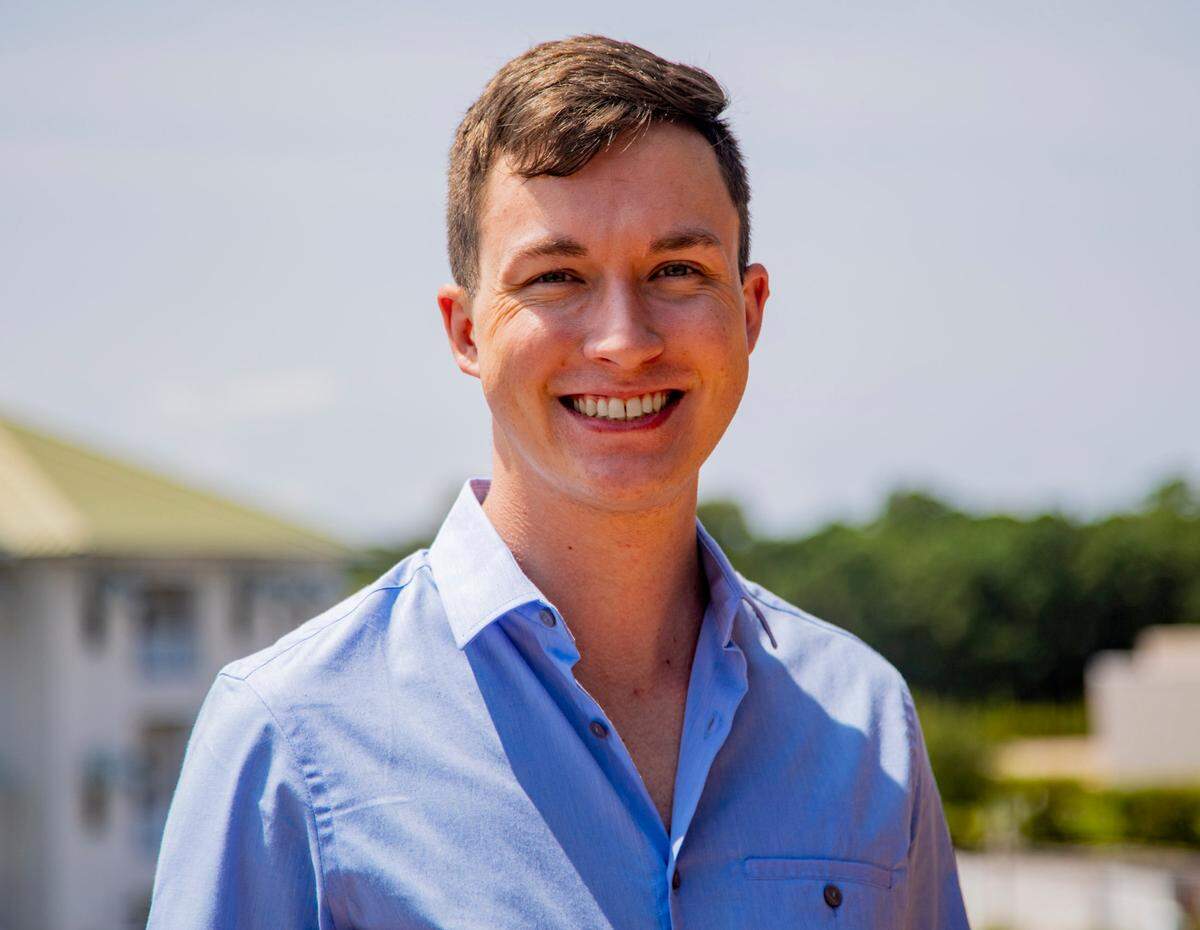
‘Move forward stronger.’ SC Pride leader stepping down as LGBTQ+ rights face uncertain future
For almost all of Jeff March’s tenure as president of South Carolina Pride, life for LGBTQ+ people has gotten better in the Palmetto State.
Same-sex marriage was legalized in 2015, S.C. Pride moved to Main Street Columbia, and the summertime bash Outfest launched and grew.
South Carolina, for a moment, was even seen as a better place for LGBTQ+ people than North Carolina, after that state banned transgender people from using the restrooms corresponding to the gender they identify with.
March and S.C. Pride even managed to keep both Outfest and Famously Hot South Carolina Pride alive after canceling both events in 2020. They roared back to life in 2021, better than ever, he said.
At the end of this year, March will step down from the volunteer job of leading the state’s major LGBTQ+ Pride organization after more than a decade. He announced his decision at Outfest last weekend. The next leader of S.C. Pride will be chosen in November following an election by the organization’s board.
“I feel like I’m under a lot of pressure to keep building and building and making it better and better,” March said. “You have to make sure you make an awful lot of people happy as well. I love the work, and I’m not leaving because I don’t love it. I’m leaving just because I think it’s time to pass it off to another generation and see what they can do.”
Radically changing South Carolina Pride
When March started his work, South Carolina Pride was held at Columbia’s aging, battered Finlay Park. The event drew 8,000 people in 2011.
March wanted to change that immediately. In 2012, S.C. Pride overhauled the event, moving it to Columbia’s Main Street, right in front of the Capitol. They also launched the now-famous Get Lit Nighttime Parade. It was the first nighttime parade held in the city, March said.
S.C. Pride also brought in one of its biggest acts yet — Joan Rivers — for an event at the Koger Center that year.
As the event drew near that year, March and his vice president of branding, Nick Kask, wondered if they had gone too far, if they were risking tanking a decades-old celebration.
But it worked. S.C. Pride recouped all of the money it spent to stage the event, and more. The 2012 Pride celebration drew 15,000 people, nearly double that of 2011, Kask said. In 2021, the event attracted nearly 100,000 people.
“These are some people’s first Pride, the first chance to be themselves,” Kask said. “Every year makes us tear up, makes us like randomly cry at 8:30 at night at some weird moment. We just hug each other and are like, ‘We did it.’ It’s been amazing to help effect some of that change.”
March didn’t want to stop there. Famously Hot S.C. Pride, held in October, always felt like more of a statewide event. He wanted to have something that was more for Columbia.
In 2018, S.C. Pride launched Outfest. The event has gotten bigger every year, including doubling its turnout between 2019 and 2021 (the 2020 event was canceled).
“Outfest was something I wanted to do for Pride month,” March said. “We couldn’t move our festival from the fall because this is a college town and we need the kids to be in school. Plus, June is still hot.”
The turnout at last year’s Outfest, double that of 2019, helped S.C. Pride get past its latest major roadblock — the coronavirus pandemic, which forced the cancellations of Outfest and Famously Hot S.C. Pride.
“We’ve been through the fire,” said Kask, who moved to Philadelphia a few years ago but worked with S.C. Pride to help put on last year’s mid-pandemic events.
Now, after so many years, so many rounds of throwing wild ideas at Kask, who said he would whittle them down to something closer to reality, March said he’s done everything he envisioned possible with Pride and wants to hand it off to someone new.
“Everything that I thought I could do, I pretty much managed to do. Everything people told me I couldn’t do, I did,” March said. “People said, ‘Oh, you can’t have a night parade down Main Street on a Friday night. That’s impossible.’ We do every year now.”
But his time at S.C. Pride wasn’t just about redesigning events.
Shifting priorities
Four years into March’s time running S.C. Pride, the U.S. Supreme Court legalized same-sex marriage, a major milestone that generations of people had fought for.
But even before that, acceptance of the LGBTQ+ community was growing rapidly. President Barack Obama came out in support of the LGBTQ+ community and same-sex marriage and lit up the White House with rainbow lights after the decision.
North Carolina’s attempt to restrict the restrooms transgender people could use failed in front of the nation, as it lost outside commercial investment — for instance, the Netflix show “Outer Banks” moved its production to South Carolina in reaction to the so-called “bathroom bill” — and major sports championships, among other losses. The “bathroom bill” was later repealed.
For S.C. Pride, those nationwide advances meant a shift in priorities at home. Now, the parade and festival served more to grow allyship and acceptance for the LGBTQ+ community, rather than fight major political wars.
“Those people who might not feel safe in their hometown or South Carolina, who may not feel safe in their homes, can hopefully find a way to go to one of these events and feel safe and feel like, ‘There are people like me that I can be around, and I can find a way to be myself,’” Kask said. “That’s the purpose of Pride festivals and Pride marches, is to speak loudly for those who can’t speak.”
Famously Hot South Carolina Pride, and later on Outfest, ensured that people could have a space to go to a few times a year where they were welcomed, surrounded by people like them, March said.
“Our festivals are packed with our straight allies and family members, and all that is opening minds to understand and who LGBT people are,” March said.
Several years ago, S.C. Pride launched the “Brave the Rainbow” campaign. Businesses could apply for a 30-inch window sticker featuring a rainbow and the name of the campaign to show customers that they were an LGBTQ+ friendly space.
“We have to be present in every space we can get in,” March said. “We need to be seen everywhere because the more seen it is, the more familiar we become or the more familiar everybody else becomes with us, and hopefully the more comfortable and understanding people will grow to be around us.”
Growing the base of allies is crucial, March said, because, “a lot of people just don’t understand how their vote hurts us, but more and more people are starting to figure it out now, especially after Trump.”
March watched all that progress raced along faster and faster. He felt joyous seeing the positive changes unfold. The LGBTQ+ community, he said, was so much better off than 11 years ago, and definitely since he was a child growing up gay.
Then, in 2021, that progress slammed into a brick wall.
Losing ground and fighting back
The constant move forward for the LGBTQ+ community in South Carolina that defined much of March’s tenure hit a barrier in 2021. Republicans lawmakers in the state, like many others across the country, took up policies to ban trans girls from playing in the sport that corresponds to their gender and restrict doctors from providing gender-affirming health care to trans children.
“We are better than we were 11 years ago, yes, but recently we started taking a few steps back,” March said. “It seems like we’re losing everything since marriage equality. We got too comfortable.”
Both bills died in 2021, but the trans sports ban passed this year and was signed into law by Gov. Henry McMaster, despite facing opposition from Democrats and even Republican state Superintendent of Education Molly Spearman. McMaster and other Republicans claimed the trans sports ban was necessary to protect women and girls sports. The law, as of right now, affects just two student athletes out of hundreds of thousands in the state.
“You’ve got to get vocal, you’ve got to get in people’s faces, and you’ve got to fight the battle because we are, especially the trans community, really losing ground,” March said.
The future of same-sex marriage, too, now seems fraught. Some fear that the conservative supermajority on the U.S. Supreme Court could overturn the 2015 decision that legalized same-sex marriage across the nation, ending a constitutional right that millions of people across the country, including in South Carolina, have come to appreciate.
March said he hopes this potentially regressive future — and regressive present — will motivate LGBTQ+ South Carolinians to fight back politically, from the ground up.
“The generations before have died off or are tired. They fought all their lives,” March said. “We really need this new community and this new generation to come along and really keep fighting for the rights of our whole community.”
The Republican party controls state politics, but the LGBTQ+ community needs to hold local lawmakers that much more accountable to make up for it, March said.
“Last year when it was a political election year here in Columbia, we had everybody barreling down, wanting to be on our stages,” March said. “This year? They didn’t return.”
The last few years have shown that the LGBTQ+ community can’t afford to let up or look away for even a second, Kask said.
“We came along at a time where celebrating was the right move, and some of that celebration seems possibly ill-placed at the moment,” Kask said. “I’m hoping that the next leadership finds a way to uplift, which is to say, celebrate but in a way that grabs back some of that power that is slowly lifting out of our hands.
“I hope that we’re in a last gasp of death for such conservative views of how people should live their lives.”
As Pride celebrations and gay bars have declined across the country in the last two decades, South Carolina is a prime example of why Pride still matters, March said.
“It’s important to have our visibility that Pride gives us and our awareness,” March said. “I was worried that after COVID, that we were going to start seeing Pride slowly drift away, and many in big cities have. That’s a sad reality. When it comes to South Carolina, it’s more important than ever that we move forward stronger.”
This story was originally published June 10, 2022 at 5:00 AM.