
Winthrop movement ignites after 130 reports of sex assault revealed. ‘I want change!’
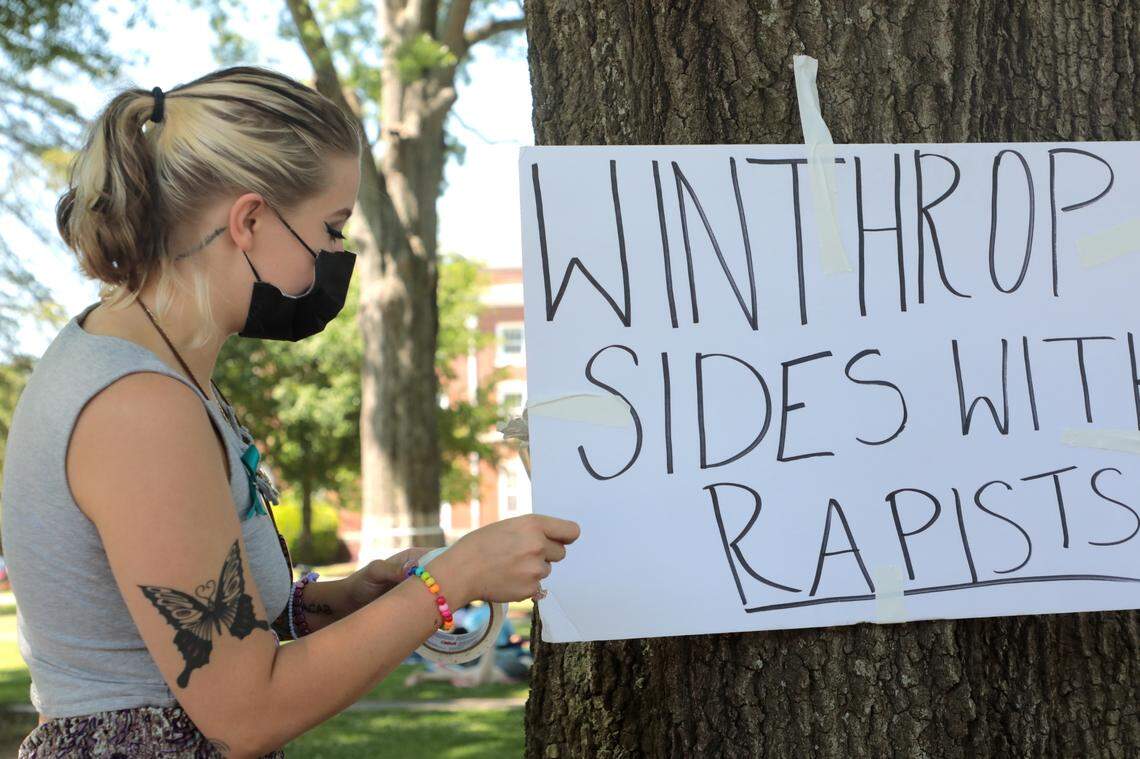
Ami Hughey stood in front of about 60 Winthrop University students gathered on the lawn outside the DiGiorgio Campus Center. She pushed her long pigtails behind her shoulders, held a sign above her head and shouted: “Winthrop sides with rapists!”
“Winthrop sides with rapists!” the group screamed back.
“I don’t want an apology! I want change!” Hughey continued.
“I don’t want an apology! I want change!” The chants echoed throughout the university’s expansive courtyard on an evening in early April.
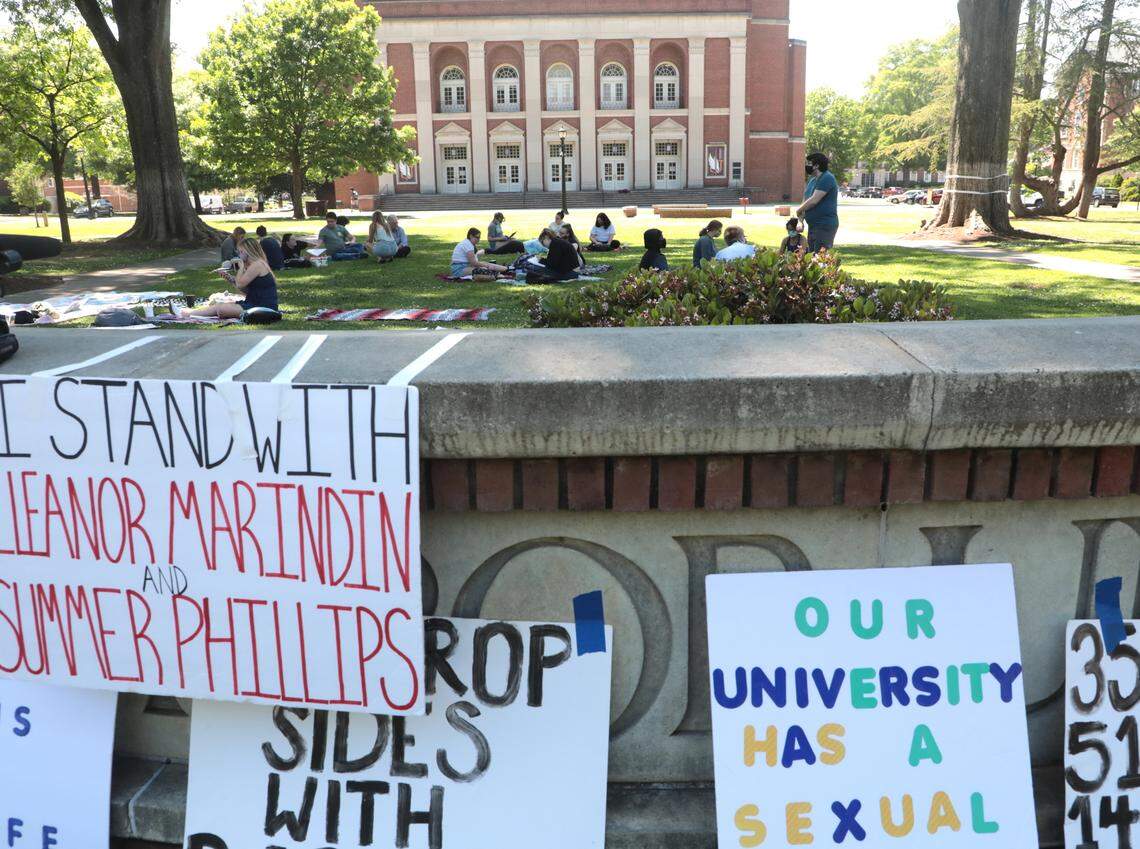
Most of the students sat on towels and blankets. Some bore picket signs. And a handful stood at the front in a line beside Hughey. One student clamored into a megaphone at others coming and going through the campus center’s doors, trying to spread the group’s message further.
“’No’ means ‘no!’” Hughey began again.
Hughey was one of several organizers to put on the event. Multiple student groups have since partnered and put on similar events as part of a campus-wide, ongoing movement against sexual assault.
The students say the movement is about the broad issue of sexual assault. But they also bring attention to specific instances — and question the university’s trustworthiness and transparency in handling sexual assault cases.
“This is a way to promote student unity and say, ‘Hey, we’re all here,’” said Winthrop senior Nikki DeLissio, an organizer of one of the events earlier this month. “We are listening and we do want to see some change. We want our voices to be heard, and show that even though this horrible thing has come to light at Winthrop, we are still a student body and we are still united.”
In a late March article, published by Winthrop’s student newspaper, The Johnsonian, two former Winthrop students alleged that they had been sexually assaulted, and they say the cases went unpunished, or disregarded, by the university. Both students were women.
One was a former lacrosse player, who said she received unwanted sexual contact from someone on the Winthrop athletic department’s staff in 2018, the article said. The other was a former student who, while incapacitated, was allegedly gang-raped in 2017 by three Winthrop athletes.
The student newspaper’s report also referred to a campus climate survey administered in April 2017. But the university never published results.
The survey, which was provided to The Herald via a Freedom of Information Act request, paints a different picture of student safety than data the university is federally required to report.
“There was a student climate survey conducted, and the information was suppressed,” Hughey told The Herald at a demonstration earlier this week. “I mean, my mom, before I ever came to Winthrop, she was doing research on the school, and I asked her what the crime reports were. And she said she didn’t see anything about rape or sexual assault. That it was just pot and alcohol. And that’s just not true.
“At the time, I should’ve known better, but that’s impossible.”
Winthrop’s campus climate survey
In 2017, according to the Winthrop survey, the White House Task Force to Protect Women from Sexual Assault and the Department of Justice Office of Violence Against Women outlined recommendations for schools to collect sexual assault data — and Winthrop joined the effort.
The survey was administered at a time when discussions about sexual assault and its pervasiveness were gaining public attention. A movement, later known as #MeToo, set social media ablaze after widespread allegations of sexual abuse surfaced against television executive Harvey Weinstein in early October and other men in power later that year.
The April 2017 campus climate study was the first of its kind at Winthrop. But it did not mark the first time the university collected data related to sexual assault. Like all universities that receive federal funding, Winthrop had been reporting statistics on campus crime for decades, as required by the Clery Act.
But the prevalence of sexual violence on Winthrop’s campus could not be assessed by solely using “existing administrative records,” the survey states. That’s because sexual violence is “such a highly prevalent but underreported crime.”
In its 2017 Clery Report, Winthrop reported no instances of rape, fondling, incest or statutory rape on campus. There was one instance of rape off campus. (According to the report, non-campus buildings or properties include fraternity and sorority houses, Winthrop Coliseum and Lake area.)
In 2016, again there were no on-campus reports. There was one instance of rape on public property which, according to the report, includes streets, sidewalks, and parking facilities on campus, adjacent to and accessible from the campus.
In 2018, Winthrop reported six instances of rape on campus, five of which happened in residence halls.
These numbers, however, appear incomplete when compared with data from the 2017 campus climate survey. (Winthrop officials did not agree to The Herald’s request for an interview, nor did they answer via email why the results of the survey were never published.)
Of the 1,153 survey participants — all of whom were granted anonymity — 77 students (6.7%) said they experienced unwanted sexual contact during the 2016-17 academic year. Of those 77 students, 71% said the unwanted sexual contact was “forced touching of a sexual nature,” 35% said the contact was vaginal intercourse, and 29% said it was another form of sexual penetration.
Additionally, 91 students — or 7.9% — reported having “unsuccessful, unwanted sexual contact” during 2016-2017. And 51 students reported that someone had sexual contact with them when they were unable to provide consent because they were incapacitated due to the consumption of alcohol or drugs.
Sexual assault unreported at Winthrop, but known
Only a few of these cases were ever reported to university officials.
In the survey, 130 students gave more details about their ordeals. Only 10 of the students went on to report their assault to Winthrop authorities.
The study states that there are multiple reasons Winthrop students did not report the incident to campus authorities, including but not limited to:
“Ashamed, didn’t want to bring it up”
“Didn’t think it was serious”
“Didn’t feel important”
“Became pregnant”
“Didn’t want to get in trouble”
“Embarrassment and fear”
“He was my boyfriend”
That’s not to say only 10 cases posed life-changing impacts, the study states: 60% of victims reported a change in eating habits; over 50% of students said their grades dropped; and 49% reported that they attempted suicide — a fact that the study calls “most concerning of all.”
Current Winthrop students say they are aware more instances of sexual assault happen than those that show up each year in the Clery Act report.
“Those aren’t the only ones,” DeLissio said at the April protest. “There’s so much talk.”
Her friend, Isabella Fleischer, interrupted: “I’m only a freshman and I’ve heard so much.”
“Especially pertaining to friends,” DeLissio responded.
Sexual assaults on campuses have for years been a concern for colleges and universities across the country.
Winthrop is not unique in witnessing a campus-wide movement in the name of this issue: This year, students at the University of South Carolina have come together in protest after reports that 10 women, since 2017, have alleged that the university did not effectively respond to harassment complaints, per reporting from The State newspaper.
A persisting movement
Even as the academic year concludes at the Rock Hill university, the student’s movement remains active.
Last week, dozens of students marched around Winthrop’s campus toward the President’s House to protest. During finals week, a handful of students gathered Tuesday for a peaceful sit-in on the grass in front of Byrnes Auditorium. As of Friday morning, more than 600 people have signed an online petition calling for Winthrop to acknowledge the role it “has played in perpetuating rape culture” and revise how it manages reports of sexual assault.
University officials seem to be listening.
This week, students told The Herald, multiple university leaders, including interim Winthrop President George Hynd, met with a panel of students to discuss ways the school could best handle instances of sexual misconduct.
Chloe Pearson, a student selected to be a part of the talks with Winthrop leadership, told The Herald the meeting went well. She said Hynd was thoughtful and focused on making a difference. The panel talked about a variety of topics, Pearson said — from finding a safe way for students to disclose if a professor has made them uncomfortable, to trauma training for Winthrop employees.
However, some students still are not satisfied.
One of the student organizations formed in wake of the sexual assault allegations, Winthrop Students for Change, refused to meet with Hynd unless the university fulfills several demands:
- The group insists that Winthrop hire a full time Title IX coordinator. Kimberly Faust, university vice president and chief of staff, now serves as the Title IX coordinator.
- Rather than a private meeting, the group also urges Hynd to hold a campus-wide discussion on sexual assault. “We believe that Winthrop students are far too diverse to be represented by one or two people,” the group wrote.
- Winthrop Students For Change requests that Winthrop fires the member of Winthrop athletic department’s staff who, in the aforementioned Johnsonian article, allegedly inappropriately touched a former Winthrop athlete. The name of the staff member, who still is employed by the university, has not been publicly released.
“I can count people on more than one hand right now who have been affected by faculty members here,” Winthrop senior Grayce Kellam said at Tuesday’s sit-in.
Of the 1,153 respondents to Winthrop’s 2017 survey, 9% of students said they were told sexual stories or jokes by faculty/staff that were offensive, or felt that Winthrop faculty/staff were condescending because of their sex. Another 4% were offended by gestures of a sexual nature.
Winthrop’s response
Hynd sent a campus-wide email, provided to The Herald, Wednesday evening detailing the university’s promises to improve campus safety in light of the Winthrop students’ continued effort. He addressed The Johnsonian article, the protests, the petition and his meeting with students.
“While I believe that Winthrop is a safe campus and has responded appropriately to complaints of sexual misconduct, there is still much to do to make this as safe a campus as possible,” Hynd wrote.
Hynd listed eight ways the school plans to improve safety, including its plan to hire a sole Title IX coordinator, falling in line with one request from Winthrop Students For Change. Students will be represented on the search committee for the role, he said.
The university also will work with “outside legal counsel” to update its sexual misconduct policy to include new guidance on investigating complaints.
And Winthrop, partnering with a third party, will offer another campus climate survey during the 2021-22 academic year. The university will revisit the findings and recommendations in the 2017 survey to evaluate its progress, Hynd said.
“We’re hoping to keep up the energy over the summer and keep communicating,” Hughey said. “If COVID has taught us one thing, it’s how to communicate with each other when you’re not together in person. So, we can hit the ground running in the fall, hopefully (with Winthrop Students for Change) as an official student organization.”
This story was originally published April 30, 2021 at 1:10 PM with the headline "Winthrop movement ignites after 130 reports of sex assault revealed. ‘I want change!’."

.jpeg)