
Attorney blunder? SC cop’s 20-year prison sentence in Walter Scott case to get review
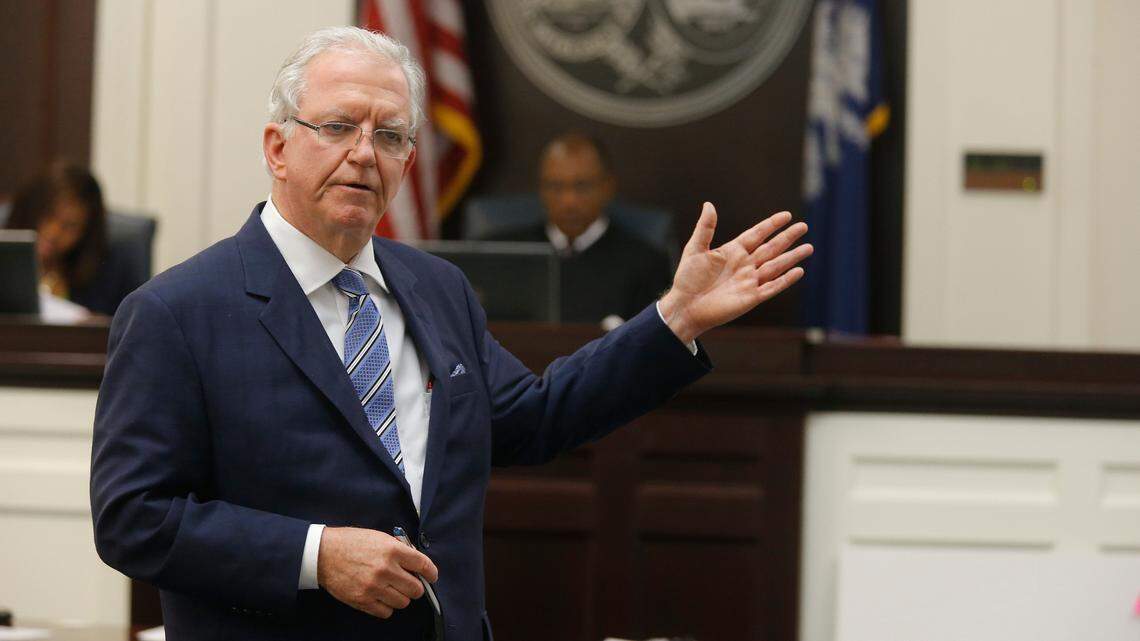
A prominent Charleston attorney has admitted he blundered in a high profile case involving the shooting death of Walter Scott, a Black man who was fatally shot by North Charleston police officer Michael Slager as he fled the officer.
The admission by attorney Andrew Savage, contained in court records, is part of a legal bid by Slager to undo the 20-year sentence given Slager in 2017 by U.S. District Judge David Norton. Savage represented Slager at the time.
It is the latest twist in the 2015 shooting and killing case of an unarmed Black man running away from a white officer in North Charleston. The incident was caught on a bystander’s cell phone video and within days went viral around the world.
Slager’s effort to overturn his sentence is being taken so seriously that already a new federal judge on the case, Richard Gergel of Charleston, has scheduled a two-day hearing in mid-April to hear evidence on “numerous” factual disputes that Slager is raising, according to a court filing by Gergel.
Federal prosecutors have indicated in court filings they will vigorously contest Slager’s bid to overturn his sentence and defend the plea that led to the sentence. Slager’s defense team, which included Savage, performed “competently, diligently and reasonably,” federal prosecutors said.
Slager had been exposed to a maximum life sentence when he was sentenced, federal prosecutors said in court filings.
Slager’s main claim to undo his sentence is that he had “ineffective assistance of counsel,” legalese meaning his lawyer made a mistake so significant it led to an unjust outcome. Thus, Savage’s admission of a mistake is central to Slager’s bid to undo the 20-year sentence.
Savage’s purported mistake in handling Slager’s case, Savage wrote in a court filing, was that he badly misinterpreted out-of-court comments made by Judge Norton about the Slager case months before Norton formally sentenced the officer to 20 years.
“I realize that my blind trust in the Court’s (Norton’s) statement induced me to provide advice that was harmful to Slager and that it was my advice, not his (Slager’s) conduct on April 4, 2015, (the day Scott was killed) that led to his extraordinarily harsh and unexpected sentence,” wrote Savage.
Norton’s comments were made in January, 2017, in a meeting of lawyers with the judge to discuss the Slager case, Savage wrote.
“During the course of our discussion, the Court (Norton) informed those present that it was his opinion that this clearly was not a murder case. I accepted the Court’s words as his thoughtful conclusion, as I knew from other statements the Court made that he was thoroughly familiar with the facts and circumstances of the case,” Savage wrote in his court filing.
“(Norton’s) statement was not a casual or off-hand comment,” Savage wrote. “Following that conference, I proceeded with the firm impression that this was the settled position of (Norton). ... I accepted his words as a given,” Savage wrote.
Months later, in December 2017, Judge Norton held a four-day hearing in federal court to determine Slager’s sentence. At the hearing’s end, Norton gave Slager a 20-year sentence and characterized Scott’s death as second-degree murder.
Before the judge’s 20-year sentence, Savage wrote, he had repeatedly and mistakenly urged Slager to reject a federal prosecutor’s final plea bargain offer of 151-188 months (about 12 1/2 years to 15 years) because it would have required a judicial finding of voluntary manslaughter.
Thus, in plea negotiations with federal prosecutors before Norton’s sentence, Savage wrote, he continued to rely on the judge’s statement that “this was not a murder case.”
Savage also wrote that Slager “trusted me implicitly” and “every time he asked about the risk he was taking by not accepting the Government’s offer to plead with a guaranteed voluntary manslaughter finding as to the underlying offense, I assured Slager that he was not facing a more punitive sentence.”
In fact, Savage wrote, he even assured Slager “there was a chance of a lesser sentence than what the Government was offering.”
In his statement, Savage also said, “I had repeatedly assured Slager that he was not risking a longer sentence by rejecting the Government’s final offer. I told him repeatedly that I had known the Judge for over 40 years, and that based on my professional and personal relationship with him, that I felt very comfortable in assuring Slager that I believed the Judge’s unsolicited statement and given that, I believed rejecting the Government’s offer was in his best interest.”
Slager’s 20-year sentence was the most severe ever given to a white S.C. police officer for the wrongful killing of a black person, civil rights activists said at the time. Slager had pleaded guilty in May 2017.
Slager is serving his sentence at a minimum-security federal prison in Colorado, according to the Bureau of Prisons.
Because Scott was African American and Slager is white, the case also was, and continues to be, cited as a tragic example of what critics say is a national pattern of unnecessary killings of Black people by white police officers.
Just before the shooting, Slager had stopped Scott for a broken tail light. Scott, who had no serious criminal record, jumped out of the car and ran for reasons that are still not fully clear.
In 2016, Slager was tried in state court for murder but the result was a hung jury. Afterwards, some jurors told reporters that the jury was unanimous that this was not a murder case. After months of behind-the-scenes negotiations by state and federal prosecutors, state murder charges were dropped. Slager agreed to plead guilty to civil rights violations in connection with Scott’s shooting and let his sentence be determined by a federal judge.
Before Norton gave Slager 20 years, he said, “Today, no matter what sentence I give, neither the Scott family nor the Slager family will think it is right.”
At the hearing’s end, Norton said he was influenced by evidence showing Slager had obstructed justice, by giving false statements to police about the killing, and also had moved evidence at the scene, making it look like Scott had taken his stun gun. Scott had scuffled with Slager but, in fact, did not take Slager’s stun gun. Norton said he determined Slager had no reason to use deadly force against Scott.
The bystander’s video showed Slager taking aim at the fleeing Scott and firing eight times from a distance of at least 10 yards. Five bullets struck Scott in the back. Slager’s initial version of events — that he only killed Scott because Scott was fighting with him and took his Taser — had been publicized widely until the video surfaced.
An attorney for Scott’s family on Saturday scoffed at the notion that Savage — regarded as one of S.C.’s best trial lawyers — now claims he was an “ineffective” attorney for Slager.
“As if hiring Andy would ever be ‘ineffective’!” said Rep. Justin Bamberg, D-Bamberg, “In the state murder case, Andy convinced a jury that Slager wasn’t guilty of murder, and he presented a defense in federal court that stopped Slager from getting life without parole — which he deserved for shooting an unarmed man in the back.”
“Slager played judge, jury and executioner,” Bamberg said.
For years, police acted with impunity against citizens but today, “police officers can be punished,” said Bamberg, who represents Scott’s family with Atlanta attorney Chris Stewart. “Slager needs to just serve his sentence and spend those 20 years thinking about what he did to destroy a family, a community and the image of law enforcement.”
Savage, 73, who has participated in numerous high-profile cases, has been profiled in publications such as The Washington Post and mentioned prominently in The New York Times. He represented families of victims slain by white supremacist Dylann Roof in the 2015 Charleston church massacre.
In 2018, Savage gave an interview to the Charleston Post and Courier in which he called Norton’s unexpected 20-year sentence “the most difficult” experience of his career. He fell into a “deep depression” that he had to work his way out of, Savage said.
Neither Savage nor Norton could be reached for comment. It is rare for federal judges to comment outside of court or their filings.
Rhett DeHart, acting U.S. attorney for South Carolina, referred a reporter to court filings.
Within six months of Scott’s death, the city of North Charleston reached a $6.5 million settlement with his family.
This story was originally published March 26, 2021 at 3:02 PM with the headline "Attorney blunder? SC cop’s 20-year prison sentence in Walter Scott case to get review."