
These 5 counties are considered more economically ‘distressed’ than they were a year ago
At the start of the new year, five North Carolina counties will be considered more economically “distressed” than they were a year ago in the eyes of the state.
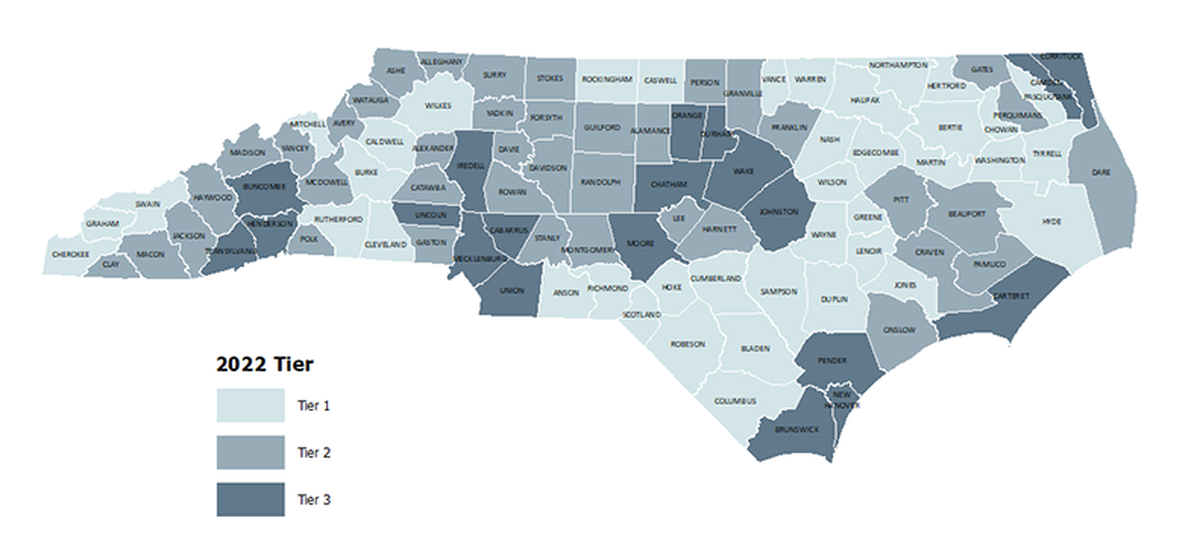
The North Carolina Department of Commerce released its new tier rankings for the state’s 100 counties this week, an annual ranking that influences which counties are eligible for the most aid.
The tier system is mandated by state law, and it influences how the Commerce Department operates a handful of programs that assist in economic development.
Those programs include the One North Carolina Fund and the powerful Job Development Investment Grant, which uses incentives to lure new companies to the state or get existing companies to expand or keep jobs. It also affects the state’s Utility Account, which helps pay for infrastructure upgrades, and the downtown revitalization Main Street program.
The more distressed a county is in the ranking system the more favorably it is treated under the programs.
The tier system is broken down into three levels — with Tier 1 counties generally being the most economically distressed and Tier 3 counties generally being the least economically distressed.
The Triangle, which has grown rapidly in the past decade and is attracting employers such as Apple and Google, is made up almost entirely of Tier 3 counties.
Many of the state’s most rural counties fall into Tier 1.
Who got downgraded?
Eleven counties saw their tier designation change in the latest rankings — a drop from the previous year, when 22 counties were either upgraded or downgraded.
The five counties that will now be considered more “distressed” are: Chowan, Jones, Macon, Polk and Watauga.
Chowan, a small county in far eastern North Carolina home to the town of Edenton, is now a Tier 1 county. Jones County, also in Eastern North Carolina, also moved to a Tier 1 designation.
Macon and Polk counties, located in the southwestern part of the state, both saw their rankings lowered to Tier 2.
Watauga County, a mountainous county home to Boone and Appalachian State University, also received a downgrade, going from Tier 3 to Tier 2.
Moving up
Six counties, on the other hand, moved up in the tier rankings.
Alexander (Tier 1 to Tier 2)
Brunswick (Tier 2 to Tier 3)
Buncombe (Tier 2 to Tier 3)
New Hanover (Tier 2 to Tier 3)
Randolph (Tier 1 to Tier 2)
Rowan (Tier 1 to Tier 2)
Buncombe and New Hanover are home to some of the state’s stronger economic hubs (Asheville and Wilmington respectively) outside of the Triangle or Charlotte region. Brunswick County was the second-fastest growing county in the state over the past 10 years.
And Randolph County could be on the verge of making a big economic development splash in the coming weeks.
The state’s recently approved budget is appropriating some $320 million to a megasite in Randolph County, The News & Observer previously reported. There has been speculation that Toyota could build a new battery plant on the site, as the specifications in the state budget closely match investment totals outlined by Toyota.
What is considered in the rankings?
The county tiers are calculated using four factors outlined by the N.C. General Assembly:
- Average unemployment rate
- Median household income
- Percentage growth in population
- Adjusted property tax base per capita
Before 2018, the Commerce Department also took into consideration several “adjustment factors” when making its tier system, including a county’s total population, The N&O previously reported.
Previously, any county with fewer than 50,000 people automatically qualified as either Tier 1 or 2. Those with fewer than 12,000 people — or those with fewer than 50,000 people and a poverty rate of at least 15% — were Tier 1.
The move allowed many of the state’s larger counties with lower incomes, like Cumberland County, to qualify for more economic development aid.
This story was produced with financial support from a coalition of partners led by Innovate Raleigh as part of an independent journalism fellowship program. The N&O maintains full editorial control of the work. Learn more; go to bit.ly/newsinnovate
This story was originally published December 2, 2021 at 3:47 PM with the headline "These 5 counties are considered more economically ‘distressed’ than they were a year ago."