Triangle biotech scene is growing fast, but still trails Boston and Bay Area, report says
Whenever Gov. Roy Cooper announces North Carolina has lured another biotech company to the state — something he has done quite a bit recently — he warns other metro areas that the Triangle is coming for their biotech jobs. Usually, it is a reference to the Boston area.
“Cambridge and Boston better look out because North Carolina is coming,” Cooper said while announcing Amgen would create more than 300 jobs in Holly Springs.
A new analysis of the country’s best biotech clusters by the real estate services firm Newmark, however, shows that while the Triangle has made great strides in biotech, the Boston area still maintains a healthy lead.
In Newmark’s analysis, which ranked the top life-science clusters in the country, Boston came out No. 1, followed by San Francisco and San Diego.
But the Triangle is closing in on the top three spots, according to Newmark, ranking fourth in the overall standings.
Newmark ranked metro areas by venture capital funding, available lab space and concentration of science-focused jobs, among several other criteria. The company also took into account the growth of real estate investments and new tenant deals over the past 12 months to add a sense of which metro areas have the most momentum.
And the Triangle’s momentum is clear to see, said Doug Brock, a director in Newmark’s Raleigh office.
“You’re seeing that momentum take shape,” Brock said, noting there’s currently around 10 million square feet of biotech space across the Triangle region.
“But we’re tracking about 10 million feet (of new biotech space) under development,” he added, calling it a significant increase.
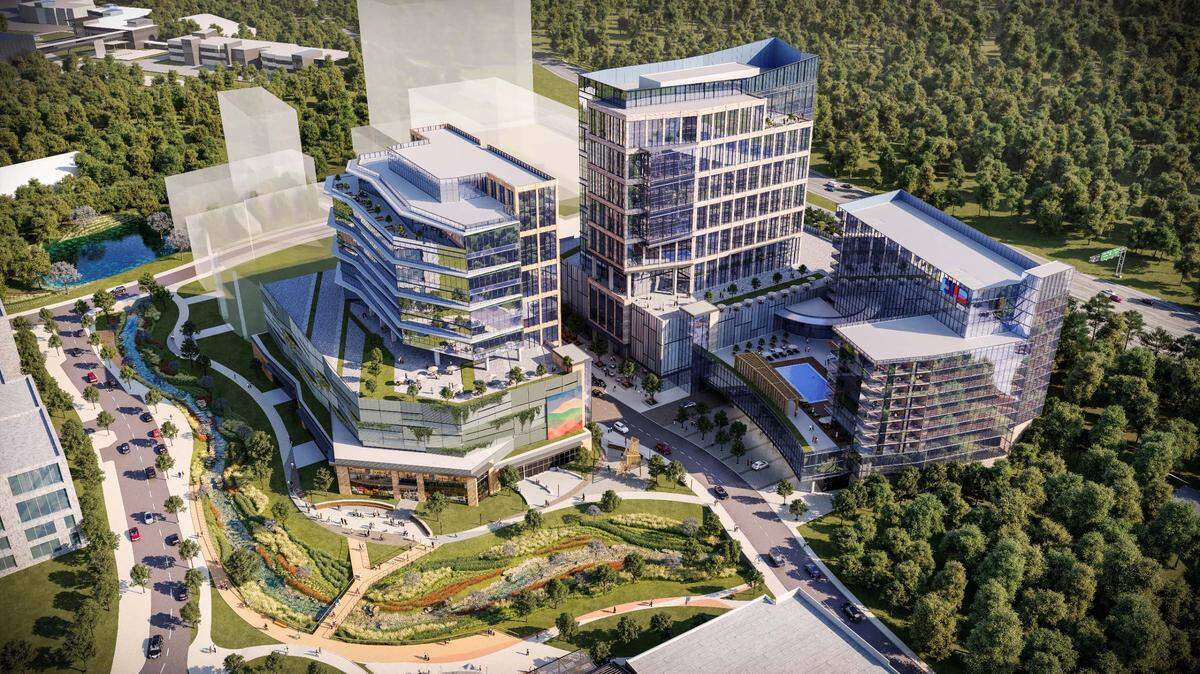
All of those projects will take time to be completed, from Fujifilm Diosynth’s massive Holly Springs facility to Longfellow’s planned eight-story tower in the heart of the Research Triangle Park. “But this market is really firing on all cylinders,” Brock said.
The Triangle’s primary advantages at the moment, Brock said, are that businesses can find extremely talented workers in the region, and land here is much cheaper than in more established metro areas. In Boston and San Francisco, he said, there’s a real struggle to find new land to develop.
In the Triangle, while it is getting more competitive around RTP, there is still plenty of land available in southern Wake County.
The difference can be seen in the cost per square foot between the top metros.
Life-science rents in the Triangle run between $28 and $42 per square foot, according to Newmark. Boston life-science property rents for $50 to $120 per square foot; in San Francisco, it’s $63 to $81 and in San Diego, $50 to $67.
But because the Triangle’s biotech scene was built by expansions from outside companies and it is less established than other metro areas, North Carolina’s ranking suffers from its current investment structure.
This can be seen in the amount of venture capital biotech startups have raised in the Triangle versus other top metro areas.
In the past 12 months, Triangle biotech companies have raised $573 million from investors, according to Newmark. Meanwhile, Boston-area companies raised $11.7 billion, and Bay Area biotech companies raised $10.5 billion, according to the analysis. In San Diego, biotech companies raised $3.4 billion.
“It’s chicken or the egg, you know,” Brock said. Investors “go where the talent is, where all the companies are being spun out of the universities.”
That cycle is picking up, with more life-science businesses emerging from UNC-Chapel Hill and Duke University, like Xilis, a cancer treatment company that just raised $70 million from investors like Google.
And just last year, AskBio, a UNC-Chapel Hill spin-out, fetched a $4 billion price tag when it was acquired by Bayer.
“I think we’re getting that cycle now, but it will take a long time, if ever, to catch up to those” established clusters, Brock said.
“Will we ever be Boston? Probably not,” he added. “But, you know, can we be a solid number three behind the Bay Area and Boston? Definitely. And I think that’s something over the next 10 to 20 years that could easily happen.”
Newmark’s 2021 Biotech Cluster Rankings:
- Boston
- San Francisco
- San Diego
- Research Triangle
- Seattle
- Philadelphia
- Maryland
- Los Angeles
- New York City
- New Jersey
This story was produced with financial support from a coalition of partners led by Innovate Raleigh as part of an independent journalism fellowship program. The N&O maintains full editorial control of the work. Learn more; go to bit.ly/newsinnovate.
This story was originally published August 27, 2021 at 11:19 AM with the headline "Triangle biotech scene is growing fast, but still trails Boston and Bay Area, report says."