UNC’s tumultuous COVID year ends with Fauci and Corbett virtually addressing grads
When UNC-Chapel Hill kicked off a weekend of five in-person commencement ceremonies on Friday, it marked the end of an academic year that’s tested students, faculty, campus operations and budgets more than ever.
UNC navigated the coronavirus pandemic in the national spotlight this school year — from postponing and then canceling in-person classes due to spikes in cases to requiring mass COVID-19 testing to vaccinating college students at its campus clinic as part of a nationwide research study.
The university has also been critical to the national and global effort to fight COVID-19 through research on campus.
So it’s fitting that UNC-CH graduates hear virtual commencement speeches from two of the nation’s top COVID-19 researchers — Dr. Anthony Fauci and Dr. Kizzmekia Corbett.
Fauci has been leading the nation’s COVID-19 response as the chief medical advisor to the president. He is the director of the National Institute of Allergy and Infectious Diseases at the National Institutes of Health.
Corbett, a Carolina alumna, is the scientific lead on the Vaccine Research Center’s coronavirus team under Fauci at the NIAID. Her work was critical to the development of the COVID-19 Moderna vaccine. She was recently honored by Time magazine as an emerging leader and she’s joining the faculty at Harvard University’s T.H. Chan School of Public Health this summer.
UNC Chancellor Kevin Guskiewicz said when the school decided to host a “pandemic-safe” in-person commencement, Fauci and Corbett rose to the top of the list of potential speakers.
“Their work aligns with our mission here at Carolina to solve the problems of the state, the nation and the world through teaching and research,” Guskiewicz said.
So they gave it a shot, Guskiewicz said. When he made the call to Fauci’s team, he initially got the standard reply turning it down.
But, Fauci’s chief of staff called back and apologized saying Fauci wanted to participate “because of the impact that our researchers have had on taking on the virus,” Guskiewicz said.
‘You did it in a pandemic’
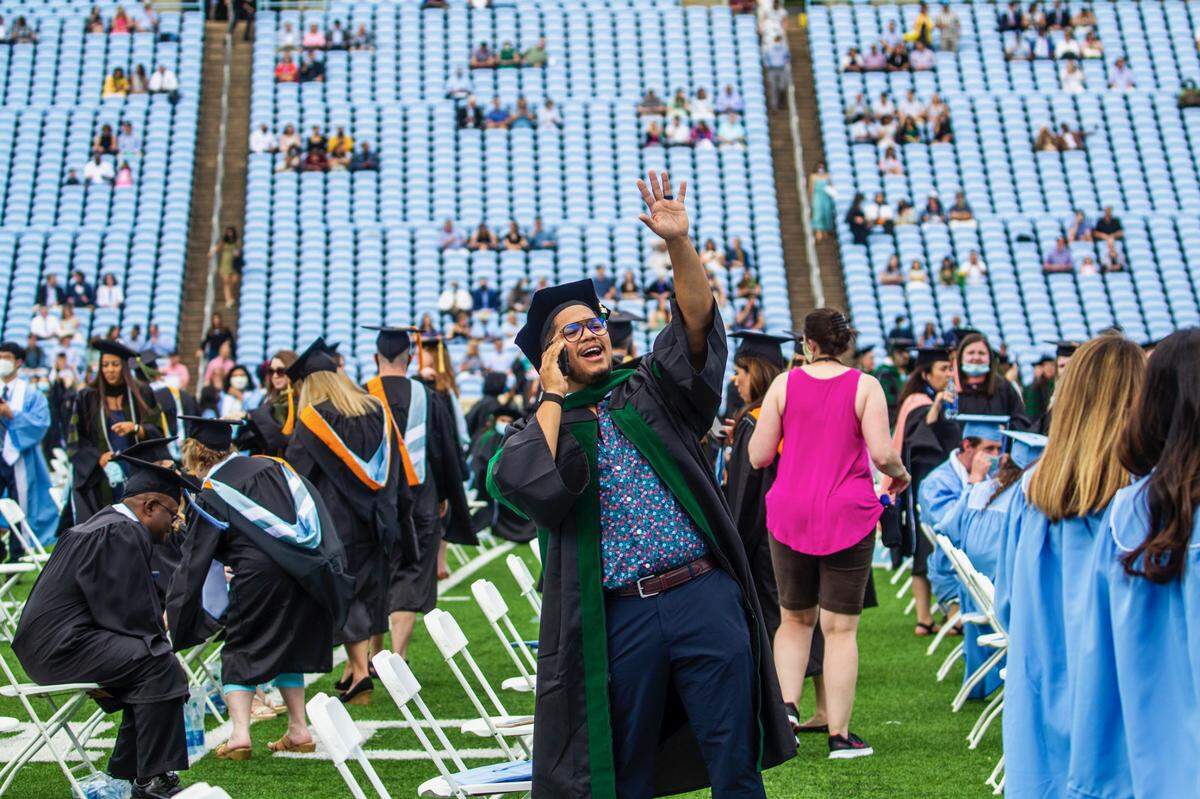
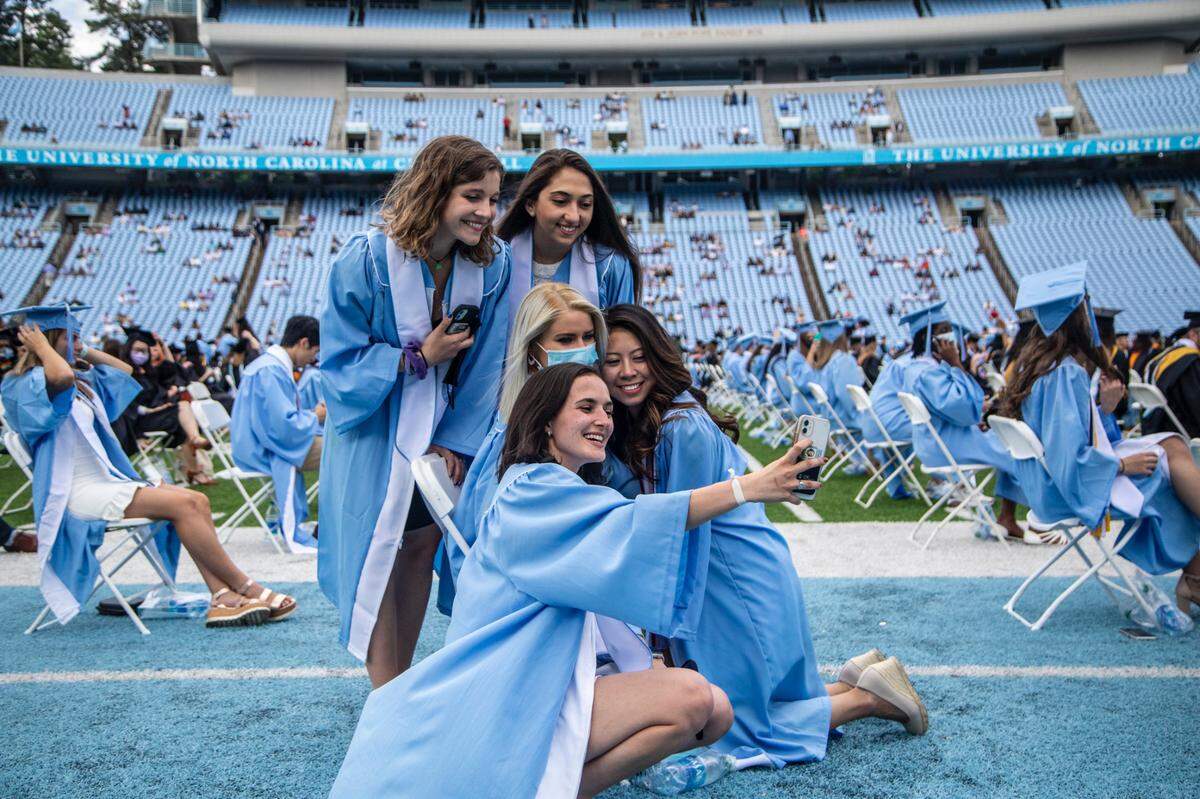
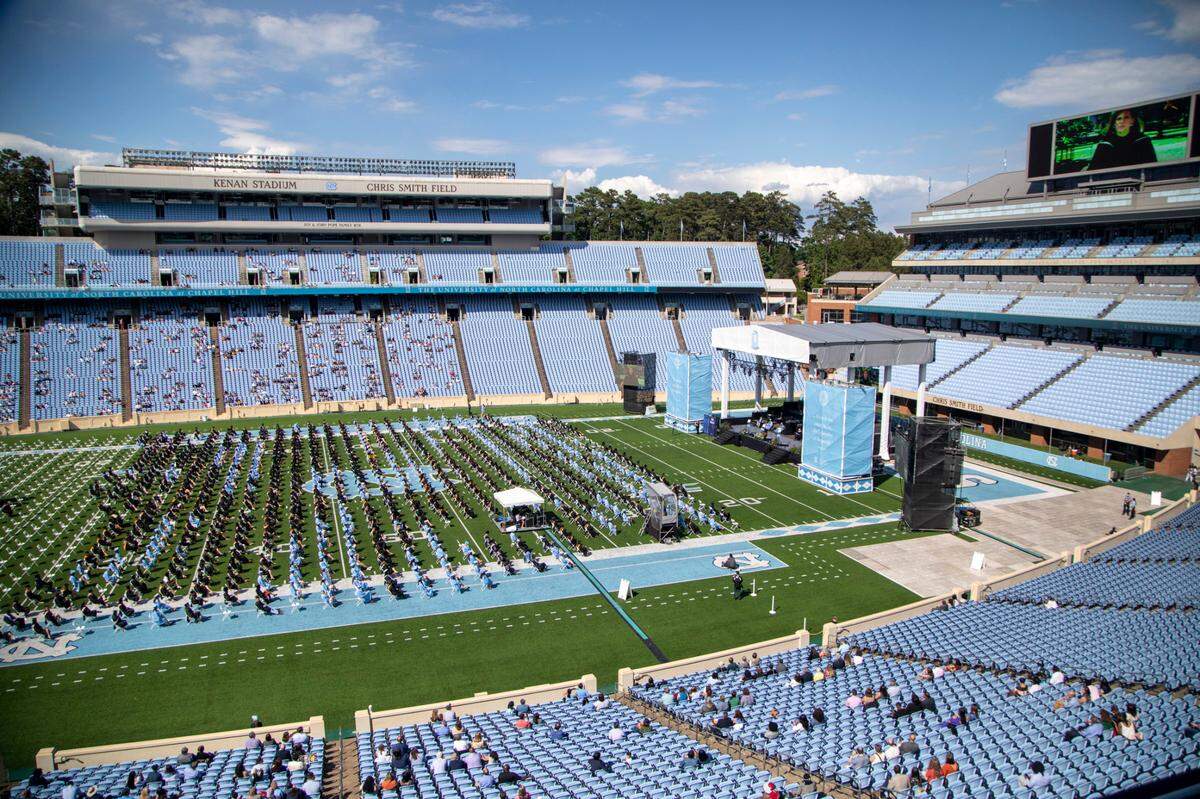
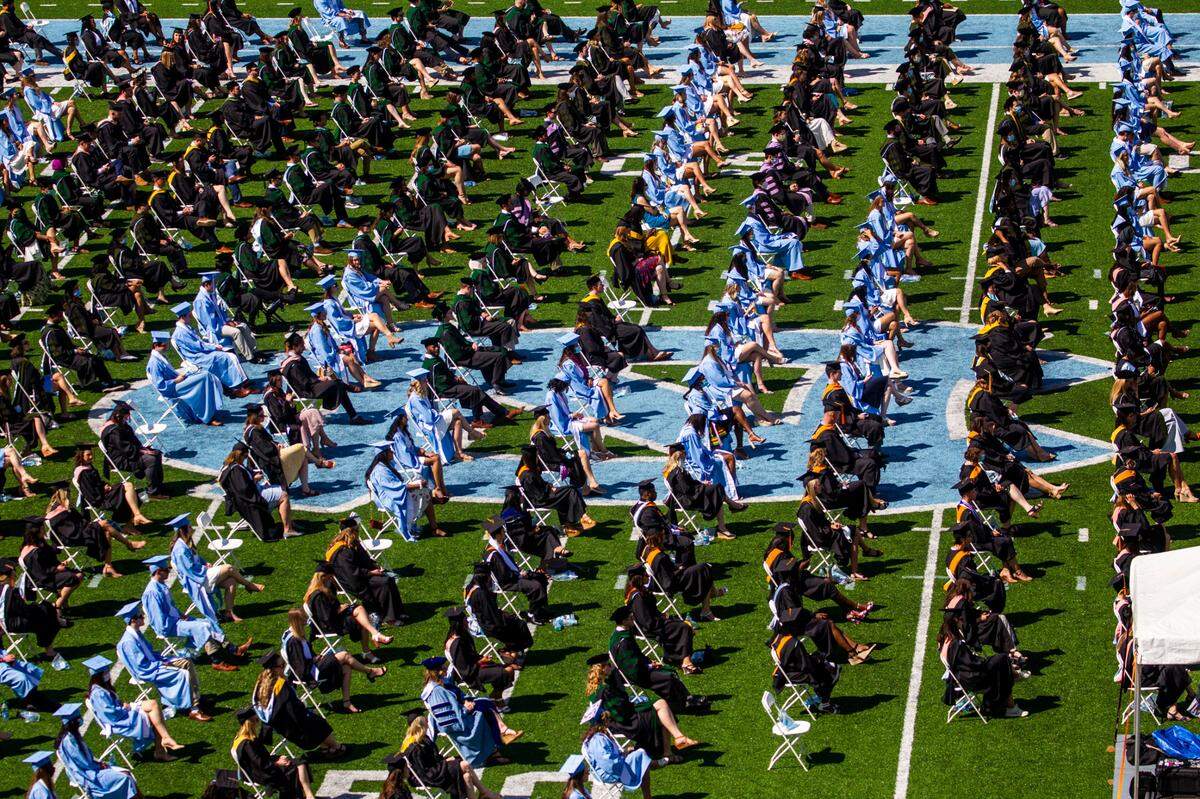
On Friday afternoon, graduates sat 6 feet apart in chairs on the field at Kenan Stadium wearing face masks. Their families, who made the trip despite the state’s gas shortage, sat in groups in the stands. And some students who couldn’t make the in-person ceremony appeared on a Zoom, joining their fellow classmates in the celebration.
The crowd heard live and pre-recorded speeches from university and student leaders before graduates turned their tassels, as is tradition.
In his speech, Fauci told graduates that he can usually relate to students and their experiences when he gives commencement addresses. But that “just does not pass muster this year” as students faced a truly unprecedented year as their lives were upended by COVID-19, he said.
No students have ever had this level of disruption to their lives and the world that they are entering has changed dramatically, he said. And it’s going to be tough.
“However, what I’ve seen of how you have responded to the pandemic thus far gives me confidence that you will adjust and you will thrive,” Fauci said.
Fauci described how COVID-19 has shown a bright light on the extraordinary health disparities among minority groups, particularly African-Americans, Hispanics and Native Americans. He noted the greater likelihood of being hospitalized or dying from COVID-19 because of their jobs as essential workers, lack of access to healthcare and “the restriction put upon them by the undeniable racism that exists in our society.“
Fauci also noted how the division made public health measures political and hostile. He challenged graduates to pull together with a singular purpose of the common good as the nation goes through this pandemic and future crises.
The heaviness of his speech ended with a bit of joy. Fauci reminded the students to allow themselves to cultivate joy as much as they do their professional accomplishments.
“Find your own source of joy or happiness and fully embrace it and let the sounds of your laughter be heard,” Fauci said.
Corbett thanked the Class of 2021 for simply being there in her virtual speech.
“Congratulations, you did it!” Corbett said. “You did it boldly, you did it fearlessly, you did it intelligently, and the prize of it all is that you did it in a pandemic.”
Corbett talked about home and how it’s not just the place that people are raised.
“Home is or are the culmination of places that amass experiences that shape who you are, that shape who you will be,” Corbett said.
And no matter where graduates are headed after this moment, Carolina will always be home, just as it is for her, she said.
“Everyone in that stadium is now a Tar Heel, but your being, the pieces of you that are unparalleled to anything that anyone else has to offer, will come from remembering where you came, from where you conquered,” Corbett said, “here at UNC and every other step along the way.”
Carolina connections to COVID research
For decades, UNC-CH has led coronavirus research, and it’s been particularly influential over the past year.
The world has looked to Dr. Ralph Baric and the research at his lab in the Gillings School of Public Health as the basis for COVID-19 treatments and a vaccine.
Scientists at the NIH, including Facui, have been collaborating with Carolina faculty throughout the pandemic.
“Several of your UNC scientists, whom I know quite well, are playing major roles in the development of a substantial public health response to this pandemic through the implementation of high-impact biomedical research,” Fauci said. “Of this you should feel justly proud.”
UNC-CH was one of the leaders in finding a vaccine and researchers helped prove that the Moderna vaccine worked through experiments with mice.
The only COVID-19 treatment approved by the U.S. Food and Drug Administration, called Remdesivir, was discovered in a UNC-CH lab. Fauci called it the “standard of care” for a faster recovery for patients.
UNC-CH researchers also helped test and develop a drug that can be taken as a pill that reduces COVID-19 symptoms and prevents further infections. It’s currently being tested in clinical trials by Merck Co.
And UNC professor Zeynep Tufecki, has gained national attention for her work giving practical advice about what how to stay safe during the pandemic, which often contradicted or preceded guidance from health organizations.
“Our students and faculty at Carolina have played a leading role in solving some of the greatest challenges of the pandemic,” Guskiewicz said.
One of his messages to graduates this year will be that he hopes they look back on 2020 and think about the way their alma mater has helped society adapt during the pandemic.
“That’s what great research universities must do,” Guskiewicz said.
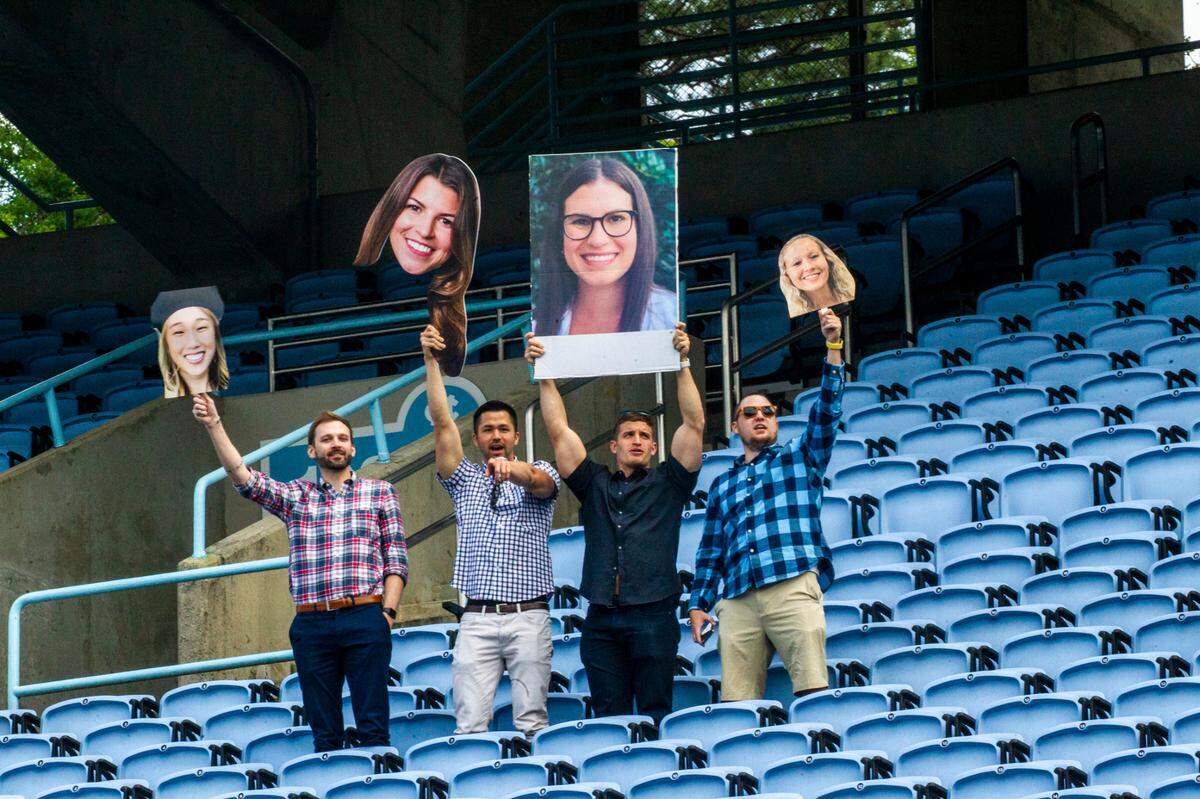
Impact on 2021 graduates
UNC-CH Senior Class President Chris Suggs, 20, was hesitant about the school’s plans to bring students back to dorms and classrooms at the start of the fall semester. Looking back, he said he’s proud that he was so vocal when things weren’t safe.
COVID-19 cases were rising as students returned to Chapel Hill. On the first day of classes, Suggs said, “we’re really just walking into what feels like a burning building.”
A week later, UNC-CH made national news when it was forced to abruptly move classes online and students out of dorms because of spikes in cases and limited capacity in quarantine and isolation spaces. The scrutiny continued throughout the academic year as clusters of cases spread in dorms, students hosted parties during sorority and fraternity recruitment and rushed Franklin Street after beating Duke.
Students took virtual classes from their kitchen counters and childhood bedrooms, lost campus jobs, got tested for COVID-19 regularly and struggled with their mental health.
“There’s really no hyperbole when I say this has been the most difficult year of my life,” Suggs said. “And I know it’s the same for so many.”
The challenges piled on, from trying to navigate college virtually and finish up their undergraduate education in the midst of the pandemic to the social unrest around the nation to the individual losses of friends and family members.
Despite the circumstances, they made it. And they learned that “distance means very little” when it comes to building relationships and supporting each other, Suggs said.
“I think this graduating class, we all have something to be extremely proud of that we’ve persevered and been so resilient,” Suggs said. “But I hate that we had to get through so much to get here.”
Suggs has been an advocate for vaccines on campus and in the community the past few months. He’s continuing that with his post-grad plans as he starts a new job with the state on vaccination outreach, particularly in Eastern North Carolina and for people in marginalized communities.
In his speech Friday, Suggs said his class has seen the university community at its best and at its most vulnerable.
They entered on the heels of a national champion and witnessed Roy Williams’s retirement. They took part in the “fearless activism” that led to the removal of the Silent Sam Confederate monument and made the campus a more welcoming and inclusive place, he said.
And in that time, they’ve all found a second home at Carolina.
“My hope is that as we depart from home, whether you consider that to be Chapel Hill, your hometown or simply the people with whom you feel most safe,” Suggs said, “we always remember and cherish it.”
Other NC graduation ceremonies
N.C. State, UNC Charlotte, Western Carolina University and Wake Forest University also have commencement ceremonies Friday, Saturday and Sunday.
Here’s a list with more details on North Carolina universities’ 2021 spring graduation plans.
UNC-CH is also planning a graduation ceremony for the Class of 2020 next fall.
This story was originally published May 14, 2021 at 2:42 PM with the headline "UNC’s tumultuous COVID year ends with Fauci and Corbett virtually addressing grads."