How do you teach America’s ‘sins?’ NC board still at odds over social studies standards
North Carolina education leaders are struggling with how to balance teaching students about both the nation’s historical sins and its accomplishments.
The State Board of Education will vote Thursday on new K-12 social studies standards that include language such as having teachers discuss racism, discrimination and the perspectives of marginalized groups. Republican board members have complained that the standards are unbalanced, while some Democrats don’t think they go far enough.
In an effort to bridge the divide, GOP State Superintendent Catherine Truitt presented Wednesday a new preamble to the standards that say they must discuss “hard truths” such as Native American oppression, anti-Catholicism and Jim Crow. But she said the standards must also teach how the U.S. Constitution created the world’s first organized democracy since ancient Rome and how the U.S. went on to end legalized slavery.
“Let us study the past such that all students can celebrate our achievements towards a more perfect union while acknowledging that the sins of our past still linger in the everyday lives of many,” Truitt wrote. “Let us study the past so we can understand where it might lead us today.”
GOP board members said they agreed that students need to learn about the nation’s warts. But they said Wednesday the standards still are overly negative and don’t talk enough about the progress that has been made.
“Discrimination and oppression must be covered and it will be,” said board member Todd Chasteen. “Yet the last thing I want to do is to mislead students to think the U.S. is hopelessly bigoted, irredeemable and much worse than most nations, unless that were true. But I don’t believe it is.”
More inclusive standards sought
The latest standards have gone through multiple drafts, including an earlier one that would have had third-grade students study how monuments such as Confederate statues are valued by their community.
In July, the state board voted to delay adoption to give the state Department of Public Instruction more time to ensure diversity and inclusion in the standards.
Examples of new language presented last month include:
▪ Eighth-grade classes would explain how the experiences and achievements of women, minorities, indigenous and marginalized groups have contributed to the development of the state and nation over time.
▪ Civics students would interpret historical and current perspectives on the evolution of individual rights in America over time, including women, tribal, racial, religious, identity and ability.
▪ Civics students would learn about “inequities, injustice, and discrimination within the American system of government over time.”
But Chasteen said the new standards tell teachers to talk about how U.S. foreign policy has helped the privileged but not how it’s helped marginalized groups.
Board member Olivia Oxendine said the standards don’t talk enough about the gains that have been made since the Civil Rights Movement.
GOP Lt. Gov. Mark Robinson said Wednesday he has 27,000 signatures on an online petition calling on the state board to reject the new standards. Robinson said public education has become so anti-conservative that he has not been allowed to speak at schools but activities such as Black Lives Matter are promoted.
“It would be irresponsible for this board to pass them at this time,” said Robinson, who is a state board member due to his position. “I know it’s going to take time to do more work, but there are enough people in this state who have questions and concerns about these standards that we need to go back to the drawing board again.”
Editorial cartoon criticized
Opposition to the standards led to an editorial cartoon published Tuesday by WRAL that depicts GOP state board members as KKK members, the News & Observer previously reported.
Several GOP board members lashed out at the cartoon on Wednesday.
Robinson, who is Black, said portraying him and Oxendine, who is Native American, as KKK members shows the standards are divisive.
Oxendine said the cartoon is telling people who disagree to shut up and be quiet or else.
“For others that wear the GOP vest, when we come to this table we’re about children and we’re about students,” said board member Amy White. “What happened yesterday was offensive. Nothing short of bullying and it should not be tolerated.”
State board chairman Eric Davis came to the defense of his colleagues on Wednesday. While he was appointed by former GOP Gov. Pat McCrory, Davis has often sided with the Democratic members on contentious issues.
“We acknowledge and respect the right of free speech under our federal and state Constitutions,” Davis said. “However, the members of the State Board of Education wish to express our dismay about — and extreme disagreement with — the depiction in a recently published cartoon of some of our members as being associated with the KKK.
“This information is absolutely inaccurate and unfair to the individuals involved. Political disagreements are fair game. Personal unfounded attacks such as this are out of bounds in the context of civil discourse and disagreement.”
Capitol Broadcasting Company, the parent company of WRAL, defended the cartoon.
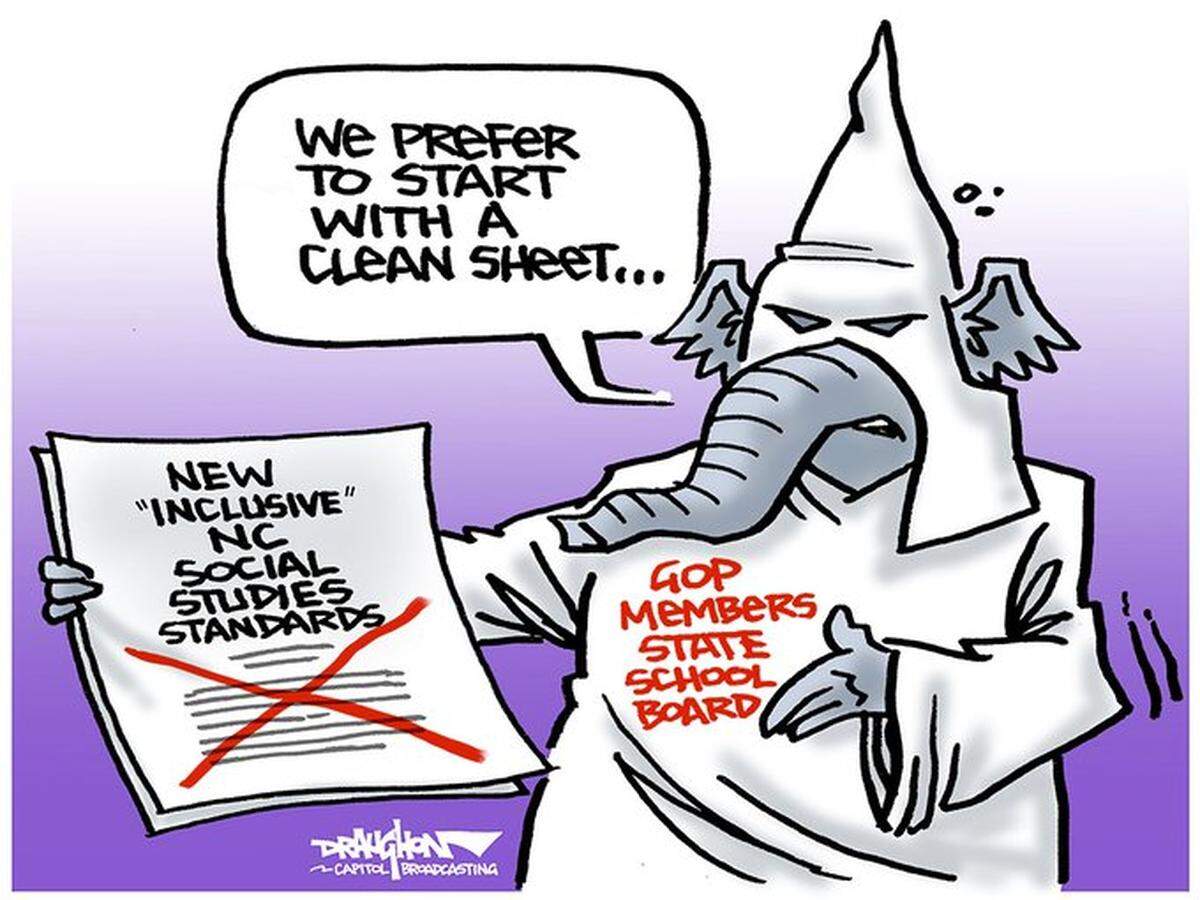
“Editorial cartoons are creative and provocative, using hyperbole and satire. No one believes Republicans on the State Board of Education are members of the Ku Klux Klan,” Seth Effron, opinion editor for Capitol Broadcasting, said in a statement Wednesday.
“The editorial cartoon by Dennis Draughon is meant to point out that these members of the State Board are trying to wipe out from the social studies curriculum the record of racism which includes the Klan and the segregationist practices that were imposed in our state and nation’s history.”
Should systemic racism be taught?
In an attempt to mollify opponents, Truitt had proposed last week removing the words “systemic racism,” “systemic discrimination” and “gender identity” from the standards. They’d be replaced by racism, discrimination and identity.
Davis said he would support Truitt’s revisions even if they don’t have everything in it that he would desire.
“I’m just supremely confident that our teachers and students can handle the truth of our history, both good and bad, and I’ll not deny them the opportunity to learn from our achievements or our shortcomings,” Davis said. “I have no doubt that they will respond with increased admiration, increased devotion and increased love for our country and for one another if first we will believe in them.”
But five advisers to the state board said they back the version that kept in the terms systemic racism, systemic discrimination and gender identity.
“We do believe in telling the whole truth of our country’s history and validating the identities of each and every child in our history that we teach, and that includes LGBTQ students, our indigenous students, our Black students and other students of color,” said Matt Bristow-Smith, 2019 North Carolina Principal of the Year and a board adviser.
“Their histories matter, and they should be taught. That’s why these standards are so important.”
State board member James Ford has also questioned dropping the use of the term systemic racism. Ford, who is Black and a former high school social studies teacher, said it’s time to teach more than the dominant narrative that’s been in schools for years.
“There is a new America emerging that is browner, that is in many ways younger, more diverse,” Ford said. “The question before us is are we going to adopt standards that are inclusive of this new America?”
This story was originally published February 3, 2021 at 2:51 PM with the headline "How do you teach America’s ‘sins?’ NC board still at odds over social studies standards."