‘A problem we can’t see’: NC child abuse reports, foster placements drop during pandemic
By Tyler Dukes and
Virginia Bridges
RALEIGH
When Adrian Tucker was growing up, school was his escape from the physical and mental abuse he says he and his mother faced almost daily.
He played sports. Joined the band. Activities that let teachers, coaches and counselors see him — and make sure he was OK.
“I was one to sign up for a lot of things,” he said. “A big reason for that was it kept me away from home.”
That’s what worries Tucker, an instructional assistant at W.G. Pearson Elementary School in Durham, about students in virtual classes.
“There are students who needed that time away from home,” he said. “And there are adults, for lack of better words, who might have needed time away from their child.”
Spending time with children day after day helpseducators like Tucker recognize the signs of abuse and neglect. That time, he said, can also build enough trust for students to share what’s happening to them.
“That is one of the things I am terrified about,” he said. “We have been able to break through certain veils and barriers virtually, but there is still not that connection with the student sometimes, or at least the opportunity to have that.”
With much of that connection now remote, data from state and local child welfare agencies suggest the pandemic has made it harder to protect kids from abuse and neglect.
Reports to Triangle counties have plunged. And statewide, hundreds of fewer kids are entering foster care, where children land when they’re taken out of dangerous situations.
Such declines would, in past years, have been a positive sign. But experts fear that multiple stressors — including wage and job loss, psychological challenges and health issues — are actually driving up child abuse and neglect cases hidden in the shadows of the pandemic.
“The prevalence of abuse is very likely off the charts, and we are going to see the domino effect for a very long period of time to come,” said Cristin DeRonja, executive director of SAFEchild, a Raleigh agency working to eliminate child abuse in Wake County.
When things get back to normal, child welfare advocates say, there’s likely to be a surge in need.
And they’re not sure the state is ready.
‘A problem we can’t see’
County social services agencies handle thousands of reports of child abuse and neglect every year. Those numbers typically drop in the summer while children are out of school — and out of sight — of teachers and counselors.
But in 2020, reports in Wake, Orange and Durham counties dropped roughly 15% compared to the same period in 2019.
To Paige Rosemond, director of Wake County’s child welfare division, it was a sign that fewer children were showing up at child care centers, schools and doctor’s offices during the COVID-19 pandemic.
Educational personnel accounted for about 25% of abuse and neglect reports the week before the pandemic closed Wake schools. In the weeks that followed, that number fell to a weekly average of 8%, according to information provided by Wake County.
While overall reports returned to their pre-COVID-19 level of roughly 75 to 150 reports per week after virtual school started, Rosemond said, reports from teachers, guidance counselors and other school employees remained low.
The overall increase may have reflected children resuming extracurricular activities or attending more medical appointments, or possibly more domestic violence incidents with children present, Rosemond said.
“We are still posing those hypotheses,” she said.
Less reporting, though, means more uncertainty.
At the N.C. Department of Health and Human Services, Lisa Cauley, deputy director of Child Welfare Services, said more parents at home during the pandemic could create safer environments for kids.
But she’s also concerned about the alternative: without the school safety net, more kids are falling through the cracks.
“I worry that it’s a problem we can’t see,” she said.
In February, a Guilford County elementary school official reported concerns about a student who had missed weeks of school and returned thinner and with red marks on his arms, according to court documents.
The red marks came from being chained to a television stand, the court documents state. Officials also found cigarette burns on his buttocks and thighs.
If the boy had returned to school a month later, the abuse likely would have continued undetected because school officials wouldn’t have been at school at the time to see the warning signs, said High Point Police Officer Matt Truitt, a former high school resource officer.
It’s hard to notice those physicaldetails in virtual school, he said.
“You had vigilant and observant school teachers, school administrators, counselors, social workers — all the people that see the children on a daily basis,” he said. “Now, they are not being seen.”
Those severe cases, however, aren’t typical of the cases that social service workers, educators and others see on a daily basis.
Those more often involve children coming between caregivers during domestic violence, or parents who aren’t measuring out proper amounts of formula for children to thrive. In such situations social workers may be able to refer people to parenting classes and one-and-one support to address their challenges, Rosemond said.
Recognizing trouble
For Tucker, it was his coaches and band teacher who helped him without ever broaching the topic of abuse.
“Even if they didn’t recognize what it was, they could see there was something that was troubling this child,” he said.
And they poured energy into him, he said.
Tucker takes that approach when he’s concerned about his students
“Let me see what is going on, but also realizing and living in the fact that I am not going to know everything,” he said. “And I am not going to pry too much.”
A report to child protective services, on its own, doesn’t necessarily mean a child is experiencing severe trauma. Not all reports are substantiated, and others result in support services or periodic monitoring.
But some cases do require removing children from potential harm. More than 10,000 kids are in North Carolina’s foster system at any given time.
And state data show that system, too, has taken a hit.
Brooks Rainey Pearson, left, and Dave Pearson stand for a portrait together with their foster son, on Tuesday, Oct. 27, 2020, in Durham, N.C. Casey Toth ctoth@newsobserver.com
Fewer kids in foster care
When Brooks Rainey Pearson and her husband were licensed as foster parents in 2017, social workers warned them to keep their phones on. The need in Durham and across the state is typically so great that open spotsare filled quickly.
“We got a call in two hours,” Rainey Pearson said.
They’ve cared for several children since then, including an 9-year-old who’s been with them for more than three years. So when their second spot opened up again this February, days before North Carolina confirmed its first case of COVID-19, she expected a similar, quick turnaround.
This time, Rainey Pearson didn’t hear from social workers until August. And she wasn’t the only one.
“We were hearing a lot from foster families at the beginning that even when they had openings and were prepared to take in a child, they weren’t getting any calls,” said Rainey Pearson, who serves on the board of Fostering Families, a group that offers support and resources in the Triangle.
Those openings remained because there were fewer kids to fill them, an analysis by The News & Observer shows.
From April to August, the most recent data available, more than 700 fewer children entered the foster care system in 2020 compared to the previous five-year average. That’s a decline of almost 30%.
And just like with the dip in reports of suspected abuse and neglect on the county level, DHHS data shows the drop statewide in 2020 is largely due to a lack of reports from teachers, guidance counselors and other school workers.
Those sources normally account for around 1 in 5 reports that lead to child protective services assessments in regular school months. But compared to the previous year, the number of referrals from educational personnel dropped during the 2019-20 school year by about 30% — the largest decline for any category of reporting.
“Schools are a safety net,” Cauley said. “It’s not just that they make a report. It’s that teachers, guidance counselors, they care.”
The consequences of trauma
A foster parent and senior fellow at the Duke-Margolis Center for Health Policy, Aaron McKethan has reviewed the data on the decline in foster care entries after noticing the slump in demand firsthand.
Those numbers, he said, have big limitations.
“What we won’t be able to see in the data is the extent of the harm, the nature of harm that these kids will have to overcome,” McKethan said. “It’s going to be a long road.”
Beyond the risk of physical injuries, abuse and neglect can change children’s brains — and how they develop in the world.
In the short term, abuse may result in a child having trouble concentrating and performing poorly in school, said Sharon Hirsch, president and chief executive officer of Prevent Child Abuse North Carolina.
The state-supervised but county-administered social services system gives each county its own reporting line. If screening questions suggest abuse, state law requires county staff to conduct an in-person visit within 24 hours — 72 in the case of neglect.
Even though staff never went virtual, Cauley said the coronavirus has complicated the process.
“People who may not have wanted you in the house before COVID would want you in the house less because of COVID,” Cauley said. “There are some additional challenges to CPS responding, but CPS is used to breaking down that resistance.”
Social service workers responding to reports might prescribe or recommend next steps, which could include parenting classes or counseling. Officials could also determine there is no need for services.
A coming surge?
Experts are also worried, however, about what happens when the pandemic starts to ebb.
Families are dealing with new stressors, from social isolation to uncertainty about employment, housing and food security. And the impacts of that additional stress, experts fear, have been largely hidden.
Tripp Ake is director of training for the Center for Child and Family Health in Durham, which focuses on the treatment and prevention of childhood trauma. It’s handling plenty of referrals for services now. But Ake said it’s unclear what will happen when in-person instruction returns — and starts catching signs of months of backlogged trauma.
“I feel like it’s really just the tip of the iceberg in some ways as far as the level of need that we’ll see later,” Ake said.
Big caseloads and burnout among child welfare workers predated the events of 2020. A suddensurge in demand could make matters worse.
Cauley said the potential for a surge worries her too.
“This was hard work before COVID — and same thing with the counties. What sustains you is that understanding: We can’t quit,” Cauley said. “People need the child welfare system; foster parents rely on us. Biological parents of children rely on us. That’s what keeps you going.”
Ake credits the state for starting to invest in training, self-care and support for the child welfare workforce,but notes there’s more to be done. “I do think if the system is properly supporting the workforce, that’s a model for how we want our workers to take care of our kids,” Ake said.
The potential need goes beyond workers. A surge in reports would increase demand for foster families that could outstrip the pre-pandemic supply.
Foster families need background checks, 30 or more hours of training and other assessments before they can earn a license. So adding capacity takes time.
“We have this issue where we’re expecting to see more kids eventually come back into the system when schools reopen, mixed with an uncertain supply of foster families given the difficulty of training them,” McKethan said. “It really adds up to be a perfect storm that unfortunately places the greatest risk on the most vulnerable children in our state.”
That’s why he’s urging families to step up now.
“There are fewer ways that we can think of to actually practice what it means to be a good neighbor,” McKethan said. “It could just as easily be our kids who need help, and that’s what’s driven us to participate.”
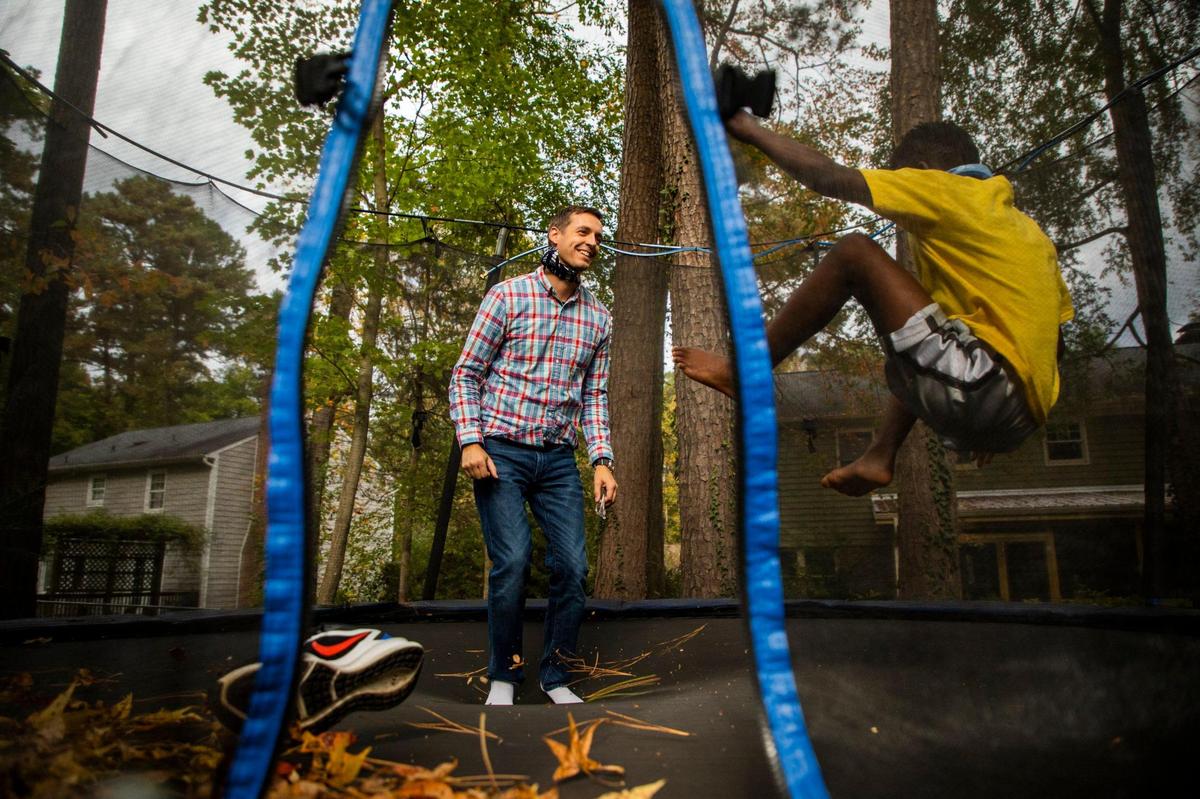
Dave Pearson jumps on the trampoline with his foster son, on Tuesday, Oct. 27, 2020, in Durham, N.C. Casey Toth ctoth@newsobserver.com
‘Those kids are out there’
In November, McKethan piled his two boys in the car and struck out for the North Carolina coast, one of their last chances for a family fishing trip before winter.
Over their excited chatter, McKethan worried aloud about who wasn’t there. The open foster care spot in his home remained vacant, as it largely had since the pandemic began.
The way forward, he argues, is to get schools reopened safely. It’s a process he acknowledges is likely to be “expensive and complicated and frustrating.”
But he sees few other options. And in the meantime, he worries children will continue to suffer unseen.
“It’s disheartening,” McKethan said, “because you know those kids are out there. It’s not like the abuse and neglect evaporated.”
Getting help
In North Carolina, state law requires anyone with knowledge of abuse, neglect or death due to maltreatment to report it. Those who don’t could face a Class I misdemeanor.
Physical abuse includes unexplained injuries, an infant with marks or bruises and children who are frightened of their parents; instances in which caretakers use physical discipline; and a substantial threat to kill the child, according to Wake County Human Services.
Emotional abuse includes a child being isolated from other family members, visible self-inflicted injuries or suicidal ideations, and situations in which parents speak in a mean or demeaning way toward a child.
Sexual abuse includes children displaying overt sexual behaviors or knowledge inconsistent with their age.
Neglect, which is more common than abuse, includes situations where children are left alone for too long, aren’t cared for or taken to the doctor when needed. It can also include children living in a risky environment, such as with a caretaker who is abusing drugs or in a home with domestic violence.
Warning signs include a child with multiple and repeated injuries, a child who is fearful or withdrawn and a child who appears malnourished.
Rachel Galanter, executive director of the Exchange Family Center in Durham, advised parents to be aware if they have shifted into “survival brain,” that might include fight, flight or freeze responses.
They might be making snap decisions. They might be numb and withdrawn. They might be agitated and angry.
“If you are stuck in one of those places, it probably would be useful to get support,” she said.
Seek support from neighbors, extended family and community-based resources. Some parents might need food, she said; others, parenting classes or mental health treatment.
“And say ‘I just need someone to help me navigate through this process, and get me the strategies and help me start implementing them so I can develop routines and habits that I can get to help my family through this time,” Galanter said.
The process includes home visits, interviews and criminal background checks and the completion of a 30-hour course “designed to inform participants about the child welfare system, the role of foster and adoptive parents, develop participants’ skills to become successful foster or adoptive parents and assess families to determine if fostering or adopting is the best fit for their family.”
Tyler Dukes is the lead editor for AI innovation in journalism at McClatchy Media, where he leads a small team of journalists that helps the company’s 30 local newsrooms responsibly harness data, automation and artificial intelligence to elevate and strengthen their reporting. He was previously an investigative reporter at The News and Observer in Raleigh, N.C. In 2017, he completed a fellowship at the Nieman Foundation for Journalism at Harvard University. He is a graduate of North Carolina State University and grew up in Elizabeth City, N.C.