
With few visitors and some windows still boarded up, downtown Raleigh businesses struggle
Throughout the coronavirus pandemic, Taiseer “Taz” Zarka has managed to keep the doors of his convenience store on the corner of Wilmington and Hargett streets open.
He’s hopeful they’ll stay open, but he’s not sure.
“I have no idea. It all depends on… it’s a disease. It has to be controlled by the health department and by politicians. It’s not in our hands,” Zarka said while giving a customer back his change on Friday afternoon.
Zarka’s store is one of only a few open on the block.
Lack of foot traffic means that business is down 60% from what it was before the pandemic. Zarka blames the closure of office buildings in the area and a law limiting alcohol sales after 11 p.m.
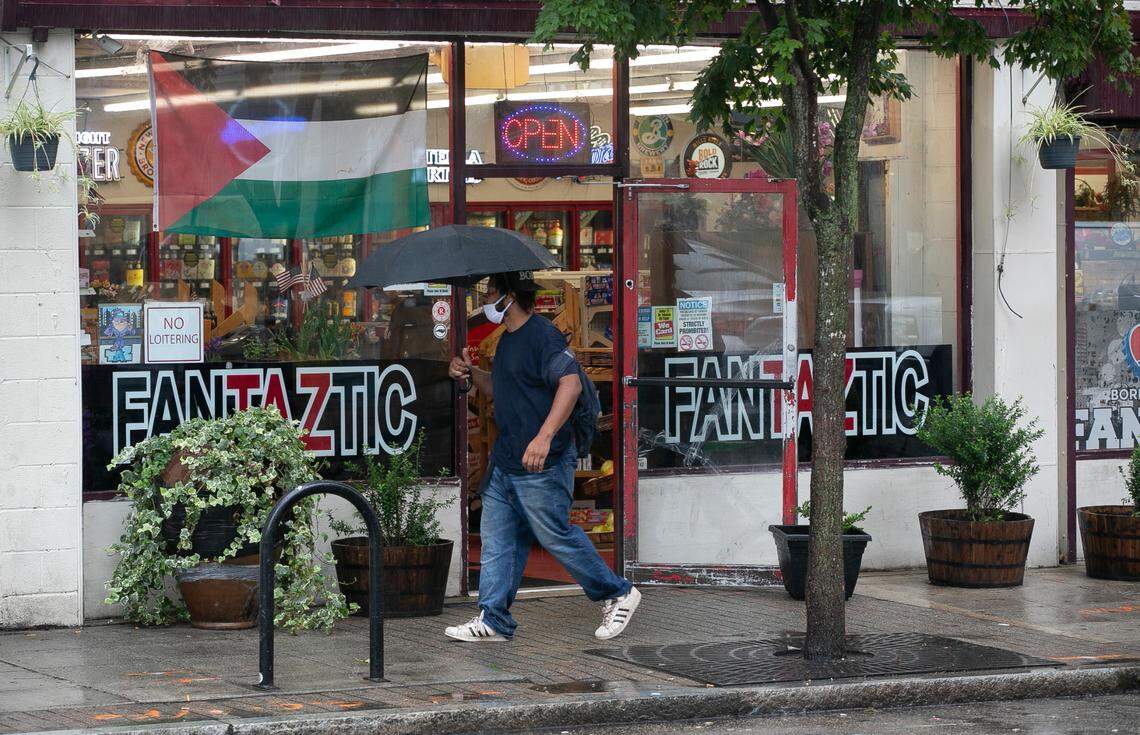
“We’re not corporate that if one shop out of 3,000 locations goes bad no problem we’ll fix it up,” he said. “We only have one.
“Downtown, we’re doomed. If it’s gonna continue as this, everybody’s gonna go. You’re gonna see a lot of doors are closed.”
More than six months since the first case of COVID-19 was reported in North Carolina and more than three months since the first protests against police brutality shook Raleigh, downtown businesses are struggling to keep their doors open.
According to a survey of over 200 small business owners conducted by Shop Local Raleigh, a nonprofit that promotes local independent businesses, less than a third of small business owners believe their business will survive the pandemic. More than half replied that they’re not sure, while over 10% responded that their business won’t make it.
Over half responded that they were negatively impacted by damage following the protests, too.
According to a report released by Raleigh Police Department this past week about the protests and the department’s response, 71 incidents of property damage were reported between May 30 and June 1.
Much of that damage occurred on the night of May 30, when thousands of demonstrators gathered in downtown Raleigh as part of nationwide protests prompted by the death of George Floyd. After police responded to protests with tear gas and pepper spray, the protest fragmented and some groups began smashing storefronts along Fayetteville and other nearby streets.
The report did not include an estimate of the cost of the damage, which it said is forthcoming. “The current cost analysis would not adequately factor the revenue lost by businesses due to vandalism, closure, and repairs,” according to the report.
Windows still boarded
At Carroll’s Kitchen on Martin Street, the windows are still boarded up from that night. Fires were also set inside the store, a nonprofit that employs women recovering from homelessness, incarceration, domestic violence and addiction.
The owner, Vicky Ismail, estimates that the damage cost $20,000 total, most of which was covered by insurance.
She doesn’t think having the boards up has directly decreased sales in the last few months, but says the overall effect on downtown has been stark.
“If you think about downtown a year ago, there used to be so much life, there’s people everywhere and energy, and sitting outdoors eating and laughing and walking and drinking coffee and now there’s kind of none of that. People pull up to curbside — that’s the saddest part. And the boards just remind me of the sadness of that. But we’ll come back,” she said.
Ismail hopes replacement windows will arrive in the next couple of weeks. She’s planning to keep the boards in the back of the store, though, so she can put them up in advance of future protests.
Since May, business owners have expressed their disappointment with the city’s response to both the protest damage and the pandemic.
Three-quarters of respondents to the Shop Local Raleigh survey responded “no” when asked if the Raleigh City Council and Wake County Board of Commissioners have “the best interest” of the small business community in mind. The same number said they do not support the actions of Raleigh Mayor Mary-Ann Baldwin or the City Council in response to both the pandemic and the civil unrest.
Some suggested that the city needs to invest in more security and police presence downtown.
“When police were not dispatched during the nights of rioting to certain locations it made me feel that our Chief of Police and mayor were turning their backs on us — letting the rioters have a free pass with no consequences,” one person wrote in response to the survey.
RPD’s report this week acknowledged some “areas for improvement.”
“Field communication is key in critical times such as this. We certainly saw some examples of the consequential impact of inconsistent communication and misinformation in a fluid environment,” the report said.
Businesses ask for help
Business owners have also emphasized the need for more assistance as much of downtown remains shut down because of the coronavirus. Some respondents to the Shop Local Raleigh survey demanded more consistent updates about the city’s plans.
“Not having a difinitive [sic] answer on a time line for what’s next, it truly sucks to have to watch a news conference every 5 weeks to know what happens the next day, a little transparency would be amazing,” wrote one respondent.
Others called for direct financial assistance.
“Traffic and sales are way down. The money from PPP is gone. I was one of the first round so it was only for 8 weeks. The EIDL [Small Business Administration loan program] was meant to last six months. This pandemic is still ongoing and it seems no one is willing to help us now,” wrote one business owner. “Big corporations are always being bailed out. It seems this pandemic has been put on the backs of our small businesses.”
Many suggested that the city and state should allow all businesses to reopen. The state is currently under Phase 2.5, in which bars, nightclubs, movie theaters, and other entertainment facilities will remain closed.
“How am I going to keep my business afloat? How am I going to pay personal bills? Should I walk away after 17 years and start over? I have spent all of my life savings trying to survive the past 5 months!” wrote one respondent.
Some indicators are more optimistic.
Sales and foot traffic increasing, but remain far short of normal
According to an annual State of Downtown report published Thursday by the Downtown Raleigh Alliance, food and beverage sales increased by 87% from May to June and foot traffic downtown increased 34% from July to August.
“We have seen a lot of repairs made and a lot of the glass come in,” said Bill King, CEO of DRA in a phone interview with The News & Observer. “We’ve got a lot that have reopened.”
King estimated earlier this month that 80% of businesses that did have damage had since taken the boards off their windows. Some businesses boarded their windows again in advance of protests last month in response to the shooting of Jacob Blake, a Black man in Kenosha, Wis., who was paralyzed after a white police officer shot him in the back.
Some business owners say that customers have been slowly returning.
Sosta Cafe, on the ground floor of Red Hat Tower, lost about 80% of its business in the early days of the pandemic, according to owner Jerome Lauck. Before the pandemic, most of Lauck’s clientele were office workers on their lunch break.
Business slowly climbed back to about 70% in April and May he says, but over the summer stabilized at about 50% of its pre-pandemic business.
Lauck had to lay off one employee and reduce two others to part time. He now works six days a week.
“I’m not paying vacations anymore, which I used to do. I’m not taking vacation, which I used to do,” he said while working a slow Friday lunchtime shift. Two customers lingered inside the cafe, another two sat outside.
He’s not eager for office buildings to open back up though. He says it would put him and his staff at greater risk of contracting COVID-19.
“I’m in a situation where I’m not closed, and I still function — I’d rather stay like this than, you know, potentially be exposed to the virus. Because it’s only two of us,” he said, motioning to one of his employees working in the kitchen. “If one of us gets it. We’ll go for two weeks, three weeks. And that will be devastating. I don’t have enough manpower.”
This story was originally published September 18, 2020 at 5:30 AM with the headline "With few visitors and some windows still boarded up, downtown Raleigh businesses struggle."