
Gov. Cooper cautions against divisive politics if state wants to attract entrepreneurs
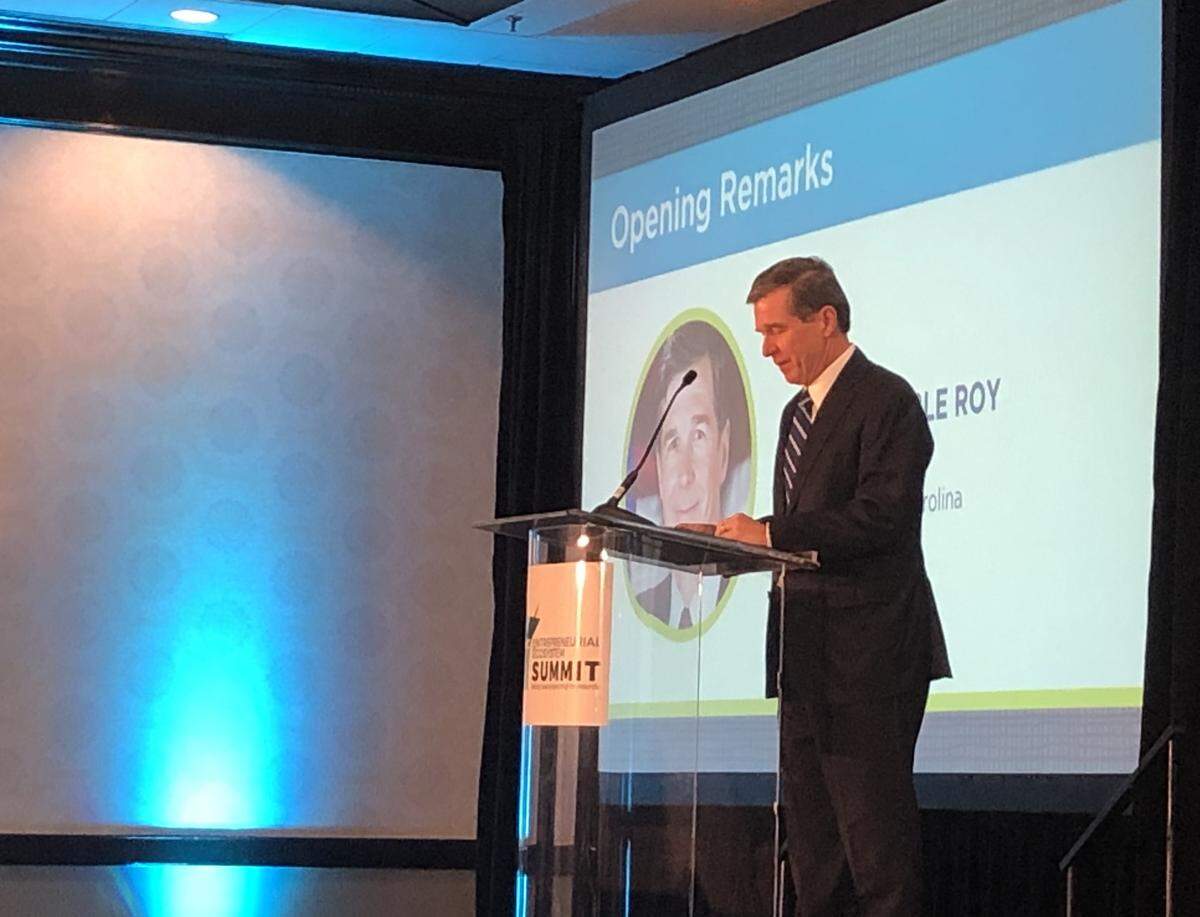
North Carolina Gov. Roy Cooper told a conference of entrepreneurs and economic developers Tuesday that his veto can keep the state’s economy safe from unnecessary pitfalls.
Citing the effects that House Bill 2, the “bathroom bill,” had on the state’s economy, Cooper said the state needs to avoid “divisive social issues” that turn away talented workers and potential businesses.
The Associated Press estimated that the backlash against HB2, which included boycotts from across the country, cost the state nearly $4 billion. The law prohibited local governments from enacting antidiscrimination protections for LGBTQ people and required people in government facilities to use bathrooms matching the gender on their birth certificates. It was repealed in 2017.
“Entrepreneurs can go anywhere in the world to start a business or pick where they want to live before starting a business,” Cooper told attendees at the NC IDEA Ecosystem Summit. “I think it is critical for us as a state to send a message across the country, and across the world for that matter, that North Carolina is an open and welcoming place for all kinds of people. That we are open for business. That we value diversity.”
Cooper, a Democrat, said the state is still actively trying to overcome the image HB2 gave it.
“We still have work to do across this country to convince industry leaders and businesses far and wide that this kind of legislation was cooked up by some leaders that do not reflect the values of North Carolinians,” he said.
In an interview after his speech with reporters, the governor said the state’s entrepreneurial economy is “poised to take off” without political controversies, highlighting his veto of an abortion-related bill earlier this year.
That bill would have created new criminal and civil penalties for infanticide, specifically for situations in which a fetus survives an abortion procedure. It applied to doctors and nurses who don’t provide care for the surviving newborns. Supporters of the bill did not show evidence of that happening in North Carolina, and if it did, a perpetrator can already be charged with murder, The News & Observer previously reported.
“That kind of social, right-wing legislation is not good for business in North Carolina and most business people will tell you that,” he said. “…I think it’s important now that we’ve cleaned a lot of that up and are able to go forward and send a strong message that North Carolina values diversity, and that we’re open for business.”
Lauren Horsch, a spokeswoman for Republican state Senate Leader Phil Berger, responded to Cooper’s comments, saying in a statement, “Only a radical liberal would call a ban on post-birth abortions a socially divisive issue.”
Investments over tax cuts
At the entrepreneurship conference, Cooper also said that while the state’s economy has been successful for the past few years, it needed to make it easier for people to take risks and start companies.
He celebrated the state’s “unicorns” — startups that have $1 billion valuations, like locally based Epic Games and Pendo. But he added that the small- and mid-size businesses play a large role in North Carolina, employing 1.6 million people and contributing 45% of North Carolina’s gross state product.
“In order for us to succeed, we have got to invest in the areas that help get us to this place of a good economic situation for North Carolina,” he said.
To get there, Cooper said, the state needs to give teachers and principals at public schools significant salary increases, invest more in community colleges and universities, spread broadband internet access to more parts of rural North Carolina and expand Medicaid in the state.
In a familiar refrain to businesses, he said the state should not enact further corporate tax cuts and instead choose investments into education that will improve the state’s workforce. North Carolina’s corporate tax rate currently sits at 2.5%, which is lowest in the country, according to the Tax Foundation, although several states don’t have a corporate tax at all and collect taxes only on gross receipts.
Earlier this month, the N.C. General Assembly approved average raises of 3.9% for teachers and 2% for non-instructional staff over the next two years. But Cooper vetoed the bill, calling the raises inadequate. Cooper had offered a budget compromise in July that included 8.5% average raises for teachers.
Horsch criticized Cooper’s stance against tax cuts, calling him “a classic tax-and-spend radical who thinks he can spend the people’s money better than they can.”
“Those tax cuts he’s so against have helped make North Carolina one of the top states to do business in and have helped bring 500,000 new jobs to the state,” she said. “Under Republican leadership, teacher salaries have increased by more than $9,000 since 2014. In the last five years, Republicans raised teacher salaries at the third-highest rate in the entire country. That’s a pretty significant boost to the economy, if you ask me.”
Cooper also pointed to other decisions that could improve the state’s workforce or make it more entrepreneurial, including creating a council on how to help people leaving the prison system reintegrate into society with jobs and boost the number of workers with disabilities in state government, as well as fund “finish line” grants that help people in community colleges pay for unforeseen expenses like car repairs or health emergencies.
The state is also going to work with young students more, he said, by creating an online tool that gives students in middle school information about what salaries can be expected with certain careers and how much schooling is needed.
“The strong signal we are sending is you don’t necessarily need a four-year degree,” he said. “You don’t need to go deeply into debt to get a four-year college degree.”
Additionally, the governor’s Entrepreneurship Council, a group that was formed earlier this year, has returned its first recommendation, the governor said. The state is now working to develop a program where students can partner with entrepreneurship mentors to help make state government more effective and efficient, giving students work experience and potentially creating solutions for government agencies.
For example, Cooper said a group of students will work with the state’s Department of Information Technology to create an app that will allow people to ask their smart speakers what DMV office is closest to them.
“Things like that we are going to use ... to make government more efficient to the taxpayers and a government that works better,” he said.
This story was produced with financial support from a coalition of partners led by Innovate Raleigh as part of an independent journalism fellowship program. The N&O maintains full editorial control of the work. Learn more; go to bit.ly/newsinnovate
This story was originally published November 19, 2019 at 6:32 PM with the headline "Gov. Cooper cautions against divisive politics if state wants to attract entrepreneurs."