SC government chops or a candidate who flipped GOP seat? Gov hopefuls head to primary
In a year when South Carolina Democrats are trying to win back an office they haven’t held since Jim Hodges was elected governor in 1998, the primary race for governor has been fairly milquetoast.
That is, until just the past week, the final days before the primary election on June 14, when the heat has turned up as the two party frontrunners fight for voters’ support.
Mia McLeod, a state senator from Richland County, and Joe Cunningham, a former congressman from the Lowcountry, more or less read from the same playbook when it comes to hot-button issues from health care to abortion to legalizing marijuana.
But their messaging could not be more different when it comes to who is best equipped to defeat the popular incumbent Republican Gov. Henry McMaster in November.
McLeod wants voters to try something new — she is the first Black female candidate for governor — while also trusting her State House experience. And Cunningham wants voters to remember he’s the candidate who has a record of flipping a GOP-held seat.
Also on the ballot are Columbia’s Carlton Boyd and Calvin McMillan, and William Williams, of Florence.
McLeod and Cunningham will finally meet — for the first and only time — on the debate stage Friday night as Democrats from across the state convene for their annual convention in Columbia days before the primary election.
The debate, broadcast by South Carolina ETV, has this week become must-watch television after McLeod published what has been described as a tweet storm Tuesday aimed at House Minority Leader Todd Rutherford, a fellow Richland County Democrat, after he publicly endorsed Cunningham over his delegation colleague.
The State recently followed the candidates to gauge whether their individual messages were sticking with voters, finding, despite no previously scheduled debate, most voters had made up their minds. But some had not — a challenge for both candidates that has persisted in the mostly quiet race where, at one event, a voter said they were unaware the governor’s race was up for election this year.
“I like them both for different reasons; they bring different things to the table,” said Jason Kwiatkowski, one of those undecided voters, who, with his wife Kathryn of Pawley’s Island, watched Cunningham speak in May in Georgetown. “(McLeod) has experience in the State House already, she knows the people there.”
But Cunningham, Kwiatkowski continued, “knows how to work with lots of people. I think he can turn a lot of people out to vote.”
Still, with about five days left until the primary, Kwiatkowski said they have not decided who to vote for — critical for the two leading candidates who need to get at least 50% of the vote next Tuesday to avoid a June 28 runoff.
“We’re going to keep listening,” Kathryn said.
What they do, and don’t agree on
The campaign platforms of McLeod and Cunningham ring about the same.
On the stump, they hit similar progressive points, such as expanding Medicaid, protecting abortion access and legalizing marijuana.
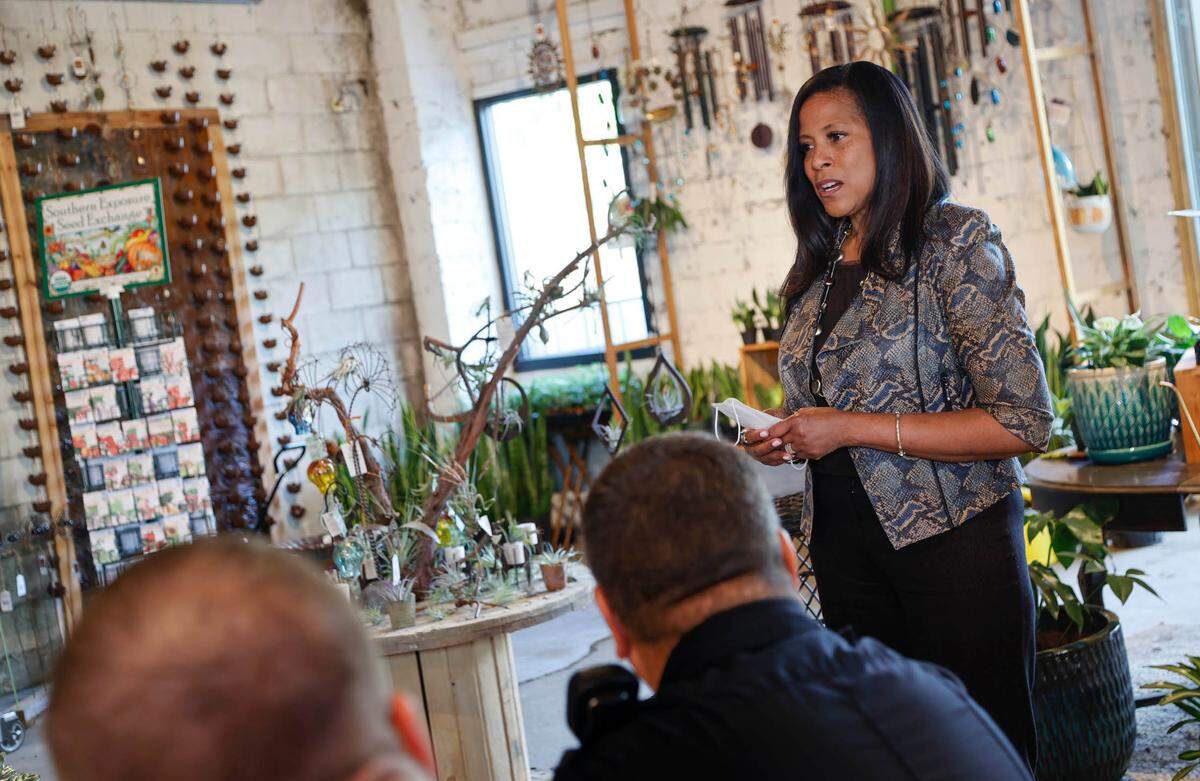
“Last time I checked, I’m the only candidate in this race who has a uterus,” McLeod said in Winnsboro. “I’m the only candidate in this race who has bore children. So I don’t appreciate it when our male-dominated legislature tries to tell us what to do and how to do it.”
McLeod serves in the Senate, which last year drafted and passed a six-week “fetal abortion” ban that has since been stalled by the courts. On the trail, McLeod often makes reference to tongue-in-cheek legislation she filed in 2016 — known as the “Viagra bill” — that came in response to efforts by legislators to curb abortion access in the state.
If elected governor, Cunningham has promised to veto any abortion ban the Legislature passes.
“Right now we’re at a crossroads because of what’s going on with Roe v. Wade for the first time in history, our daughters are poised to have fewer rights than their mothers and grandmothers,” Cunningham said in Myrtle Beach when, referencing a pending U.S. Supreme Court decision that could overrule the 1973 landmark abortion case and send the decision to the states.
“One day they’re going to look as an ask and how we allow a right to slip through the fingers of our very hands at this critical time in history,” Cunningham added.
Where the two candidates differ on policy appears to be solely focused on one main issue: minimum wage. The issue is likely to come up at the Friday night debate.
McLeod wants to raise the minimum wage to $15 an hour, up from $7.25 an hour.
“I’m the only candidate in this race who believes that the hard working people of South Carolina deserve a living wage of $15 an hour. I’m not just saying that because I’m running for governor,” said McLeod, who has unsuccessfully tried to pass legislation in the past. “I’m saying that because I’ve always put my actions where my mouth is. I’ve introduced legislation to do just that to raise the minimum wage in our state.”
In Congress, Cunningham voted against legislation to raise the minimum wage to $15 because he said it eliminated tip wages for service industries workers. Cunningham instead supports a $12-an-hour minimum wage.
Rather than raising pay to $15, Cunningham often tells voters he wants to bring new industries to the state and offer jobs with strong health and retirement benefits that encourage young people to stay in state. He ties that stance with a campaign promise to raise starting teacher pay to $50,000 over the course of eight years, and expand Medicaid to improve health care access in the state.
“I want to bring new jobs into our state. I want to lead in certain industries. I would love for South Carolina to be known as the No. 1 electric vehicle manufacturer,” Cunningham said. “We can provide those good jobs as long as we have a healthy and educated workforce, and every single issue today that may be in your minds, I can tie back to education and health care.”
The challenges they face
Both face the uphill challenge of running in a historically red state.
Neither say they see that as a problem.
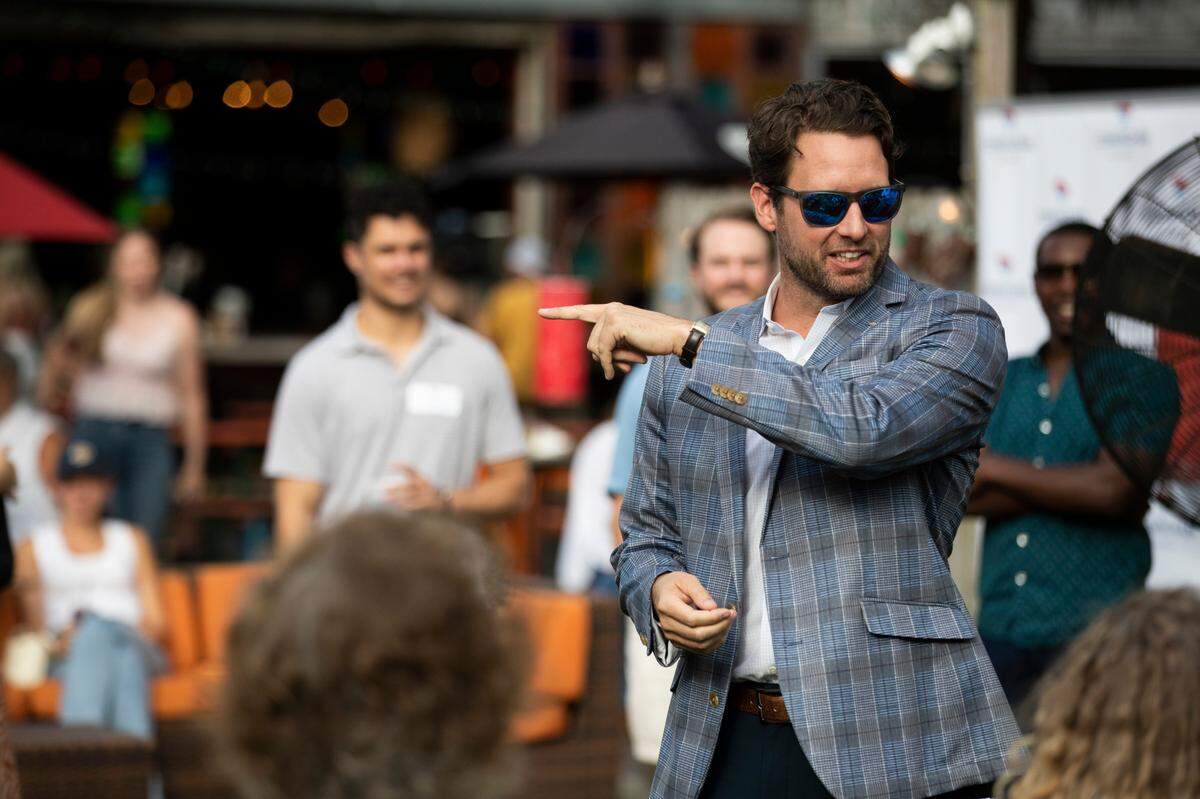
“We polled a while back, and it shows we got a commanding lead and folks want somebody who can win, not only in the primary but in the general election,” Cunningham, a 40-year-old divorced father of a 4-year-old boy, said of an internal poll the campaign placed in the field late last year.
In 2010, Vincent Sheheen lost to former Gov. Nikki Haley by less than 4.5 percentage points. The margin widened in the 2014 rematch when Sheheen lost by 14.5 points. In 2018, James Smith lost to McMaster — who was governor but running for his first full term — by 8 percentage points.
Improving upon those results will be necessary to win the governor’s office, where Democrats running statewide in the last two elections have topped out in the mid 40s.
In the 1st Congressional District, which Cunningham won in 2018, he carried 50.6% in his defeat of Katie Arrington. When he lost in 2020 to now-U.S. Rep. Nancy Mace, he got 49.3% of the vote.
“That’s the kind of crossover support it’s going to require to win statewide here in South Carolina, and I’m the only candidate in this primary that’s ever flipped a seat,” Cunningham said.
McLeod, 53, a divorced mother of two adult sons, says Democrats need to try something different if they want to win in November.
“We know after two decades of Republican control what a losing strategy looks like,” McLeod said in May in Winnsboro. “Why do we keep doing the same thing and expect a different result? It’s time for us to do something different.”
McLeod, who previously worked for the South Carolina Department of Probation, Parole and Pardon Services and the State Office of Victim Assistance, has based her campaign around government and legislative experience.
But in her efforts to appeal statewide, she has struggled to fundraise and, unlike Cunningham, spend money on the airwaves that can give candidates a name ID boost. She’s instead relied on social media to get her message out, and in-person events to introduce herself to potential primary voters.
McLeod has raised $492,000 through May 18, and has only about $67,000 left in the bank. Meanwhile, Cunningham has raised $1.8 million and had $322,000 in the bank as of May 25.
The lack of financial resources also means McLeod is not doing any polling, a common campaign tool to determine where the race stands and a surprising move for a statewide campaign, many said.
“A lot of times that’s one of the first things you’ll do to get a sense of where the voters are, what your name recognition is,” said Gibbs Knotts, a political science professor at the College of Charleston. “If you have the resources you want to be able to do it on somewhat regularized basis to see are the things we’re doing in the campaign working, are we seeing improvements, are we getting bumps when we do certain things?”
McLeod, who has served in the state Legislature since 2011, said the lack of polling is not a setback.
“I don’t think we’re running blind either,” she said. “I think we’ve got a really good sense of where people are just from being on the ground.”
Where is their support?
Where the two candidates see success election night could come down to regions, observers say.
For Cunningham, much of his support could come from the areas along the Atlantic Ocean, his home base.
“This has been a home base along the coastline for the last few years,” Cunningham said in an interview while in Georgetown. “Being in Congress, I think the whole state got to see the type of leadership I provided in Congress. We’re sitting good across the state, but obviously voters in the Lowcountry know my record and know me very well.”
Rebecca Smitley, 72, a retired Myrtle Beach resident, is backing Cunningham because she said he has the better chance at knocking off McMaster in November.
“I’ve seen them both speak at places and I just feel like he’s got the personality to go out and talk to people and see how they feel and he really engages more I think,” Smithley said. “He’s a real people person and he gives a damn about all of us. I really feel he’s genuine and sincere.”
McLeod could see success in the Midlands, her home base where she represents thousands of voters in part of Richland County. She’s also made a concerted effort in her campaign to visit rural, mostly Black areas of the state. Black voters make up roughly 60% of the Democratic voter bloc.
McLeod is originally Bennettsville, and often highlighted those rural roots in visits to rural Allendale and Fairfield counties.
Kevin Thomas, 58, a Newberry County school bus driver, decided early on to support McLeod’s run because he said he can relate to her and her rural upbringing. And Sylvia Harrison, a Fairfield County school board member, said she decided to vote for McLeod because she’s been impressed with her reach into rural communities.
“We need to be heard too,” Harrison said after hearing McLeod speak in Winnsboro in Fairfield County. “We’re a small rural community, and sometimes they forget about us. But it seems like she hasn’t forgotten about the small people.”
How to watch
What: S.C. Democratic debate for governor
When: 5 to 6 p.m. Friday, and again at 8 p.m. June 13
Where: Viewers can watch the debate live on ETV’s statewide network, its livestream on the ETV website, or on ETV’s Facebook and YouTube pages.
This story was originally published June 9, 2022 at 12:52 PM with the headline "SC government chops or a candidate who flipped GOP seat? Gov hopefuls head to primary."