
Loss of Richland County SC House seat would be reversed in 2024 under new settlement
Richland County will reclaim the state representative it lost in the recent House redistricting process if an agreement to adjust the boundaries of the contested map comes to pass.
The change, one of several alterations House Republican leaders agreed to make to settle a federal lawsuit alleging the new map intentionally discriminated against Black voters, would reestablish two House seats in rural Lower Richland County starting in 2024.
Lower Richland lost a seat during last year’s reapportionment when Districts 70 and 80 were consolidated into a single heavily African American district, setting up a June primary between Democratic Reps. Wendy Brawley and Jermaine Johnson.
If Senate lawmakers and the governor sign off on the House changes, the revised map would look more like the old map, with two Lower Richland districts where Black voters could elect candidates of their choice. A Republican-held district in Kershaw County would be shifted into Richland County to accommodate the change.
“I can’t emphasize enough how important it is to have the rural vote represented at the capital,” Brawley, of Hopkins, said Monday. “This lawsuit, if it’s approved by the House, Senate and ultimately the governor, gives back what was taken. And that is a voice and a vote for rural Richland County.”
In total, the settlement over the new House map will affect the boundaries of roughly a dozen districts in three parts of the state, namely Richland/Kershaw, Orangeburg and Dillon/Horry counties.
It comes as the result of a suit filed last October on behalf of the South Carolina chapter of the NAACP, which challenged the map’s constitutionality, arguing it intentionally diluted the power of Black voters in nearly one-quarter of the state’s 124 House districts.
House Republicans have denied any racial motivations factored into their map designs, but agreed to resolve the lawsuit rather than take the case to trial.
“With this settlement, we will end costly litigation with a decision that is reasonable for voters and allows voters to have confidence in the electoral process,” House GOP attorney Mark Moore said in a statement last week.
Lower Richland districts redrawn
The boundary adjustments in Lower Richland County create two interlocking districts that roughly resemble concentric backward Cs.
The inner district wraps around eastern Columbia into Elgin in Kershaw County and mirrors the old District 80, currently held by Johnson.
The outer district takes on a somewhat different configuration than the old District 70, represented by Brawley. Rather than stretching east to Sumter County, as the district had done prior to last year’s reapportionment, it now curls up into Kershaw County, picking up the cities of Lugoff and Camden.
The Black voting age population in both districts is between 40% and 50%, down from the 66% African American votership in the single Lower Richland district created last year. Critics have accused Republican lawmakers of packing that lone Lower Richland district with Black voters to dilute their power elsewhere in the state.
“I liked the diversity of having red and blue and everything in between, so we can truly come to a consensus on how to move our state forward,” said Johnson, an outspoken critic of the Republican redraw of his district, which he called “the definition of gerrymandering.”
“If we truly want to be an equitable state and have representation from all the demographics of South Carolina, our lines should look the part,” he said Tuesday.
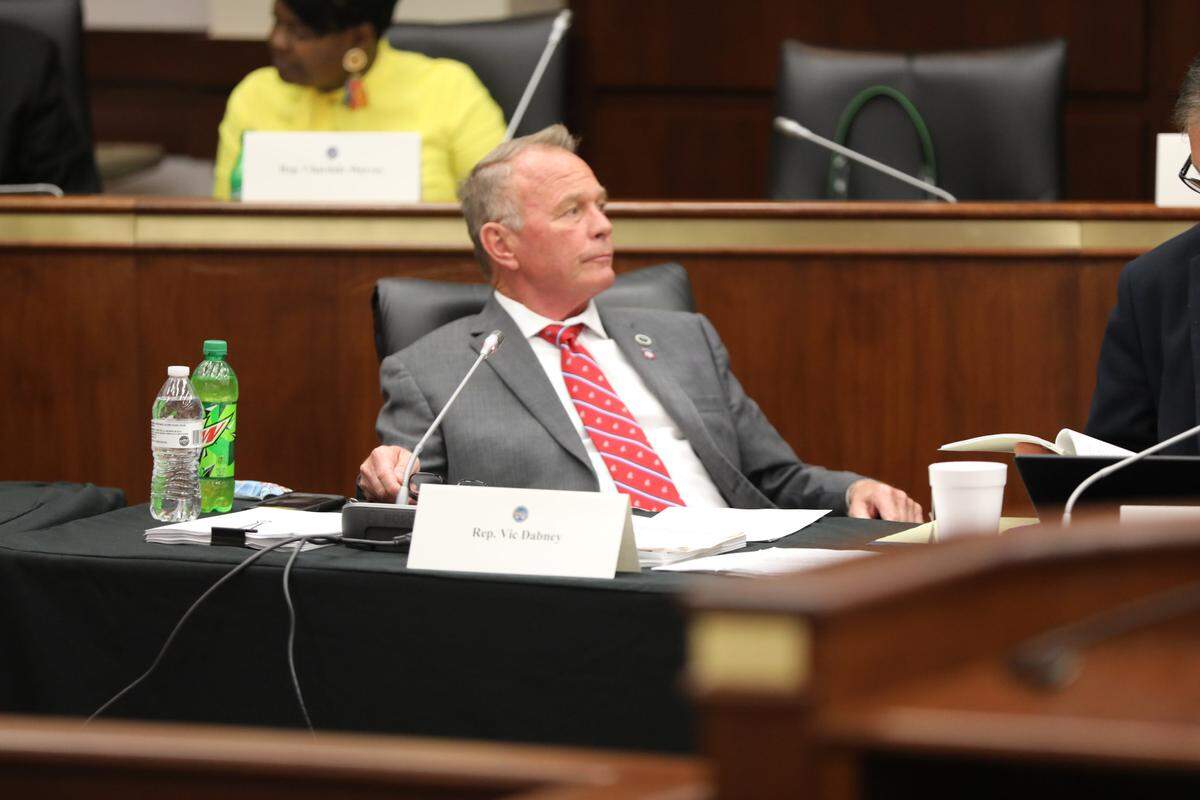
The changes to Lower Richland County come at the expense of state Rep. Vic Dabney, R-Kershaw, who finds himself paired with Brawley in a district where any Republican would face an uphill battle.
Dabney, who was drawn out of his district during last year’s reapportionment and recently moved in with his mother in order to seek reelection to his current seat this year, said he was disappointed with the development, but chose not to fight it for the party’s sake.
“The way it was explained to me was if they continued to argue over this issue and fight for me … the courts were going to end up settling this and it wasn’t going to be good because it was going to affect everybody,” he said. “I was willing to go along with it because it was the right thing to do for our leadership and for the greater good.”
Despite the long odds of winning in a solidly blue district in 2024, Dabney said he still plans to run, albeit on a shoestring budget.
“If my (political) career ends, I’ve got a lot of stuff I can do and want to do,” he said. “It won’t be the first time I’ve been kicked in the nuts.”
Will Senate sit on House settlement?
The agreement to redraw portions of the state House map is contingent on House Republicans this week amending an existing bill to include the adjusted map and the Senate passing the amended bill and delivering it to Gov. Henry McMaster for his signature by May 12, the last day of the legislative session.
If McMaster signs the bill into law by May 17, a trial over the House map will be averted and the newly agreed upon map will go into effect in 2024.
Both sides are confident the legislative hurdles can be cleared this week, but it’s far from a foregone conclusion given the recent bad blood between the chambers. Senate leadership remains miffed about the House killing a Senate-approved medical marijuana bill last week using a procedure to rule the legislation unconstitutional.
When asked Monday about the possibility of sitting on the House’s redistricting changes, Senate Majority Leader Shane Massey, R-Edgefield, was coy.
“I think that’s something that we’ll have to take a look at when we get it,” he said. “I’m sure we’ll give it the due deliberation that the Senate provides.”
House GOP leaders and the South Carolina chapter of the NAACP had been poised to go to trial over the House map on May 16, absent a settlement, but that trial was canceled Monday. It would need to be rescheduled if the settlement is not executed.
Regardless of what happens with the redrawn House map, the parties are set for trial in September on the state’s new U.S. congressional map, which the S.C. NAACP also is challenging.
Any trial on the maps would be heard by a three-judge panel of Margaret Seymour, Toby Heytens and Richard Gergel.
This story was originally published May 10, 2022 at 2:39 PM with the headline "Loss of Richland County SC House seat would be reversed in 2024 under new settlement."