
SC’s lone competitive House seat would get redder under Senate redistricting proposal
A U.S. congressional redistricting plan released Tuesday would transform the historically competitive 1st Congressional District, represented by Rep. Nancy Mace, into a more reliably red district, leaving Democrats with little chance of holding down more than a single seat in the House.
The draft map, produced by the South Carolina Senate redistricting committee, leaves five of the state’s seven congressional districts largely unchanged, and focuses primarily on adjusting for population disparities between the growing 1st and shrinking 6th District, held by House Majority Whip Jim Clyburn, D-Columbia
.
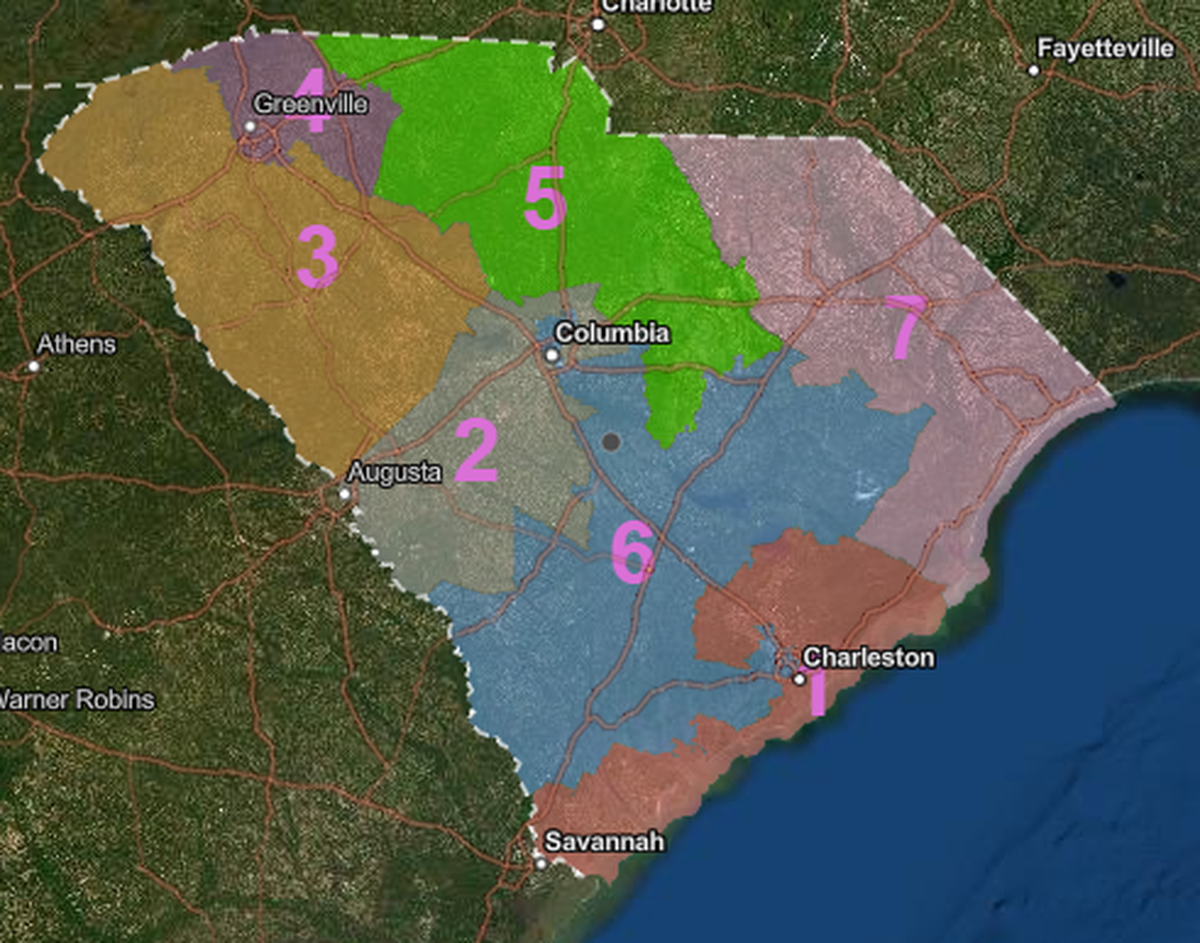
Mace’s coastal district, which has experienced explosive growth over the past decade and needed to shed about 88,000 people, lost portions of Charleston County to Clyburn’s largely rural, majority-Black district, including parts of West Ashley, about half of Johns Island and a segment of downtown Charleston that includes the College of Charleston.
Clyburn’s district in turn swapped parts of Berkeley County with Mace, whose district added the communities of Jamestown, Shulerville, Huger, Cordesville and Cainhoy, the Naval Weapons Station in Goose Creek and the southern tip of Jasper County.
The 6th District would still have easily enough African Americans to ensure Black voters are able to elect a candidate of their choice under the Senate proposal, but would no longer be a majority-Black district. Some have criticized the district’s current lines, which afforded Clyburn a nearly 40-point win over his Republican opponent last November, as so packed with African American residents that they diluted Black votes.
A Clyburn spokesman declined comment on the draft congressional map and a spokesman for Mace did not immediately respond to a request for comment.
The voting district shifts, which leave all districts within a single person of the 731,204 population ideal, were roundly criticized on social media by Democrats and the nonpartisan League of Women Voters of South Carolina.
“This is a map that would make South Carolina’s voters obsolete in November,” the League, which has published its own draft congressional map, tweeted minutes after the Senate redistricting committee released its proposal.
Marc Elias, a well-known voting rights attorney who has represented multiple Democratic presidential candidates, tweeted he was “watching” South Carolina, after a Democratic political consultant asserted the map left South Carolina Republicans open to a “big lawsuit.”
An analysis of the Senate’s congressional map proposal by Dave’s Redistricting, a popular map drawing tool, found it made races slightly less competitive than the current map.
The 1st District, which has flipped from Republican to Democrat back to Republican over the past three cycles, would now favor the GOP by about 14%, according to the app. The district currently leans red by just over 11%.
State Republican leaders, who control the redistricting process, have yet to shed light on the decisions that went into creating the draft congressional map.
Senate Judiciary Chairman Luke Rankin, R-Horry, who chairs the Senate’s redistricting panel, did not immediately respond to a request for comment. He said previously that ensuring compliance with the law and equalizing populations in each district were paramount.
Beyond those criteria, Senate staff also were instructed to consider the contiguity and compactness of districts, and to keep together communities of interest by minimizing county, city and voting precinct splits.
The Senate’s proposal would split 13 of South Carolina’s counties between two districts, one more than the current map. It splits Calhoun County between the 2nd and 6th districts and Jasper County between the 1st and 6th districts, but unlike the current map does not split Newberry County.
Newberry, which currently is split between the 3rd and 5th districts, remains whole in the 3rd District, represented by Rep. Jeff Duncan, R-Laurens, in the proposed redraw.
A Senate redistricting panel will meet Monday morning to take public testimony on the plan.
The proposed congressional map and a state Senate map must pass out of subcommittee and be adopted by the Senate Judiciary Committee before Dec. 6, when the full Senate returns to finish redistricting.
The South Carolina House, whose redistricting process is running concurrent to the Senate’s, also has set aside time in early December to wrap up its map.
Reporter Caitlin Byrd contributed to this article.
This story was originally published November 24, 2021 at 10:21 AM with the headline "SC’s lone competitive House seat would get redder under Senate redistricting proposal."