
Building from 1930s found in Maine sand dune: ‘Nothing left to do but start digging’
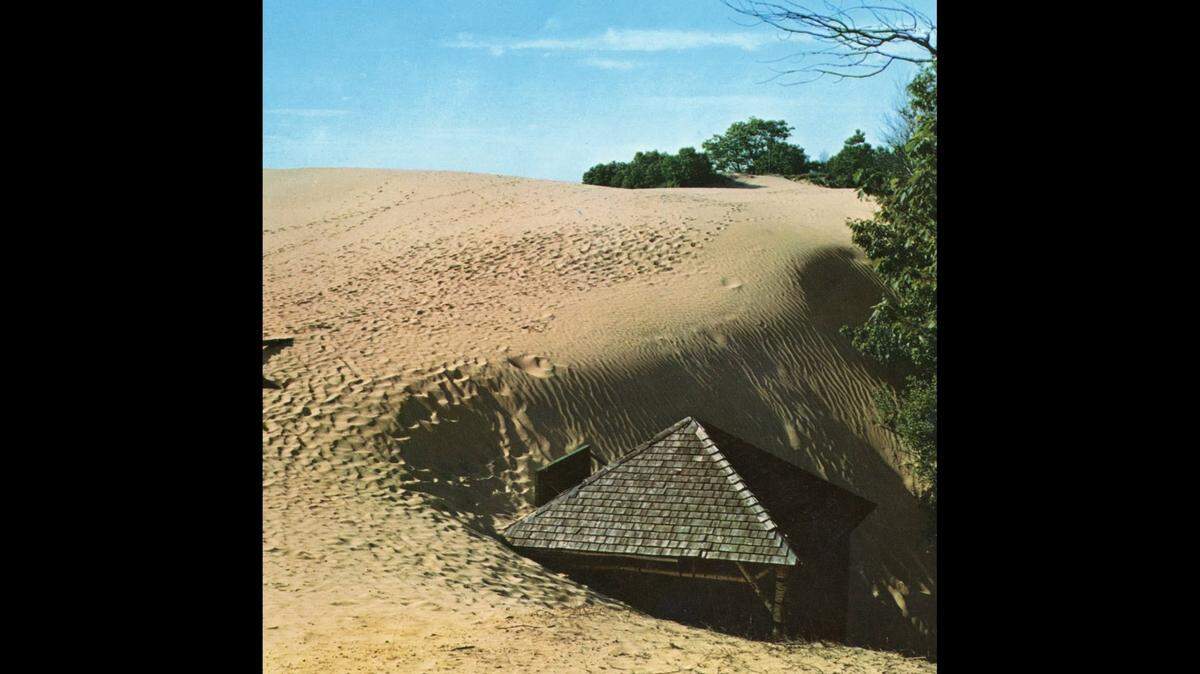
Shipwrecks, vintage cars and even WW II bombs been found buried in sand dunes along the East Coast, but a tourist spot in eastern Maine says it just found an entire building.
The Desert of Maine — technically a 40-acre oasis of finely ground glacial sands — announced the discovery in a Facebook post that identified the building as a Spring House, built nearly a century ago. The site is 4 miles west of Freeport.
It’s believed the building vanished 60 years ago, according to the Sept. 19 post. It was under at least 8 feet of sand.
“But ground penetrating radar said otherwise — at least 15 feet to the roof!” the owners wrote. “After referencing old aerial photos and survey maps, there was nothing left to do but just start digging.
“It’s hard to describe just how much sand we removed before we hit something solid with our fiberglass probes. We carefully dug down and found the old sign that was on the roof. We have found it!”
Vintage postcards show the Spring House was a rustic structure set atop an elevated stone foundation, with a solid roof and railed sides to give people a view of the dunes. It was built in 1938 and tourists flocked there in its heyday to “enjoy a cup of natural spring water for 5 cents,” according to the post.
“During World War II, the Desert of Maine was closed for a few years and the Spring House was partially buried by the advancing sand dunes. By the time they reopened, it was too much effort to remove all of the sand and year after year the Spring House became more buried,” the park says.
“By 1962, the tip of the roof disappeared from view. In the decades that followed the winds piled on more sand and countless visitors read about the buried structure beneath their feet, but no one has laid eyes on it for nearly 60 years.”
News of the find comes not long after a geologist unearthed a “uniquely colored” layer of sand at the site that is believed to be 15,000 years old, according to Newscentermaine.com. The layer represents what was once ocean floor, geologist Josh Smith told the station.
The Desert of Maine’s odd geology dates back at least 10,000 years, when Maine was covered by glaciers, according to Smithsonian Magazine.
“These glaciers scraped rocks and soil as they expanded, grinding rocks into pebbles, and grinding those pebbles down into what is known as glacial silt — a granular material with a texture somewhere between sand and clay,” the magazine reports. “Layers of glacial silt piled up as high as 80 feet in some parts of southern Maine.”
The Desert of Maine opened as an attraction about a century ago, and the site now hosts events and offers tours that explore the odd juxtaposition of desert and forest, according to its website.
“Our plan is to keep excavating (the Spring House) to see what kind of shape it is in,” the site posted. “Our hope is to eventually build a retaining wall so visitors can appreciate how deep it was under ground. It is a jaw dropping spectacle.”
This story was originally published September 25, 2020 at 9:59 AM with the headline "Building from 1930s found in Maine sand dune: ‘Nothing left to do but start digging’."