
SC chief justice praises state judges, asks for reforms and bashes social media
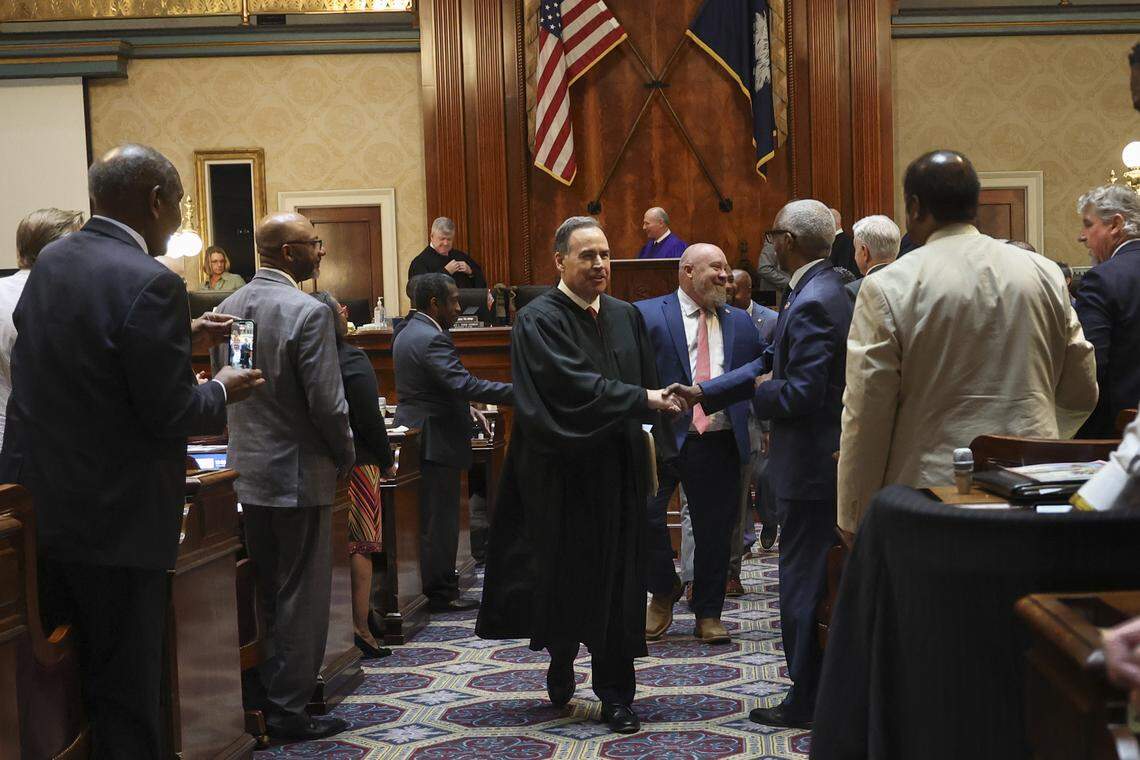
In his annual message to the S.C. General Assembly about the state of the judiciary, Supreme Court Chief Justice John Kittredge asked for modest reforms, defended the way state judges are chosen and criticized those who use social media platforms to post irresponsible criticisms of judges.
“We in the judiciary, like you, are aware of the half-truths and false narratives that circulate on social media, podcasts and other outlets masquerading as journalism attacking you and our justice system. I believe you understand that judges are bound by ethical constraints, and those rules prohibit judges from responding to attacks against court decisions, no matter how false or outrageous the allegation may be,” Kittredge said Wednesday to a joint assembly of the most of the state’s 170 lawmakers at the State House.
Kittredge didn’t identify any particular social media postings, but last week a South Carolina podcaster in a court session in which she was examined by a lawyer acknowledged she had repeatedly referred to state Judge R. Keith Kelly as “R. Kelly,” a convicted sex trafficker. The podcaster did not apologize and said R. Kelly is the judge’s name.
One area of the South Carolina legal system that is under attack is how the state picks its circuit court and appellate judges, and its justices, Kittredge said.
“There is no perfect way to select judges,” Kittredge said. “But I suggest to you that the legislature has elected quality judges over the years. When this legislative body of 170 diverse members individually vets judicial candidates and then collectively elects judges, that diffusion of authority enhances merit selection.”
In South Carolina, a 12-member panel called the Judicial Merit Selection Commission oversees a screening process by which candidates for judge posts are vetted and examined in public hearings. Four commission members are chosen by the House Speaker, four by the governor, two by the Senate president and two by the chairman of the Senate Judiciary Committee.
The commission then recommends the names of which vetted candidates should be forwarded to the General Assembly for a vote by the 170 lawmakers. Most other states use different methods, including popular vote or where the governor has different degrees of input into how judges are selected.
“Were one person allowed to completely control the selection process, we would expose the process to the potential of having political consideration driving the process and not merit,” Kittredge said.
“I simply say, I know firsthand that South Carolina has one of the finest judiciaries in the country.”
More judges needed
“Infrastructure demands reach everywhere, and certainly that includes our court system,” Kittredge said.
In 2000, the state’s population was 4 million, and today the state has more than 5.5 million people, Kittredge told the lawmakers.
“In terms of percentage growth, South Carolina is the fastest growing state in the country... Between July 2024 and July 2025, according to the Census Bureau, South Carolina added more than 6,600 people every month — right at 80,000 for the year, so... in one year, South Carolina adds 80,000 people, which approximates the population of Oconee County,” Kittredge said.
The increase in judges has not kept pace with the increase in population, said Kittredge. He added he hopes the General Assembly will fund this year four additional resident circuit judges in targeted areas of need.
Some other Southeastern states have more judges per 100,000 people than does South Carolina, Kittredge said. “We are behind other states, but the four additional circuit judges would move us in a positive direction.”
Currently, there are 53 resident circuit court judges who handle both civil and criminal dockets of serious cases. They preside over trials and handle guilty pleas and other legal matters. They make $221, 925 yearly. In addition, each judge has a law clerk and a secretary.
Magistrate reforms
South Carolina has more than 300 magistrates, judges who handle lesser civil disputes and criminal matters. In comparison, the state has 66 family court judges, 53 circuit judges, nine court of appeals judges and five supreme court justices, said Kittredge.
“Magistrate court is often where a person gets their first and sometimes only exposure to the South Carolina court system. A citizen’s entire view, perception, of the judiciary may come from that magistrate court experience,” Kittredge said.
A major issue is the “gross pay disparity among full-time magistrates,” Kittredge said, adding that the highest paid South Carolina magistrate earns $155,000 and the lowest paid makes $37,105.
“That disparity in pay among full-time magistrates not only defeats the goal of a uniform system, it guarantees a lack of uniformity and all the negative consequences that necessarily follow,” Kittredge said.
Lawmakers are currently discussing ways to reform the magistrate system, and Kittredge made it clear he would work with them.
Courts by the numbers
South Carolina criminal courts are continuing to reduce backlogs, Kittredge said.
“From 2024 to 2025, in looking at indicted criminal cases, we saw overall a 17.6% decrease in the number of ccriminal cases more than 3 years old. The backlog is coming down,” Kittredge said.
In civil courts, backlogs are also being reduced, the chief justice said. “Almost 15,000 old cases were pending at the end of 2021, and at the end of 2025, there were only 9,200 old cases pending.”
Family courts — with their emotional and pressure-packed issues involving time-sensitive domestic relations matters — try to resolve cases within 365 days, Kittredge said.
“That’s a big ask, but it’s important given the critical need for family court cases — especially cases involving children — to be handled expeditiously.”
Currently, a majority of counties resolve 80 percent of cases in 365 days or less, Kittredge said, adding that with three new family court judges coming on line, more counties should meet the benchmark, Kittredge said.
Praise for judges
“Are judges perfect?” Kittredge asked.
“Of course not. As with any group or institution, we are human, and mistakes occur. We have an appellate court system, with multiple judges involved in every court case, to do our best to correct mistakes when they occur. The judges you elect are overwhelmingly competent, diligent, professional, committed to doing their best to apply the law fairly and in an even-handed manner in every case; and they are caring.”
Examples of judges’ conscientiousness and caring are many, Kittredge said.
Last year, when Judge Diane Goodstein’s house burned down and family members were injured, many judges stepped up and took over some of her cases, Kittredge said. Also, when a family court judge was unexpectedly disabled, numerous family and circuit court judges — aware of how important it can be to move fast in domestic cases — filled in, he said.
And state Judge George McFaddin Jr. each year holds a special “Adoption Day,” where uncontested adoptions can be approved quickly, he said.
Over the years, McFaddin has approved some 600 adoptions on his special days, Kittredge said.
Reaction to Kittredge
Lawmakers had generally positive comments about Kittredge’s speech.
Senate Judiciary Committee chairman Sen. Luke Rankin, R-Horry, said, “I appreciate his recognition of the challenges we face, growing 80,000 people a year.”
The Legislature recognizes and appreciates that the judiciary is reducing caseloads, Rankin said. “They are firing on all cylinders. “
Rankin, a lawyer and member of the Judicial Merit Selection Commission, also said, “I particularly appreciated the defense of how South Carolina selects its judges ... and defending us against the untruths” that are told on social media. “Every member of his bench takes shots because somebody has got a platform and they want to change the facts of their case that produce the results that they got.”
House Judiciary Committee chair Rep. Weston Newton, R-Beaufort, and a lawyer, said that lawmakers have been working with Kittredge on the various matters he brought up in his remarks to the General Assembly. “I thought it was a very appropriate State of the Judiciary speech.”
Newton agreed with Kittredge about the railings against judges on social media. “In the politically charged climate we find ourselves in today, the judiciary process continues to get attacked,” he said.
But “statistics don’t show we’ve got bad judges in South Carolina. Are there ways we can tweak the merit selection and election process? Absolutely,” said Newton, adding he’s been a part of discussions about the selection process.
House Speaker Pro Tem Tommy Pope, R-York, a lawyer and former prosecutor, said he was enthusiastic about what Kittredge said about magistrate reforms. “I’ve been working with him on that issue,” Pope said. Pay, training, education, their jurisdiction — all are in play for potential change, he said.
“I’m hopeful the speaker (Murrell Smith) will allow us to have a committee in the off-season,” Pope said.
Rep. Case Brittain, R-Horry, a lawyer, said he generally liked Kittredge’s speech, including the sections explaining how the justice system works.
When it comes to social media posts, Brittain said he believes in freedom of speech. “If people want to say what they want to say on social media, they’re justified in that they have the right to voice their opinion just like everybody else — whether or not they agree with the chief justice.”
Sen. Brad Hutto, D-Orangeburg, a lawyer, said Kittredge made a lot of good points, including that the backlogs in cases are declining.
The sharp disparities in magistrates’ pay, with magistrates in rural areas not making as much as those in urban areas, is an important issue, Hutto said.
“As in anything else, you get what you pay for,” Hutto said. “Every citizen, no matter where they live, is entitled to an educated, high quality judiciary.”
This story was originally published April 17, 2026 at 5:30 AM with the headline "SC chief justice praises state judges, asks for reforms and bashes social media."