
Horry County, police engaged in misconduct and retaliaton, new lawsuit says
Horry County, the police department and some in its leadership engaged in a pattern of corruption and systemic retaliation, according to a new lawsuit filed by a former employee claiming he was forced to retire.
Former Horry County Police Department Capt. Danny Furr, who served on the force for 27 years, is suing Horry County, deputy county administrator Renee Hardwick, HCPD Chief Kris Leonhardt, former Deputy Chief Lance Winburn and Capt. Brandon Lee.
“This case arises from the “deliberate and systematic retaliation that defendants visited upon a nearly 30-year veteran of the Horry County Police Department for doing precisely what the First Amendment protects: speaking out to elected officials about government corruption, unlawful commands, and institutional abuse of power by the HCPD police command,” the lawsuit says.
Furr believes HCPD has issues with misconduct, scandals and morale. Since Leonhardt took over as chief, Furr says HCPD leadership created a lack of direction among officers.
“When the last chief left, these current situations with morale started, and this is why we’re here today. This was not in existence under the last chief,” Furr said. “This is happening under the current command.”
Horry County spokesperson Thomas Bell told The Sun News the county, HCPD and the individuals named as defendants declined to comment on pending litigation or the allegations made.
Amid discussions at the county level to fold HCPD into the Horry County Sheriff’s Department following several high-profile scandals, including the shooting of Scott Spivey and Windburn’s departure following an Internal Affairs investigation, Furr claims officers who engaged in misconduct weren’t meaningfully punished.
The trouble started in 2024, according to the lawsuit, when Furr reported misconduct – including harassment, time clock inadequacies and misuse of county time and pay – on HCPD’s full-time special operations team to Leonhardt.
The suit alleges the officers who engaged in misconduct weren’t disciplined, but Furr was stripped of training responsibilities and put on probation.
In July 2025, Furr says he was involved in the 2022 case that eventually led to Winburn’s retirement when Sgt. William Dietzel called him with concerns about a lawsuit connected to the arrest of Horry County Councilman Harold Worley’s son-in-law, Thomas Wade Long. Dietzel allegedly said he feared retaliation if he was deposed in the suit, as he says Winburn ordered him not to arrest Long and instead take him home.
The story recently made headlines after Leonhardt addressed the situation and Winburn retired, but the lawsuit claims the chief only addressed it after Furr “blew the whistle on the misconduct in 2026.”
Meetings with Horry County Council
Furr details multiple meetings with county council members, but according to the lawsuit, he first met with county leaders on March 16, 2026, at Winburn’s direction. HCPD captains and lieutenants were allegedly told to contact council representatives and say County Administrator Barry Spivey’s “micromanaging” was getting in the way of Leonhardt’s command.
After passing on HCPD’s complaint in a meeting with Councilmen Cam Crawford and Dennis DiSabato, Furr claims he shared personal concerns about the “suspicious timing” of the promotions for two officers involved in the Scott Spivey case, misconduct on the special operations team, retaliation for an inter-agency whistleblower and “apparent favoritism” for Lee, a childhood friend of Leonhardt who served as a sergeant in the Horry County Sheriff’s office but was brought on as an HCPD captain, “despite him not meeting the written minimum qualifications.”
According to the lawsuit, Crawford and DiSabato allegedly requested a second meeting set for March 27 with Furr, as well as Councilmen Danny Hardee and Mark Causey.
Furr said retaliation followed swiftly as the two officers who joined him in the first meeting were reassigned within days.
In a command staff meeting on March 26, “Leonhardt directed his gaze at Plaintiff and announced, in words to the effect: ‘Those of you who have aspirations to go above and around me for your agenda, you better cancel your plans,’” the lawsuit claims.
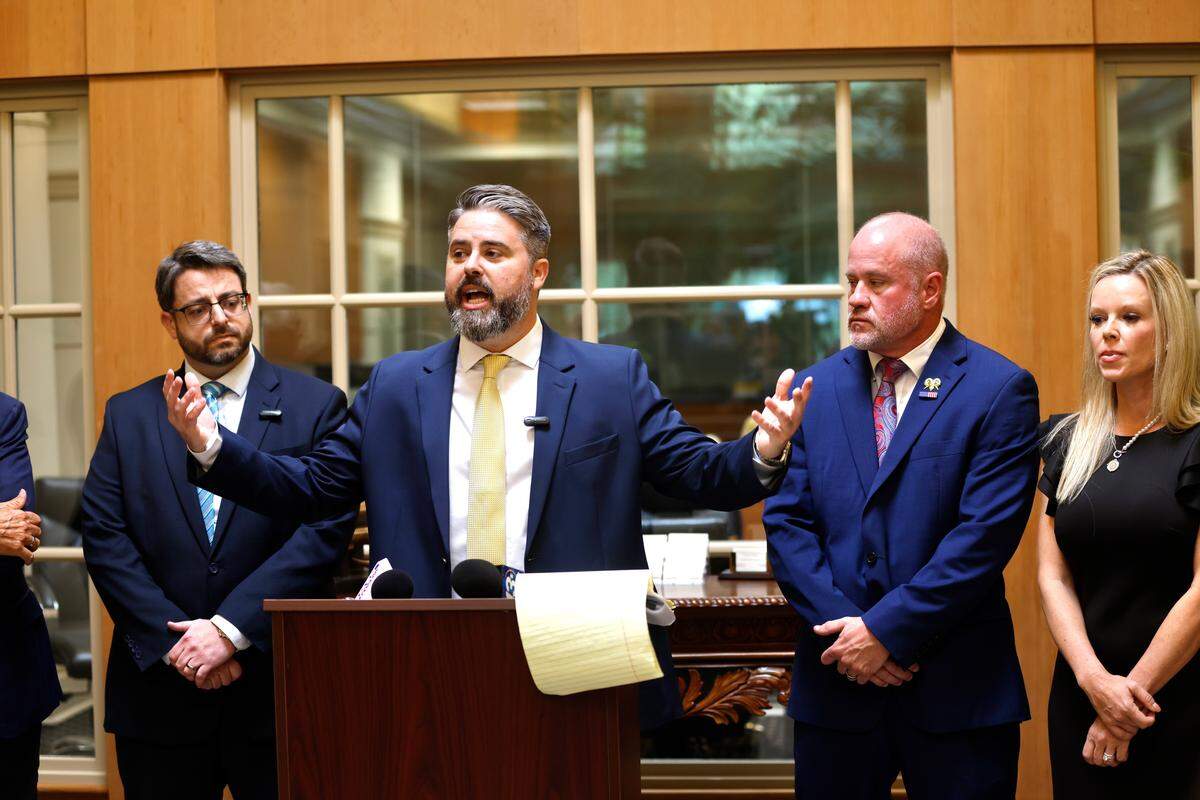
“When a chief looks directly at you, and everybody in the room knows he’s talking about you, it’s intimidating, it’s embarrassing, and it’s retaliation,” said Jonny McCoy, one of the attorneys representing Furr.
Multiple staff members allegedly spoke up against Furr’s treatment in the meeting but faced threats of retaliation. The same day, Furr alleges Leonhardt admitted he knew the initial meeting was at Winburn’s direction but said he was unwilling to admit it and told Furr to cancel his subsequent meeting scheduled for the next day, the lawsuit says.
However, Leonhardt reversed course when he “received information that the council may attempt to have Leonhardt removed from his position if he prohibited [Furr] from meeting with Council on March 27, 2026,” the suit says.
Furr says he raised the same personal concerns at the first meeting, and continued to face retaliation as a result.
DiSabato described the meetings as sessions where middle-tier command shared concerns, primarily about morale in HCPD, including a “potential mass exodus” of department staff, an alleged high rate of employee complaints and the hiring and promoting of certain officers from outside the department.
“My understanding is that, once those issues were sort of addressed, things calm down a little bit, and then Danny (Furr) wanted to have a second meeting with us,” DiSabato said. “He had alleged that there were some patterns of retaliation. He’s the only one who had indicated that there was any retaliation from those meetings.”
Internal affairs investigations
Retaliation against Furr ramped up on April 6, when Leonhardt and Lee “conspired to create false Internal Affairs (IA) allegations against him,” and Lee alleged that Furr made a derogatory comment against another captain, which Lee knew was false, according to the suit, which characterizes the move as going after Furr for his “whistleblowing free speech.”
“[Furr] didn’t find out about it until way later … which is against the rules, it’s against the law. You have to be notified if you’re under an Internal Affairs investigation,” McCoy said. “The investigation was kept secret from him.”
The investigation reportedly yielded no results after other HCPD officers allegedly refused to participate in what the suit characterizes as “an attempt to find a reason” to discredit and terminate Furr’s employment.
A second investigation followed on April 16, and Internal Affairs Investigator Blake Klauder allegedly told Furr that Barry Spivey requested the investigation because of Furr’s reported rudeness, which is not a just basis for such an investigation, according to the lawsuit.
But according to the lawsuit, the Internal Affairs investigation report indicates Leonhardt requested the second investigation.
This second investigation reportedly also attempted to steer fellow HCPD officers to “lie or support a false narrative,” but they refused, and the investigation failed to find any law or policy violations.
Internal Affairs investigator Van Sissell allegedly told Furr there were “strange circumstances” surrounding the case, which he said was not limited to the allegation of rudeness. He also reported that HCPD Capt. Heather Wilson said the investigation was an attempt to “set Captain Danny Furr up,” according to the lawsuit.
Forced retirement
Claiming he faced anxiety, marital problems, fatigue and lack of appetite from intimidation and retaliation, on April 17 Furr sought mental health help from Horry County’s Employee Assistance Program (EAP) for confidential assistance and counseling.
Furr says his attempt to get help was used to shame and discredit him in an April 21 meeting with Hardwick and the Horry County Public Safety Committee where he spoke about HCPD corruption and misconduct.
The next day, Furr was called to another meeting with Hardwick, Leonhardt and Horry County Human Resources, which he was led to believe was a good-faith mediation with the chief, according to the suit. At the meeting, Leonhardt allegedly admitted there was no basis for Lee’s allegations against Furr.
According to the lawsuit, this is when he was forced out of the department. “[Furr] was told to retire and never return to county property,” the lawsuit says. “[Furr] was informed by Chief Leonhardt that he could not allow [Furr] to be around other officers anymore.” After the meeting, Leonhardt allegedly told HCPD personnel to prevent Furr from returning to his office or county property.
“They told Danny Furr, ‘You’re effectively fired. Turn in your bag, your gun, your uniform, your property and you are no longer welcome on Horry County police property because we don’t trust you around other officers.’” McCoy said. “They told him, ‘You’re going on sick leave ‘til May 1st, at which time you’ll retire.’ He had no plans to retire. He was forced out.”
Furr, who says problems are deeply entrenched in department leadership, maintains that HCPD can’t be improved with “quick fix” solutions.
“It is a culture. It’s an issue. It’s widespread,” said Furr. “We need leaders that take their oaths seriously, that do the right thing … sometimes it’s not popular for them, I guess, and they don’t go that route, but you have to be a leader when times are bad, too.”
This story was originally published April 30, 2026 at 3:14 PM.