Myrtle Beach area upgraded to winter weather advisory. What areas will see ice?
A major winter storm is drawing closer to South Carolina, and some parts of Horry County may see an icier weekend than others.
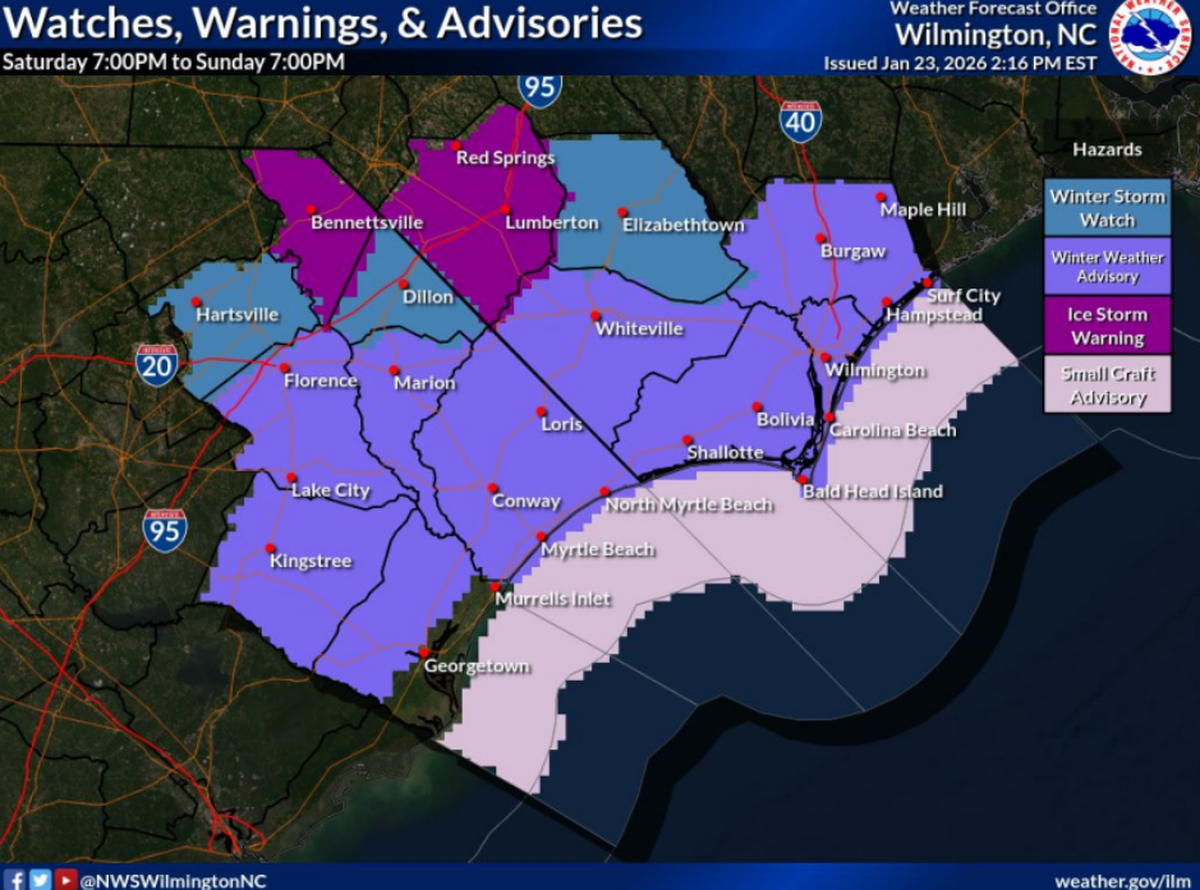
The Myrtle Beach area was upgraded to a Winter Weather advisory Friday afternoon.
The northeastern portion of the state is expected to see freezing rain and some sleet, but coastal areas are increasingly likely to simply see rain if the low pressure system forms further west, according to the National Weather Service.
It is still uncertain exactly where the transition zone from rain to freezing rain will be, but some more inland areas, such as Dillon and Marlboro counties, are under a winter storm watch as the weather approaches.
Moderate impacts from the storm are expected primarily in northwest areas, and will mostly be seen in hazardous driving conditions and possible infrastructure disruptions from ice accumulation, according to the weather service.
Inland Horry County projected to see more ice than coastal areas
National Weather Service meteorologist Mark Bacon said that Horry County could see “quite a gradient” when it comes to ice coverage from the storm, because of how far the county extends.
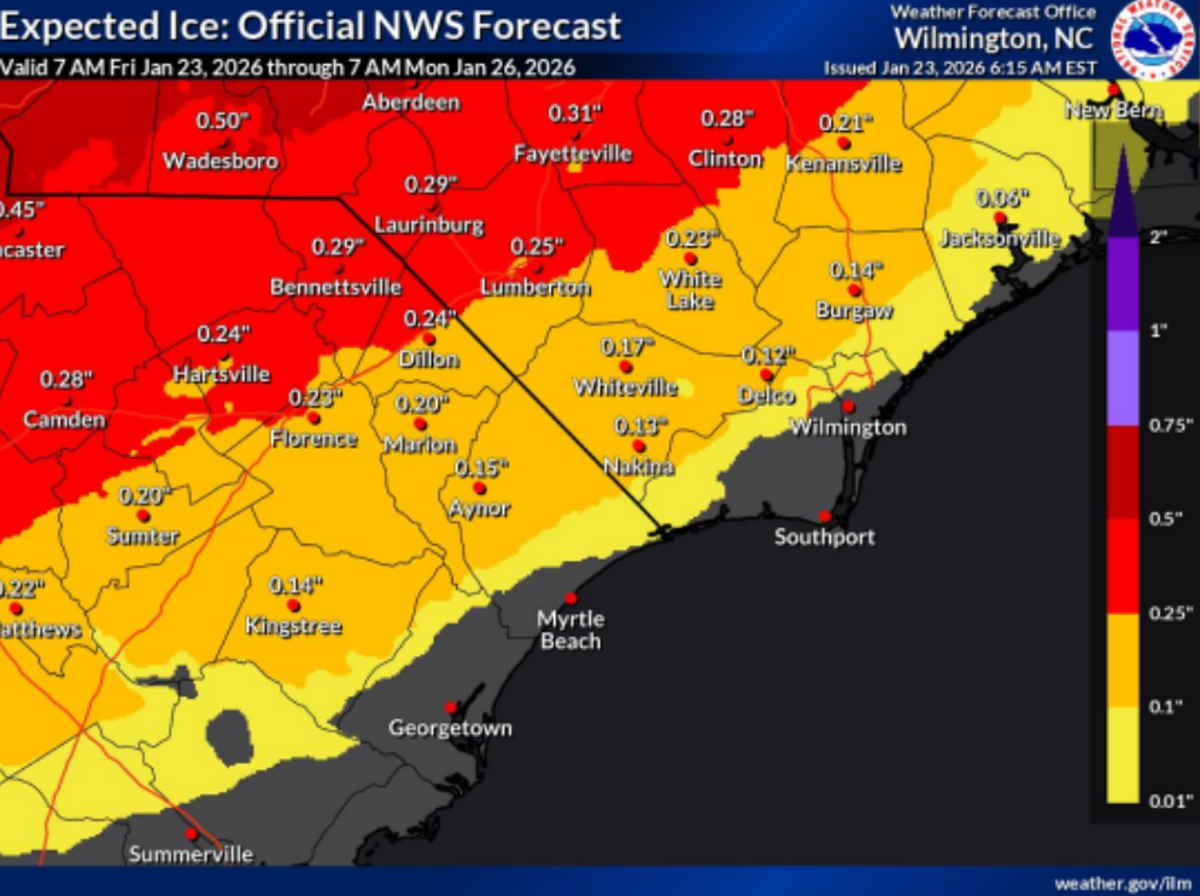
The Myrtle Beach and Georgetown areas might not see any ice coverage, according to the Weather Service’s most likely scenario projection shared Friday morning. But more inland areas are expected to see some ice. The Aynor area is projected to have 0.15 inches of ice.
Further inland, outside the county, the Bennettsville, Hartsville and Camden areas could see up to a quarter inch of ice or more.
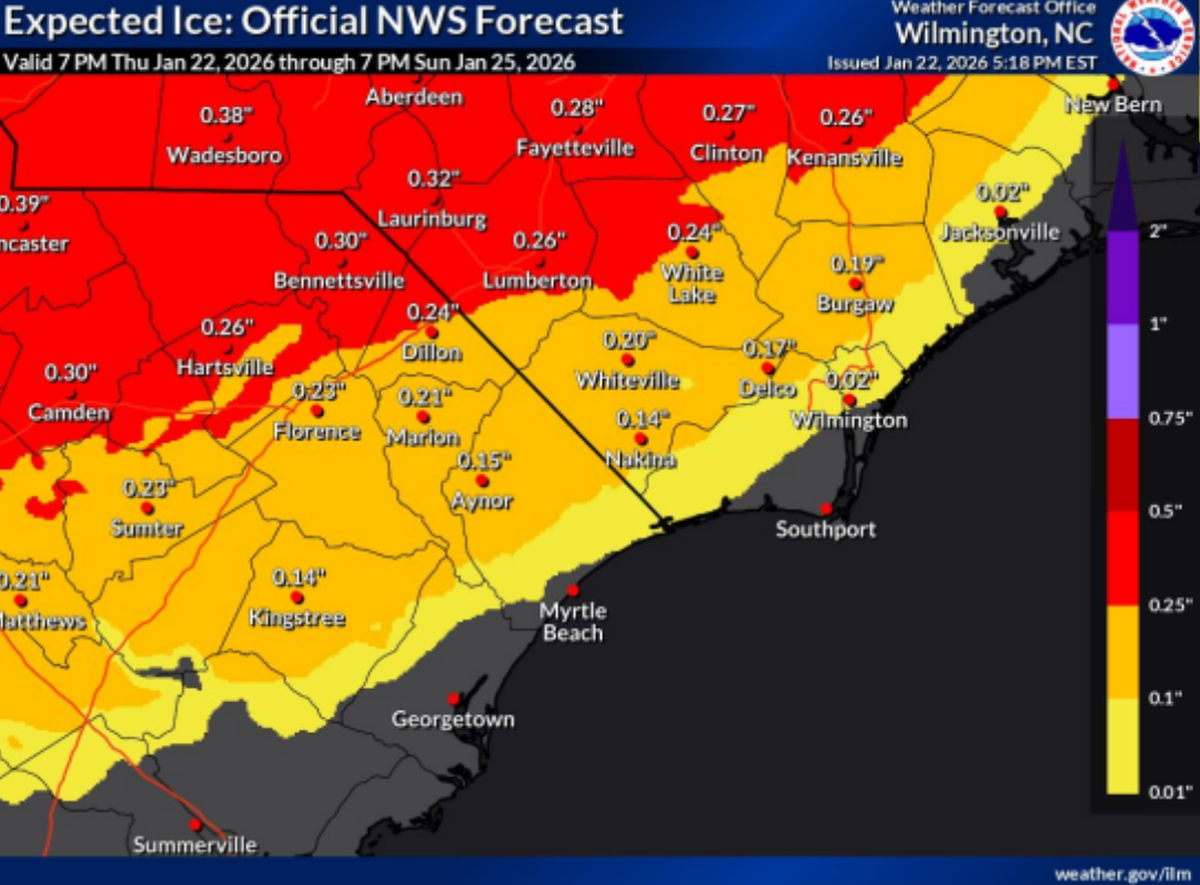
The Weather Service also released projections for the least severe and most severe outcomes of the storm. Under the least severe outcome, ice coverage would be much less — only up to 0.1 inches near Aynor.
Under the most severe outcome, Myrtle Beach could see around 0.17 inches of ice, and Aynor could see around 0.29 inches.
Updated ice accumulation projections for the most likely scenario did not appear to show any major changes on Friday afternoon, but possible ice accumulation moved closer to coastal areas.
Storm progression and precautions for Horry County
Rain is projected to begin Friday, transitioning to a wintry mix through the region on Saturday, according to a Friday morning briefing by the weather service. The briefing identifies the main window of concern as Saturday, Saturday night and early Sunday.
In areas with freezing rain, precipitation is expected to transition back to rain on Sunday afternoon as temperatures warm. However, dangerously low temperatures will follow the storm early next week, with single-digit wind chills possible on Monday, according to NWS.
This could mean any ice accumulation takes a bit longer to melt away. NWS remains uncertain just how much ice and sleet accumulation the area could see.
The freezing temperatures and precipitation have already led to a lineup of cancellations and closures in the Myrtle Beach area.
Travel is expected to be most hazardous Saturday night into Sunday.
Bacon said travel will likely be where region residents see the most impact from the storm. However, he also emphasized that temperatures will be at their most dangerous Monday night — especially if residents lose power.
For those who lose power during next week’s dangerously cold temperatures, Bacon suggested finding a shelter to stay in, and making sure not to use carbon monoxide-emitting heating methods in the home, such as gas grills. He also recommended having nonperishable food items on hand.
This story was originally published January 23, 2026 at 10:13 AM.