
See that big boat off North Myrtle Beach coast? Here’s what it will be doing
Plumes of frothy seawater, a giant crablike contraption crawling across the strand, miles of pipe, and beeping earthmovers – it’s all coming to a beach near you.
The Grand Strand Beach Renourishment project is underway in North Myrtle Beach, and will continue south for 26 miles, adding two million cubic yards of sand to the shoreline.
Staging of piping and heavy equipment could be seen at the end of Sea Mountain Highway in North Myrtle Beach on Wednesday afternoon, where beach walkers strolled, gazing out at new arrival of offshore dredges.
The U.S. Army Corps of Engineers, Charleston vessel “Galveston Island” is setting up just off the coast to begin pumping a sand and seawater slurry onto the beach. They will start near the north end of Ocean Boulevard in North Myrtle Beach and work their way south in 1,000-foot sections of beach. Each section will take two or three days to complete depending on the weather.
Officials have said that they expect that renourishment will move through North Myrtle Beach by early 2026 and then continuing through Myrtle Beach and Surfside Beach before reaching Garden City around April 2026.
“As with any large coastal project, the timeline remains subject to change due to weather conditions or equipment availability,” U.S. Army Corps of Engineers spokesperson Emily Stark said in a statement.
The $72 million project is entirely federally funded through emergency relief from the U.S. Army Corps of Engineers.
A ‘minor disruption’ to beachgoers
Pumping sand from the ocean depths and pushing it around on the beach is a messy process.
Pipes will be spewing slurry and bulldozers will be pushing it around complete with beeping back-up alarms – day and night.
Jimmy Gray, president of the Grand Strand Chamber of Commerce said the project may be a “minor disruption” to visiting beachgoers, but said that with almost 60 miles of public access to beaches, it shouldn’t be too hard to avoid the construction areas.
“The disruption is certainly worth the long term investment in our number one asset which are beaches,” he said.
Those sections of beach where construction is actually happening will be fenced off. The Corps said that beachgoers should avoid the fenced areas and any pipes that are on the beach. However, they said that there will be areas to safely cross, and that the rest of the beach will stay open as usual.
A number of beachfront accesses will be temporarily closed as the project proceeds, but the closure should only last the few days as crews rebuild those sections of beachfront.
Residents and visitors can track real-time progress through the U.S. Army Corps of Engineers’ online tracker, which will provide updates on all project areas.
For detailed views of closures and the progress in North Myrtle Beach, visit the City’s Beach Renourishment tracker.
Why the need to pump sand back on our beaches?
Renourishing beaches is an ongoing effort to maintain one of South Carolina’s most important natural resources – the beach.
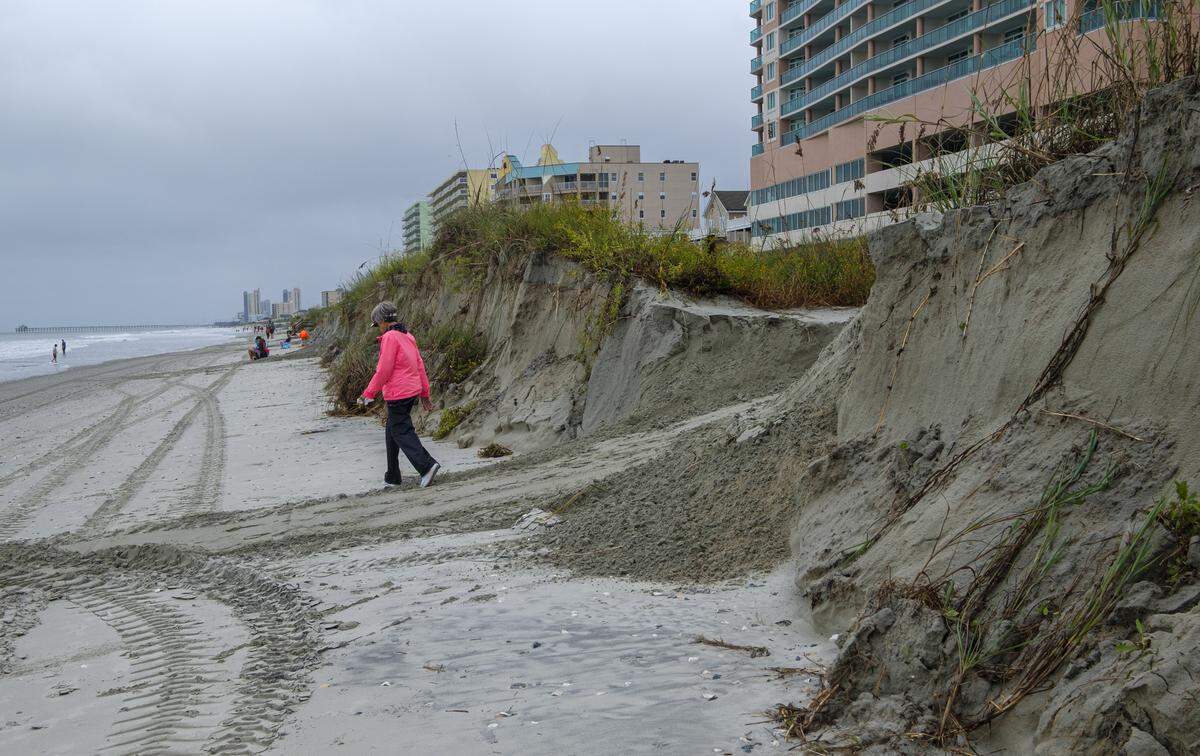
Sand dunes serve as a barrier to protect homes and local infrastructure from storm surge flooding. Wide easily accessible beaches drive tourism and add to the quality of life for residents, officials say.
On average, Grand Strand beaches require renourishment every seven to 10 years. But Hurricane Ian in September 2022 and Hurricane Debby in August 2024, are just two of several recent weather events that caused severe erosion to beaches and dunes along the Grand Strand.
Horry County’s last renourishment was completed in 2019.
How does this process work?
A “hopper dredge” located offshore will get sand from pre-determined borrow areas to provide the beach with quality sand. Drag arms are lowered to the seabed where pumps suck up a sand-water mixture into the ship’s hopper. Once full, the hopper transfers the sand to a floating pipeline called a “pump out station.” Powerful pumps then push the sand and water slurry through a submerged pipeline before blasting it out onto the beach.
That giant crab-like structure that can be seen for miles down the beach? A U.S. Army Corps engineer says that it is a tool for surveying the surf zone.
Finally, bulldozers spread the wet sand to create the profile of a wide sloping shoreline.
This process is done in 1,000-foot sections at a time continuing day and night over the course of two to three days, before shuffling down the beach and doing it all again.
This story was originally published December 18, 2025 at 5:00 AM.