Hurricane Erin may bar Grand Strand swimmers from ocean. Can surfers paddle out?
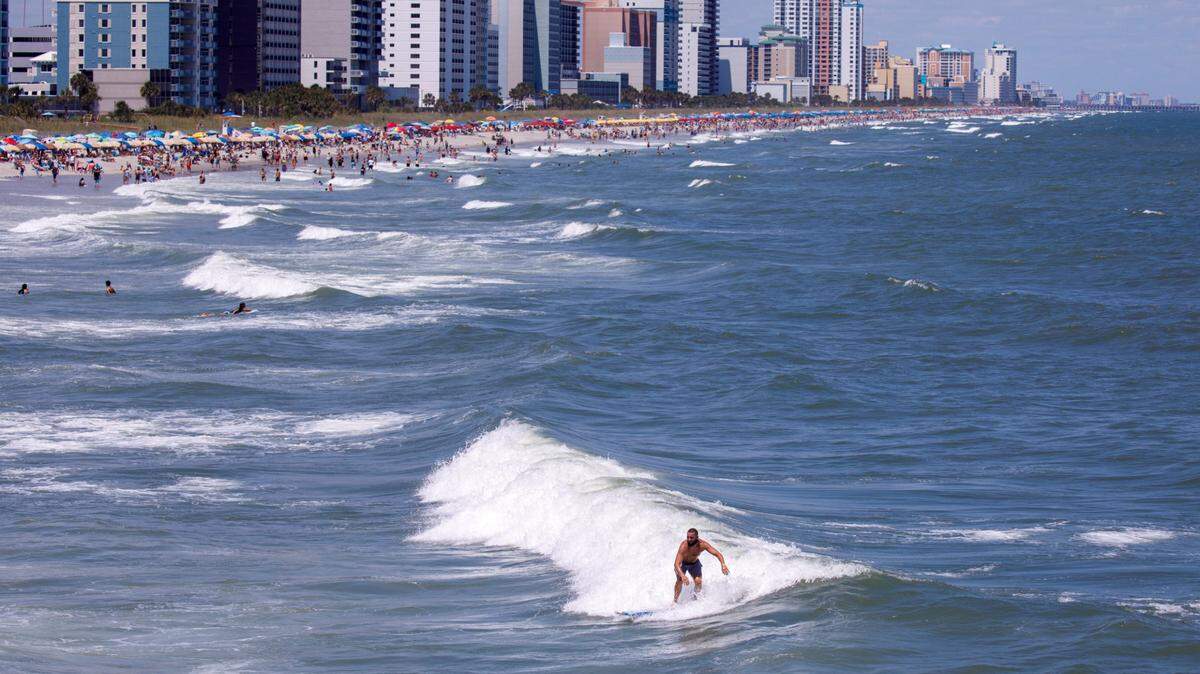
For most beachgoers, a hurricane off the coast means rough swimming conditions, but for surfers, it could mean shredding larger waves.
Hurricane Erin will pass hundreds of miles away from Grand Strand beaches, but forecasters still expect dangerous ocean conditions such as strong rip currents and waves up to 7 feet tall. If the surf gets rough enough, beaches could even close their waters to the public, marked by two red flags.
For surfers that are looking to catch the storm swell, this can be a disappointing turn of events — but it appears that whether surfers can paddle out is often left up to the discretion of lifeguards and officials..
When two red flags are posted at lifeguard stations on the beach, it means the water is closed to everyone because of dangerous conditions, even surfers, explained Capt. Jon Evans with the Myrtle Beach Fire Department. Evans said there is “certainly a possibility” of double red flags this week as Erin passes by.
The decision about closing the water is one made jointly by lifeguard services and the city, he said, and rip currents, wave strength, and rough waters are all factors in that decision.
For many surfers, closed-down waters have been a source of frustration, explained Chal Lester, owner of Surf City Surf Shop in Myrtle Beach. In recent years, he said he’s noticed ocean safety personnel getting stricter with calling surfers back to shore during rough conditions.
“It can get frustrating because surfers have been out there and they’re typically water knowledgeable,” he said.
Lester said that he is certified in ocean rescue, but has still been called back to shore in conditions he didn’t find particularly dangerous.
As Erin intensifies this week, Lester said many local surfers are hoping for some quality time on the water during the “hurricane hype,” especially after a long summer of “lackluster waves.”
Can experienced surfers bypass the rule?
When asked whether beach patrols and lifeguards may use discretion on whether to call in surfers paddling out during double red flags, Evans said “if we think it’s unsafe for someone to be out there, we’ll call them in.”
In North Myrtle Beach, experienced surfers used to navigating rougher waters may get a pass, according to Officer Frank Smith.
Smith, who surfs in his downtime, said that while double red flags technically mean the water is closed, it’s “mainly for swimmers.”
“We usually don’t call surfers back in because they’re attached to a flotation device,” he explained. However, he said if he or his colleagues see a clearly inexperienced surfer out on the water during dangerous conditions, they may call them back into shallower water, or out of the water entirely.
Smith said that he anticipated red flags on local beaches at least by Wednesday, when Hurricane Erin is supposed to make its closest pass to the Grand Strand, and Thursday. Double red flags, he said, are rare. However, he warned that as the storm approaches, the water may be “deceiving,” appearing calm on the surface while rip currents churn.
What the rules say about surfing
In Horry County, surfing is allowed anywhere along beaches anytime between sunrise and sunset, as long as surfers stay 75 yards away from any pier and wear a surfing leash 7 feet long or shorter at all times.
However, Myrtle Beach city ordinances limit surfing to certain areas and times of day from May 1 through Labor Day. During this time, surfers are allowed to hit the waves from 10 a.m. to 5 p.m. in the following locations:
- From 710 feet of the center line of the 29th Avenue South street-end to the southernmost end of city limits. - From 34th Avenue North to 47th Avenue North. - From 78th Avenue North to 81st Avenue North. - From 87th Avenue North to the northernmost end of city limits. - From 62nd Avenue North to 68th Avenue North.
North Myrtle Beach also puts its own limitations on surfing between May 15 and Sept. 15, and extends the prohibited surfing area around piers to 300 feet.
During this timeframe in North Myrtle Beach, surfing is prohibited on public beaches between 9 a.m. and 4 p.m. except in the following areas:
- Beginning at Hog Inlet and ending at 5th Avenue North with the exception of 300 feet on either side of the Cherry Grove Pier. - Beginning at 6th Avenue South and ending at 27th Avenue South. - Beginning at the Town of Atlantic Beach southern limit and ending at 46th Avenue South.
For best waves, surfers venture north
For many Grand Strand surfers chasing waves during Hurricane Erin, Lester doesn’t anticipate double red flags being a problem — even if two red flags go up, the most ambitious local surfers won’t be around to see them.
Long-period storm swells, which create longer surfable waves, usually miss northern South Carolina shores because of the coastline’s structure, and hit further north, in North Carolina. And where those strong, storm-generated waves go, surfers will follow, he said.
The Outer Banks is already seeing the effects of the hurricane, with waves expected to reach heights of 20 feet on Wednesday and Thursday. Residents and tourists in Dare and Hyde counties have been ordered to evacuate flood-prone islands Hatteras and Ocracoke. Both counties have also declared a state of emergency as the storm heads their way.
Lester has known surfers to start a surf road trip down in Florida and follow a storm all the way up to Nova Scotia chasing more exciting waves. He believes that serious Grand Strand surfers will likely make trips up to nearby North Carolina beaches, or possibly down south to Folly Beach, where the storm’s effects on the waves will be more pronounced.